

Psychobabble: For Groovy Ghouls & Retro Rockers.
Showing posts with label Edgar Allan Poe. Show all posts
Showing posts with label Edgar Allan Poe. Show all posts
Wednesday, June 21, 2023
Review: 'Corman/Poe: Interviews and Essays Exploring the Making of Roger Corman's Edgar Allan Poe Films, 1960-1964'


Wednesday, October 31, 2018
Diary of the Dead 2018: Week 5
I’m logging my Monster Movie Month © viewing with ultra-mini
reviews at the end of every week this October. I write it. You read it. No one
needs to get hurt.

Hellraiser (1987-
dir. Clive Barker) **
The premise of Clive Barker's adaptation of his own novella, The Hellbound Heart, is appropriately skeletal. Some dickhead stumbles into hell, and manages to escape and return to corporeal form by slaughtering the assholes his sister-in-law/sex monkey lures to him using her feminine wiles. Unfortunately, a band of mutant hell monsters miss torturing him so much that they go searching for him in the earthly realm. With its bad acting, leaden dialogue, and over-the-top gore, Hellraiser plays like a pre-teen goth's attempt to freak out his parents. Ooooh! Extreme!
Phenomena (1985- dir.
Dario Argento) ***
Wednesday, October 24, 2018
Psychobabble’s 31 Favorite Universal Horrors: #8
Halloween season
simply isn’t Halloween season without a regular dose of golden age Universal
horror (1923-1963). Every day this October, I’ll be giving you a steady IV drip
of it by counting down Psychobabble’s
31 Favorite Universal Horrors!
#8. The Black Cat
(1934- dir. Edgar Ulmer)

Universal horror did not always rely on supernatural horror.
In fact, what may be it’s most horrifying horror of all had no supernatural
elements, though its characters deeply believe in the powers of evil. Karloff
is no longer the conflicted creature of Frankenstein.
He’s all evil as an Alistair Crowley stand-in who matches wits with Bela Lugosi
as a psychiatrist out for revenge. Universal tried to pass The Black Cat off as a Poe adaptation, but it has zilch to do with its
namesake story. Yet, as many have pointed out, Poe would likely have approved
of the film’s perversity and bleakness. Edgar Ulmer’s noir-ish style and the
Art Deco sets give The Black Cat a
personality distinct from any of the other Universal horrors of its era.
However, it is Karloff and Lugosi who make this picture such delicious fun, and
they get to wrap their tongues around some of the most memorable dialogue they
ever spoke: “Supernatural perhaps, boloney perhaps not.” “The phone is dead;
even the phone is dead.” Even when the dialogue isn’t especially clever, the
actors’ relish makes it so, as when Karloff makes the line “He has an intense
and all-consuming horror of cats” sings like a Stradivarius.
Sunday, October 14, 2018
Psychobabble’s 31 Favorite Universal Horrors: #18
Halloween season
simply isn’t Halloween season without a regular dose of classic Universal horror (1923-1963). Every day this October, I’ll be giving you a steady IV drip of it by counting down Psychobabble’s 31 Favorite Universal
Horrors!
#18. The Raven
(1935- dir. Lew Landers)


Friday, October 12, 2018
Psychobabble’s 31 Favorite Universal Horrors: #20
Halloween season
simply isn’t Halloween season without a regular dose of classic Universal horror (1923-1963). Every day this October, I’ll be giving you a steady IV drip of it by counting down Psychobabble’s 31 Favorite Universal
Horrors!
#20. Murders in the
Rue Morgue (1932- dir. Robert Florey)

This delirious and rather perverse adaptation of Poe’s
timeless terror tale is a great opportunity to watch Bela Lugosi rant and rave
as an ape-wrangler with a perilous unibrow. His scheme to prove the theory of
evolution by injecting gorilla blood into women is insane, and if you think
about it, there are some pretty disturbing sexual implications there. Karl
Freund milks the premise for all its horror value with his Gothic,
expressionistic cinematography. And for once, the comic relief does not
completely fall flat.
Monday, October 9, 2017
Monsterology: Clowns

Wrong! In fact, the creepy clown has become such a common
horror figure that it’s hard to imagine there was a time when children laughed
along with the likes of Clarabell, Bozo, and Ronald McDonald. These days it
seems that the easiest way to get distribution for a cheap-o, direct-to-video
(sorry…I mean “direct-to-streaming”) horror movie is to stick a leering, fanged
clown in it. Stitches (2012), Sloppy the Psychotic (2012), Mockingbird (2014), All Hallow’s Eve (2013), and of course, Clown (2014) are just a few of these fun flicks.
Monday, October 24, 2016
Monsterology: Monster Houses
In this ongoing feature on Psychobabble, we’ve been looking at the history of Horror’s archetypal monsters.

But wouldn’t it be a stone drag if you were settling in to
relax in your sanctuary and the walls started bulging unnaturally or bleeding
even more unnaturally? Wouldn’t it simply ruin your night if that thing you
haven’t even finished paying the mortgage on yet sucked your precious little
daughter into the electrical system or made you want to pick up an axe and chop
up your precious little son?
Monsters come in all shapes, sizes, and smells, but one
thing that unites the mass of them from werewolves to robots is that they
somehow resemble organic beings. One of the few exceptions is the monstrous
house. The fact that it has no arms or legs or teeth makes the monster house
highly unusual and really very wrong (though not completely beyond anthropomorphization, as we shall see). The fact that a house is such a mundane
thing, a thing intended to protect and comfort, makes it highly insidious, especially when it turns against the children who dwell in it, as it so often does.
First of all, we must distinguish the monster house from the
haunted house. In a haunted house, the monster is some form of ghost. It may
make the windows rattle or the chairs fall over, but that ghost is the central
threat, not the place it chooses to haunt. That would be like blaming Dracula’s
castle for the vampire’s poor behavior, which would be unfair to a perfectly
fine castle. The nasty things a ghost does can be accomplished by any
breathing, visible asshole. Ghosts or other such entities may be responsible
for making a monster house monstrous, but a true monster house takes on a life
of its own; it is the threat.
The first truly enduring monster house remains the
definitive one. Published in 1839, Edgar Allan Poe’s “The Fall of the House of
Usher” largely passed over specifics to dwell on off putting descriptions of
the title building. The unnamed narrator approaches the house, and it instantly
casts its spell on him, bashing him with waves of depression and unease. He has
not even interacted with its weird inhabitants before getting a very strong
sense that the House of Usher is a bad place. He even emphasizes its inherent
monstrousness by trying to describe it in anthropomorphic terms, noting its
“vacant and eye-like windows.”
Is it the house that has seemingly poisoned Roderick and
Madeline Usher, both of whom suffer from odd maladies such as Roderick’s
intense aversion to sound and his sister’s general malaise and tendency to
lapse into catatonic states? Is it responsible for the subtextual moral decay
of the siblings, whose relationship may not be entirely platonic? As the
narrator drifts through the foreboding house, it reacts violently to the
presence of one who might uncover its strange and dirty secrets. It begins
cracking in disapproval. When the ultimate abomination comes to
light—Roderick’s premature burial of catatonic Madeline—the house has a total
nervous breakdown. As the short story’s title spoils, the House of Usher
falls—quite literally. The building collapses, claiming the poisoned siblings
as its victims while the narrator manages to escape the domestic tomb. In a perversion of home security, the house would rather self-destruct than allow its family’s ugly secrets come to life, even if that means wiping out the family in the process.
Monday, October 10, 2016
20 Things You May Not Have Known About Vincent Price!
No Halloween season is a true Halloween season without a
healthy dose of Vincent Price movies. But wait! Don’t sit down to shudder along
with House of Wax or The Abominable Dr. Phibes just yet! To
truly appreciate the man and his work, you’ll first want to bolster your
Priceducation with these 20 Things You
May Not Have Known About Vincent Price!
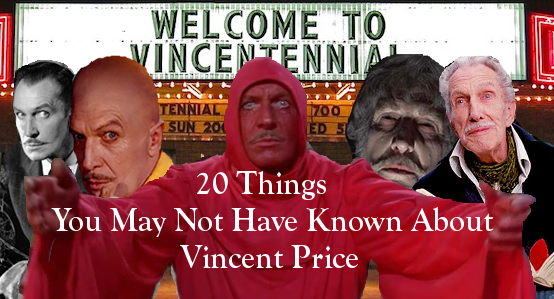
1. That Vincent
Price was a gourmet chef and cookbook author is well known among fans, but they
might not be aware that culinary interests ran deep in his bloodline. His
grandfather, Vincent C. Price, invented baking powder and pioneered cornstarch
as a baking ingredient, and his father, Vincent Leonard Price, was the
president of the National Candy Company.
2. Vincent
Price’s first wife, Edith Barrett, didn’t become as synonymous with horror as
her husband did, but she did star in the creepy classic I Walked with a Zombie.
3. Price’s
daughter Victoria is a serious writer who wrote scripts about Richard Widmark
and her dad’s old friend Roddy McDowall for A&E’s Biography series and an extensive and refreshingly objective
biography about her dad. She also had a brief role as a reporter in Price’s
final film, Edward Scissorhands.
4. As a young man
from an unquestioningly conservative St. Louis family, Price expressed sympathy
with this burgeoning Nazi party. However, he underwent a major liberal
awakening upon moving to Hollywood where he became active in such causes as the
Jewish Anti-Defamation League. Ironically, Joseph McCarthy targeted Price as a
possible communist in the fifties, citing Price’s anti-Nazi inclinations as
proof that he was some sort of dangerous radical. McCarthy was one loony piece
of work.
Friday, January 29, 2016
366 Days at the Drive-In: Day 121

The Movie: The Raven (1935)
What Is It?: Edgar
Allan Poe’s deathless poem is merely the stone in this stone soup that finds
Bela Lugosi as a mad doc with a yen for Poe and torture who gives Boris Karloff
a cut-rate face lift and everyone else the heeby jeebies. Sadistic fun.
Why Today?: On
this day in 1845, “The Raven” is
first published in The Evening Mirror.
Tuesday, January 19, 2016
366 Days at the Drive-In: Day 111

The Movie: Masque of the Red Death (1964)
What Is It?: Roger
Corman hits his horror peak with this lavish adaptation of two Poe tales (“Hop
Frog” is the other). Corman receives A-list support from screenwriter Charles
Beaumont, cinematographer Nic Roeg, and stars Jane Asher, Hazel Court, Patrick
Magee, Skip Martin, and Mr. Vincent Price.
Why Today?: On
this day in 1809, Edgar Allan Poe is born.
Wednesday, October 7, 2015
366 Days at the Drive-In: Day 7

The Movie: House of Usher (1960)
What Is It?: Roger
Corman’s first Poe adaptation has all the classic elements in place: Vincent
Price, Gothic overload, gorgeous color, lavish sets, and a Richard Matheson
script. It's a bit meandering, but the apocalyptic climax is a big pay off.
Why Today?: On
this day in 1849, Edgar Allan Poe dies.
Saturday, October 3, 2015
366 Days at the Drive-In: Day 3

The Movie: The Fall of the House of Usher (1928)
What Is It?: Jean
Epstein’s creepy and surreal silent adaptation of Edgar Allan Poe’s creepy and
verbose terror tale. Full of phantasmagoric, haunting, gothic images.
Why Today?: On
this day in 1849, Poe is seen in public for the final
time—discovered in a delirious state, he will die four days later. Enjoy your
day!
Friday, June 12, 2015
Farewell, Christopher Lee

Monday, February 3, 2014
20 Horror and Cult Classics That Deserve the Criterion Treatment

For thirty years, the Criterion Collection has been
restoring “important classic and contemporary films” and releasing them back
into the wild on laser disc, DVD, and blu-ray. As their inaugural titles—King Kong and Citizen Kane— indicated, Criterion has long had great enthusiasm
for horror and cult films. Yet even with more than 700 titles under its belt,
Criterion has not refurbished every horror and cult classic that deserves it.
Some of the most deserving have not been well served in the blu-ray age by any
of the company’s chief rivals either. So for Criterion or Twilight Time or Shout/Scream
Factory or any other distribution company with a serious interest in seriously
great movies, here are twenty terrifying and strange titles for your
consideration.
1. The Fall of the
House of Usher (1928- dir. Jean Epstein)
What is it? A masterpiece of bad dreaminess and
surreal imagery. An essential French horror film, of which there are few.
Current Region 1 availability Image Entertainment’s
2001 DVD is out of print.
Why Criterion? The
Fall of the House of Usher is certainly important in that it is arguably
the first great feature-length Edgar Allan Poe adaptation. Its art house status
is right up Criterion’s alley. Director Jean Epstein co-wrote the screenplay
with Luis Buñuel at the same time he was making “Un Chien Andalou” with
Salvador Dali. That short film would make a fabulous bonus feature!
2. Dr. Jekyll and Mr.
Hyde (1931- dir. Rouben Mamoulian)
What is it? The first and best sound adaptation of
Robert Louis Stevenson’s transfiguring horror classic. Released the same year
as Dracula and Frankenstein, Paramount’s attempt to pounce on the monster
bandwagon trounced Universal’s hits and helped complete the trio of classic
monster movie tropes: vampire, creation monster, and transformation monster.
Why Criterion? Beautifully filmed, beautifully acted,
and still really disturbing, Dr. Jekyll
and Mr. Hyde is important in that it is the first horror film to score an
Oscar (Frederic March shared the best actor award with Wallace Beery). Obviously,
it’s a classic for its quality too, though its underdog status next to the
ubiquitous Dracula and Frankenstein makes it a perfect
candidate for Criterion. MGM certainly doesn’t seem in any rush to restore this
one and get it back on the streets.
3. The Old Dark House
(1932- dir. James Whale)
What is it? James Whale’s second horror film is an
alternately funny and frightening flick with a superb ensemble cast featuring Charles
Laughton, Boris Karloff, Lilian Bond, Ernest Thesiger, Gloria Stuart, and Eva
Moore.
Why Criterion? Well, Kino can do this one if they
like, but if not, Criterion should swoop in and give it the business. Either
way I’d be happy.
4. The Black Cat
(1934- dir. Edgar G. Ulmer)
What is it? An adaptation of Edgar Allan Poe in name
only, Edgar Ulmer’s demented art-deco pairing of Karloff and Lugosi is one of
the most deliciously weird entries in the Universal horror canon.
Why Criterion? Well, Universal still has enough
interest in this essential title— chosen ahead of The Mummy, the 1943 version of The
Phantom of the Opera, and The
Creature from the Black Lagoon by a panel of critics for inclusion in The 1001 Movies You Must See Before You Die—to
rerelease it in 2012, but its failure to refurbish the film for blu-ray is
enough indication that an intervention is in order.
5. Mad Love (1935-
dir. Karl Freund)
Sunday, January 19, 2014
Ten Mysterious and Imaginative Edgar Allan Poe Adaptations
According to imdb, Edgar Allan Poe’s works have been adapted
287 times as of this writing. With eight of those not even seeing release yet,
the penner of weird and gloomy tales hasn’t fallen off the radar of film and TV
creators one iota. That’s a lot of stuff to sift through, and I won’t pretend
I’ve seen all of those adaptations. I have seen enough to put together a short
list of unmissable realizations of Poe stories, the faithful and the far out,
the straight and the surreal, the subtle, the hilarious, the animated, and the
bloody. Here are ten great Edgar Allan Poe adaptations you might want to cram
in today in honor of his 205th birthday.

1. The Fall of the House of Usher
(1928- dir. Jean Epstein)
Edgar Allan Poe is unquestionably among the most popular
writers in history, which accounts for why he’s been adapted so many times. However,
his work usually doesn’t lend itself to faithful adaptation. He’s often a lot
more interested in piling on the words to fashion a mood than he is in telling
a story. Perhaps this too is a reason for his popularity among filmmakers. An
oft-adapted story such as “The Fall of the House of Usher” is so lacking in
plot that it allows an interpreter to take it in any number of interesting
directions. French filmmaker Jean Epstein did that in his silent adaptation
from 1928, using spare surreal imagery to convey the dread Poe labors to
conjure in his story. With assistance from co-writer Luis Buñuel, then making Un Chien Andalou with Salvador Dali, Epstein welds together an assortment of
fantastical, unforgettable images. The odd ones—disorienting POV shots,
nightmarish sets, screwing frogs—pack as much power as the ones that are now
regarded as spooky movie clichés—mysteriously extinguishing candles, billowing
curtains, reanimated corpses. Even as the story takes its liberties with the
source material, the presentation conveys the atmosphere of a Poe story
uncannily, which is really the most important thing.
2. Murders in the Rue Morgue (1932- dir.
Robert Florey)
After reworking Dracula
and Frankenstein into films that
don’t rely too heavily on Stoker or Shelley in 1931, Universal treated Poe with
a similar lack of respect with its adaptation of “Murders in the Rue Morgue”
the following year. The film works mainly as a vehicle for Karl Freund’s expressionistic
cinematography, Bela Lugosi’s sinister mugging and line readings, and Robert
Florey’s totally wacko plot developments, such as Lugosi’s plot to prove the
theory of evolution by shooting up women with gorilla blood. That twist surely
would have tickled Poe, whose macabre sense of humor is lost on all those
readers who just think of him as a purveyor of opium-spiked horror. Despite the
fact that it didn’t quake box offices, Murders
in the Rue Morgue set off a mini cycle of Poe movies for Universal.
Ironically, this unfaithful adaptation was the closest thing to a faithful
adaptation the studio produced…
3. The Black Cat (1934- dir. Edgar G.
Ulmer)
…and for proof of that, check out The Black Cat. The story is actually one of Poe’s clearest, and
more faithful adaptations would come in later years (and later on this list
too), but Universal was always pretty revision happy, and writer Peter Ruric
and director Edgar G. Ulmer get downright slap-happy with “The Black Cat”. So long
to the simple plot of marital mania and revenge. Hello to a psycho chess match between
Satanic war criminal Boris Karloff and sadistic “hero” Bela Lugosi. Karloff’s
ailurophobia allows the film to very, very, very tangentially relate to Poe,
but his story has no bearing on Ulmer’s masterpiece otherwise. Karloff and
Lugosi have never been better matched, both relishing every line of peculiar
dialogue, and with its art deco style and insane brew of Satanism, torture, and
head games, The Black Cat may be the
best film on this list even if its pretty spurious as an adaptation.
4. The Tell-Tale
Heart (1953- dir. Ted Parmelee)
Monday, October 29, 2012
Diary of the Dead 2012: Week 4
I’m logging my Monster Movie Month © viewing with ultra-mini
reviews every Monday in October (as was the case last year, I’ll only be
discussing movies I haven’t reviewed elsewhere on this site). I write it. You
read it. No one needs to get hurt.

October 22
Don’t Be Afraid of
the Dark (2011- dir. Troy Nixey) ***½
For the most part I was pleasantly surprised by this remake
of a 1973 TV movie, perhaps because I never saw the original. Little Sally and
her folks move into a rundown mansion infested with tiny demonic tooth fairies.
Sally’s explorations through the house reminded me a little of Coraline, and Don’t Be Afraid of the Dark shares that film’s willingness to show
kids in real danger. Unlike Coraline,
this movie is probably too scary and violent to actually show to most kids. My
biggest problem is that we see way too much of the CG monsters. And why would
they cast a girl who looks exactly like Katie Holmes to play Holmes’s
stepdaughter? The filmmakers really missed an opportunity to make Holmes
Sally’s biological mother, but then they couldn’t have taken advantage of all
those “kid adjusting to new mommy” clichés.
October 23
Lisa and the Devil (1974-
dir. Mario Bava) ****
Mario Bava’s Lisa and
the Devil finds tourist Elke Sommer taking her room and board at Alida Valli’s
haunted mansion. Telly Savalas is a satanic butler and there’s a weeping
phantom with a taste for chocolate sprinkles. Lisa and the Devil is a sometimes bloody, sometimes romantic,
sometimes darkly comic, always incomprehensible Old Dark House yarn. Everyone
is totally nuts, but Savalas takes the cake. In other words: it’s fab.
October 25
Bay of Blood (1971-
dir. Mario Bava) *½
I kept waiting for this proto-slasher tedium to become a
Mario Bava movie, but it never did. The master just wasn’t trying when he
dashed off this crap about a killer stalking the woods around a bay. If this is
the movie that inspired the pathetic Friday
the 13th, then it’s utterly unforgiveable. Half-a-star for an
effectively gross shot of a live octopus crawling on a corpse’s face.
The Raven (1935- dir.
Louis Friedlander) ****
Early in The Raven,
we learn that sadist Bela Lugosi is so obsessed with Edgar Allan Poe that he
actually built an actual pit and an actual pendulum in his basement. No doubt,
Chekhov’s pendulum is going to be put to use by the end of this film, but first
Dr. Bela has to become obsessed with a pretty patient and give Boris Karloff a
bad facelift. We also get to hear Lugosi recite the title poem, which has to be
some sort of cultural landmark. He clearly had a great time playing this role. Plus
there’s the rare opportunity to hear Karloff do his famed Frankenstein growl without the flattop make up. Louis Friedlander
is not in the same league as Universal’s best directors—Whale, Browning, Ulmer,
Freund—but he tosses together a nice potboiler of macabre and jolly schlock.
October 26
The Premature Burial
(1962- dir. Roger Corman) ***½
The Premature Burial
is similar to so many of Roger Corman's Poe pictures in that it takes a story
that was already sketchy on the page and stretches it as thin as is imaginable.
But, goddamn, does it ever look fantastic! Corman was a master of aesthetic and
atmosphere, and The Premature Burial
provides the opportunity to spend 80 minutes in cobwebby crypts and foggy
graveyards. Where else would you rather be?
October 27
Blood from the Mummy's Tomb (1971- dir. Seth Holt/Michael Carreras) **
Sorry, but Valerie Leon in a super sexy Egyptian princess get up is not enough to raise this Stoker adaptation from the dead. Leon suffers on-and-off possession from long-entombed Princess Tera and people start dropping dead. There's some languid investigating and some exploitative gore and lots and lots of talk all adding up to very little. Seth Holt died of a heart attack while directing this movie and Hammer head Michael Carreras took over.
Murders in the Rue Morgue (1932- dir. Robert Florey) ****
Another Halloween season approaches its finale and Diary of the Dead shudders to a close with a screening at the lovely Landmark Loews in Jersey City. Poe mostly gets tossed out the window for Universal's bizarre adaptation of Murders in the Rue Morgue. Instead, Bela Lugosi is a particularly mad scientist who somehow seeks to prove the theory of evolution by injecting women with gorilla blood. It sounds silly, but plays out sadistically and Karl Freund's background in German Expressionism oozes through his disturbed cinematography. The intentional humor is strong too, particularly in a gag in which three men give their interpretations of monkey language.
Hope your Halloween is terrifying... and not hurricane terrifying.
Sorry, but Valerie Leon in a super sexy Egyptian princess get up is not enough to raise this Stoker adaptation from the dead. Leon suffers on-and-off possession from long-entombed Princess Tera and people start dropping dead. There's some languid investigating and some exploitative gore and lots and lots of talk all adding up to very little. Seth Holt died of a heart attack while directing this movie and Hammer head Michael Carreras took over.
Another Halloween season approaches its finale and Diary of the Dead shudders to a close with a screening at the lovely Landmark Loews in Jersey City. Poe mostly gets tossed out the window for Universal's bizarre adaptation of Murders in the Rue Morgue. Instead, Bela Lugosi is a particularly mad scientist who somehow seeks to prove the theory of evolution by injecting women with gorilla blood. It sounds silly, but plays out sadistically and Karl Freund's background in German Expressionism oozes through his disturbed cinematography. The intentional humor is strong too, particularly in a gag in which three men give their interpretations of monkey language.
Hope your Halloween is terrifying... and not hurricane terrifying.
Wednesday, February 2, 2011
Review: 'Danse Macabre' (aka: 'Castle of Blood')
Beloved it may be, but Italian horror cinema of the ‘60s is something of an acquired taste. More deliberately paced than Val Lewton’s decidedly deliberate films of the ‘40s, sometimes impenetrably dark, and tossed off-kilter by that weird method of dubbing all films regardless of language, Italian horror films often require multiple viewings to truly seep into the consciousness. Does that mean I should wait until a second viewing to offer an opinion of Antonio Margheriti’s 1964 film Danse Macabre (aka: Castle of Blood)? Perhaps, but that’s not going to stop me.
Subscribe to:
Posts (Atom)