

Psychobabble: For Groovy Ghouls & Retro Rockers.
Showing posts with label Vincent Price. Show all posts
Showing posts with label Vincent Price. Show all posts
Wednesday, June 21, 2023
Review: 'Corman/Poe: Interviews and Essays Exploring the Making of Roger Corman's Edgar Allan Poe Films, 1960-1964'


Monday, October 10, 2022
Review" 'The Bat' Special Edition Blu-ray

Wednesday, October 31, 2018
Diary of the Dead 2018: Week 5
I’m logging my Monster Movie Month © viewing with ultra-mini
reviews at the end of every week this October. I write it. You read it. No one
needs to get hurt.

Hellraiser (1987-
dir. Clive Barker) **
The premise of Clive Barker's adaptation of his own novella, The Hellbound Heart, is appropriately skeletal. Some dickhead stumbles into hell, and manages to escape and return to corporeal form by slaughtering the assholes his sister-in-law/sex monkey lures to him using her feminine wiles. Unfortunately, a band of mutant hell monsters miss torturing him so much that they go searching for him in the earthly realm. With its bad acting, leaden dialogue, and over-the-top gore, Hellraiser plays like a pre-teen goth's attempt to freak out his parents. Ooooh! Extreme!
Phenomena (1985- dir.
Dario Argento) ***
Friday, February 9, 2018
Review: 'Dragonwyck' Blu-ray

Twilight Time’s 1080p presentation of Dragonwyck might not knock you out—there’s a little dirt here and
there and detail is sometimes weak—but there is no significant damage or
debris, grain is organic, and the sound is excellent, really showcasing Alfred
Newman’s lush, sometimes baroque, sometimes almost poppy score, as does
Twilight Time’s obligatory isolated music track. This disc also ports over some
nice bonuses from the 2008 DVD: a featurette called A House of Secrets: Exploring Dragonwyck,
which includes some talking heads making that unconvincing “Dragonwyck is a horror movie” argument,
a commentary by historian Steve “Dragonwyck
is a horror movie” Haberman and filmmaker Constantine Nasr, and a radio drama
of the story performed by Price and Tierney in the year of the film’s release.
Twilight Time adds an additional radio adaptation from 1947, this one starring
Price and Teresa Wright, and best of all, a pair of full-length A&E
biographies—one utterly sad, one utterly charming—spotlighting the film’s two
stars.
Sunday, January 29, 2017
Review: 'The Mad Magician' Blu-ray

1954’s The Mad
Magician is another in Vincent Price’s homicidally tortured artist pictures
that kicked off with House of Wax the
previous year. A bit slight in comparison to other such movies like Wax or Theatre of Blood, The Mad
Magician is almost singlehandedly distinguished by Price, though Lenita
Lane certainly deserves credit for adding quite a bit of supporting color as
the amateur sleuth who suspects there’s something fishy about our magician (she’d
be even more wonderful playing alongside Price in 1959’s The Bat).
Despite his own rep for making moody murder mysteries such
as The Lodger and Hangover Square, director John Brahm
basically stays out of Price’s way to allow the star to chew the scenery in his
delightfully inimitable way. Price also gets to play it more subtly with some
impressive vocal disguises (George Bau and Gustaf Norin’s makeup disguises are
equally impressive). Presumably, even the film’s 3D is unostentatious. There’s
certainly no excess of magic wands or fingers poking at the camera.
Nevertheless, Twilight Time still presents its new Blu-ray
edition of The Mad Magician in 3D. Since
I’m not equipped for that, I could only watch it in two measly dimensions. Fortunately,
I never missed the poking fingers since it is still a handsome, widescreen
presentation with organic texture and no trace of scratches, squiggles, or
blemishes (which might have been pretty psychedelic in 3D!).
A 20-minute, making-of doc leads a neat selection of extras.
Two 3-D Three Stooges shorts maintain the multi-dimensional theme and deliver
on the poking things missing from the main feature. There’s also an audio
commentary between film historian Steve Peros and Price historian/master
raconteur David Del Valle that is almost as amusing as the feature.
Monday, October 10, 2016
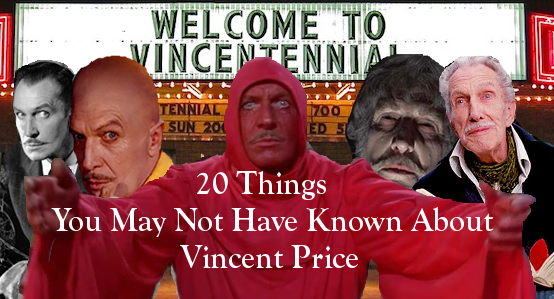
20 Things You May Not Have Known About Vincent Price!
No Halloween season is a true Halloween season without a
healthy dose of Vincent Price movies. But wait! Don’t sit down to shudder along
with House of Wax or The Abominable Dr. Phibes just yet! To
truly appreciate the man and his work, you’ll first want to bolster your
Priceducation with these 20 Things You
May Not Have Known About Vincent Price!
1. That Vincent
Price was a gourmet chef and cookbook author is well known among fans, but they
might not be aware that culinary interests ran deep in his bloodline. His
grandfather, Vincent C. Price, invented baking powder and pioneered cornstarch
as a baking ingredient, and his father, Vincent Leonard Price, was the
president of the National Candy Company.
2. Vincent
Price’s first wife, Edith Barrett, didn’t become as synonymous with horror as
her husband did, but she did star in the creepy classic I Walked with a Zombie.
3. Price’s
daughter Victoria is a serious writer who wrote scripts about Richard Widmark
and her dad’s old friend Roddy McDowall for A&E’s Biography series and an extensive and refreshingly objective
biography about her dad. She also had a brief role as a reporter in Price’s
final film, Edward Scissorhands.
4. As a young man
from an unquestioningly conservative St. Louis family, Price expressed sympathy
with this burgeoning Nazi party. However, he underwent a major liberal
awakening upon moving to Hollywood where he became active in such causes as the
Jewish Anti-Defamation League. Ironically, Joseph McCarthy targeted Price as a
possible communist in the fifties, citing Price’s anti-Nazi inclinations as
proof that he was some sort of dangerous radical. McCarthy was one loony piece
of work.
31 TV Shows for 31 Days of Halloween Season: Day 10
Series: The
Muppet Show
Episode: “Vincent
Price”, in which Vincent Price finally finds some costars who can keep up with his uniquely subtle acting style. This entire installment of The
Muppet Show reeks of the strange, the weird, the scary. A trio of ghosts
croon “I’m Looking Through You”. Muppet cannibalism is a running theme. Furniture
turns murderous. Kermit transforms into an amphibious vampire and takes a chunk
out of the guest host’s jugular. Most horrifying, most vile, most abominable of
all, Vincent Price sings a James Taylor song. James Taylor… shudder.
Friday, August 26, 2016
Review: 'Theatre of Blood' Blu-ray

With its gimmick murders (they’re based on the killings in Shakespeare’s
plays) and copious campy humor, Theatre of
Blood has much in common with another key Price film, but Robert Fuest shot The Abominable Dr. Phibes as a vibrant
psychedelic hallucination. Director Douglas Hickox realized Theatre of Blood with grittier, dirtier,
greyer realism, though cinematographer Wolfgang Suschitzky’s use of distorted,
fish-eyed lenses really heightens the film’s nightmarish, stomach-churning grotesqueries.
The grungy palette of Theatre
of Blood looked wretched on home video, and as much as I love Price and the
film’s satirical premise, I always found Theatre
to be off-putting and inaccessible because of its ugly presentation on VHS and
DVD. As I was hoping it would, Twilight Time’s new blu-ray has really turned
around my feelings about the film. Although white specks are constant (as they
tend to be on a lot of Twilight Time releases), the picture is clear, bright,
organic, and sometimes even colorful, allowing the wicked brilliance of Hickox
and Suschitzky compositions to shine through. Sound is very tinny, sometimes
distorted, but the picture looks so good that I was only
mildly bothered by the audio issues. More importantly, I’m grateful that I can now truly
enjoy one of Vincent Price’s best roles. A lively and interesting commentary by
Twilight Time’s Nick Redman and journalist David Del Valle, who performed an extensive
video interview with Price in 1988, completes this blu-ray, which is available
from Twilight Time's official site here.
Friday, May 27, 2016
366 Days at the Drive-In: Day 240

The Movie: The Abominable Dr. Phibes (1971)
What Is It?: Vincent
Price finds himself in a horror movie so bizarre, so insane, so giddy that he
can get away with a pretty restrained performance. As the title character, he
bumps off the medical professionals he blames for his wife’s death, basing each
murder on a Biblical plague. Great gimmick; great flick.
Why Today?: On
this day in 1911, Vincent Price is born.
Sunday, April 24, 2016
366 Days at the Drive-In: Day 207

The Movie: House on Haunted Hill (1959)
What Is It?: William
Castle’s best movie is great fun on its own thanks to the filmmaker’s humor and budget-trumping
artistry, Vincent Price’s Vincent Price-ness, and at least one true-blue scare,
but this is still a movie best seen in a theater full of delinquents chucking
popcorn boxes at the inflatable skeleton Emergoing overhead. Duck!
Why Today?: On
this day in 1914, William Castle is born.
Tuesday, January 19, 2016
366 Days at the Drive-In: Day 111

The Movie: Masque of the Red Death (1964)
What Is It?: Roger
Corman hits his horror peak with this lavish adaptation of two Poe tales (“Hop
Frog” is the other). Corman receives A-list support from screenwriter Charles
Beaumont, cinematographer Nic Roeg, and stars Jane Asher, Hazel Court, Patrick
Magee, Skip Martin, and Mr. Vincent Price.
Why Today?: On
this day in 1809, Edgar Allan Poe is born.
Friday, November 6, 2015
Review: 'The Bat' Blu-ray

Vincent Price is a shady doctor who ices shady banker Harvey
Stephens to get to the money Stephens stole from his own bank and hid in the
house he’s leasing to mystery writer Agnes Moorehead. Meanwhile, Moorehead’s
neighborhood is being terrorized by a masked, clawed serial killer who takes
the novel approach of releasing rabid bats on his victims—hence his nickname
and the title of The Bat. Based on
Mary Roberts Rinehart’s play of the same name (based on her own novel The Circular Staircase), Crane Wilbur’s The Bat is not exactly unpredictable as
a mystery, but it is simply oodles of fun as an old dark house picture with
shadowy, stormy atmosphere. The script is sometimes corny, sometimes genuinely
witty, and always breezy fun. Most significantly, this picture is a fab vehicle
for Moorehead and Lenita Lane, who plays her companion. It is particularly
refreshing as it doesn’t limit Moorehead and Lane to the usual “helpless
female” roles. They take an active role in solving the mystery, always support
and love each other, and are often more on the ball than the ineffectual cops
in charge of protecting them. Moorehead even refers to the dynamic duo as “two
strong women” at one point. Price does his patented menacing routine, which
means he’s a blast to watch too (also, be sure to look out for little rascal
Darla Hood in her final role).
The Film Detective’s new blu-ray of The Bat is a very appealing antidote to all the crummy versions of
this public domain movie floating around. There are a lot of white specs, and
thin scratches appear with some regularity, but the picture beneath the flaws is
handsome, indeed, with natural grain, nice detail, and bold contrast. Audio
suffers from occasional crackling, but it’s also strong overall, showing off
Louis Forbes’s smashing score well—I love his use of slide guitar to signal the
killer!
Tuesday, October 20, 2015
Review: 'Scream and Scream Again' Blu-ray

It’s probably normal to spend the majority of Scream and Scream Again wondering if
Gordon Hessler and his crew committed a botch-job of massive proportions or
made a conscious stab at abstract art. Hessler’s track record doesn’t make
figuring this out any easier since he directed his share of good pictures (The Golden Voyage of Sinbad) and exploitative trash heaps (Cry of the Banshee). Scream and Scream Again falls somewhere
in between those poles, and in this case, it’s probably wisest just to go with
the flow and take in its sundry oddities without thinking about any of it too
deeply. Half the picture is a political thriller in which a member of
some sort of Nazi-esque military organization keeps pinching people to death.
The other half finds a bloodsucking serial murderer/rapist terrorizing a London
nightspot called The Busted Pot. Why any swinging hippie would attend a joint
with a name like that is anyone’s guess. It’s like naming a brothel “The Crab
Trap.” Oops! Sorry. I promise not to think so much anymore.
Wednesday, October 7, 2015
366 Days at the Drive-In: Day 7

The Movie: House of Usher (1960)
What Is It?: Roger
Corman’s first Poe adaptation has all the classic elements in place: Vincent
Price, Gothic overload, gorgeous color, lavish sets, and a Richard Matheson
script. It's a bit meandering, but the apocalyptic climax is a big pay off.
Why Today?: On
this day in 1849, Edgar Allan Poe dies.
Wednesday, October 29, 2014
Diary of the Dead 2014
Every year I log my
Monster Movie Month © viewing with ultra-mini reviews at the end of every week
in October in a fiendish feature I call Diary
of the Dead. This year I altered the scheme slightly for a single, season-ending
post.
I wrote it. You
read it. No one needs to get hurt.

Oct. 1
Rodan (1956- dir. Ishirō
Honda) **
One of the most iconic giant Japanese monsters first
appeared in a pretty boring movie. Miners discover a baby pterodactyl that
looks and moves like a kite. It terrorizes Japan without a smidgen of the
moodiness of its forefather, Gojira. Amazing that Ishirō Honda followed that masterpiece with such a lazy picture. Rodan
would only become fun when paired with Gojira, as we shall soon see.
We Are What We Are (2013- dir. Jim Mickie) ***
I haven’t seen the Mexican film upon which this cannibal
family flick was based, so I can’t make any unfavorable comparisons. Taken on
its own merits, the American We Are What
We Are is refreshingly atmospheric. It’s also deliberately paced, which I
usually like, but this one’s a little too deliberate, bordering on tedious. It’s
also a bit empty aside from its fairly subtle critique of the patriarchy. On
the plus side, it has Michael Parks, which is worth at least half a star.
Oct. 3
Ghidorah, the Three-Headed Monster (1964- Ishirō Honda) ***½
This is more like it. Since Honda didn’t seem interested
in/capable of recapturing the grimness of Gojira
he took his kaiju franchise to its logical camp conclusion. Rodan is back and
less turgid in mood if not motion. So is Gojira and giant bug Mothra. The old
rampaging monsters experience a change of heart when faced with three-headed
dragon Ghidorah. They actually have a conversation about whether or not they
should assist humanity by offing the new menace! Plus there are those wacky
fairy twins, who appear on a crazy TV talk show. Perhaps not great fun, but
certainly good fun.
Oct. 4
Sunday, January 19, 2014
Ten Mysterious and Imaginative Edgar Allan Poe Adaptations
According to imdb, Edgar Allan Poe’s works have been adapted
287 times as of this writing. With eight of those not even seeing release yet,
the penner of weird and gloomy tales hasn’t fallen off the radar of film and TV
creators one iota. That’s a lot of stuff to sift through, and I won’t pretend
I’ve seen all of those adaptations. I have seen enough to put together a short
list of unmissable realizations of Poe stories, the faithful and the far out,
the straight and the surreal, the subtle, the hilarious, the animated, and the
bloody. Here are ten great Edgar Allan Poe adaptations you might want to cram
in today in honor of his 205th birthday.

1. The Fall of the House of Usher
(1928- dir. Jean Epstein)
Edgar Allan Poe is unquestionably among the most popular
writers in history, which accounts for why he’s been adapted so many times. However,
his work usually doesn’t lend itself to faithful adaptation. He’s often a lot
more interested in piling on the words to fashion a mood than he is in telling
a story. Perhaps this too is a reason for his popularity among filmmakers. An
oft-adapted story such as “The Fall of the House of Usher” is so lacking in
plot that it allows an interpreter to take it in any number of interesting
directions. French filmmaker Jean Epstein did that in his silent adaptation
from 1928, using spare surreal imagery to convey the dread Poe labors to
conjure in his story. With assistance from co-writer Luis Buñuel, then making Un Chien Andalou with Salvador Dali, Epstein welds together an assortment of
fantastical, unforgettable images. The odd ones—disorienting POV shots,
nightmarish sets, screwing frogs—pack as much power as the ones that are now
regarded as spooky movie clichés—mysteriously extinguishing candles, billowing
curtains, reanimated corpses. Even as the story takes its liberties with the
source material, the presentation conveys the atmosphere of a Poe story
uncannily, which is really the most important thing.
2. Murders in the Rue Morgue (1932- dir.
Robert Florey)
After reworking Dracula
and Frankenstein into films that
don’t rely too heavily on Stoker or Shelley in 1931, Universal treated Poe with
a similar lack of respect with its adaptation of “Murders in the Rue Morgue”
the following year. The film works mainly as a vehicle for Karl Freund’s expressionistic
cinematography, Bela Lugosi’s sinister mugging and line readings, and Robert
Florey’s totally wacko plot developments, such as Lugosi’s plot to prove the
theory of evolution by shooting up women with gorilla blood. That twist surely
would have tickled Poe, whose macabre sense of humor is lost on all those
readers who just think of him as a purveyor of opium-spiked horror. Despite the
fact that it didn’t quake box offices, Murders
in the Rue Morgue set off a mini cycle of Poe movies for Universal.
Ironically, this unfaithful adaptation was the closest thing to a faithful
adaptation the studio produced…
3. The Black Cat (1934- dir. Edgar G.
Ulmer)
…and for proof of that, check out The Black Cat. The story is actually one of Poe’s clearest, and
more faithful adaptations would come in later years (and later on this list
too), but Universal was always pretty revision happy, and writer Peter Ruric
and director Edgar G. Ulmer get downright slap-happy with “The Black Cat”. So long
to the simple plot of marital mania and revenge. Hello to a psycho chess match between
Satanic war criminal Boris Karloff and sadistic “hero” Bela Lugosi. Karloff’s
ailurophobia allows the film to very, very, very tangentially relate to Poe,
but his story has no bearing on Ulmer’s masterpiece otherwise. Karloff and
Lugosi have never been better matched, both relishing every line of peculiar
dialogue, and with its art deco style and insane brew of Satanism, torture, and
head games, The Black Cat may be the
best film on this list even if its pretty spurious as an adaptation.
4. The Tell-Tale
Heart (1953- dir. Ted Parmelee)
Friday, October 18, 2013
Diary of the Dead 2013: Week 3
I’m logging my Monster Movie Month © viewing with ultra-mini
reviews at the end of every week in October. I write it. You read it. No one
needs to get hurt.

Seed of Chucky (2004- dir. Don Mancini) ***
…after taking two steps forward with Bride of Chucky we take two steps back on the third and final day
of our Chucky-a-thon. In Seed of Chucky,
Jennifer Tilly plays herself as the star of a new movie based on the real-life
exploits of Chucky and Tiffany. Billy Boyd joins the family as the voice of
Glen/Glenda, the dolls’ Pinocchio-esque (and rather incontinent) child. The
problem is the movie is too mean to Tilly, who goes along with all the gags at
her expense gamely enough that maybe we shouldn’t feel too sorry for her, but
it still isn’t much fun to watch. There’s also a little too much truth in
advertising. This isn’t just called Seed
of Chucky because of Glen/Glenda; there is a lot of doll sperm in this
movie from the bad CGI opening credits sequence to Chucky whacking off to an
issue of Fangoria to a truly unpleasant
scene in which Tiffany artificially inseminates Tilly. This must be the lazy
influence of the gross-out comedies that There’s
Something About Mary spawned, or perhaps it’s writer/director Don Mancini’s
attempt to make a John Waters movie, since Waters is on board as a relentless
paparazzo. I have no beef with a sperm joke as long as it’s funny, but Tilly
getting sexually assaulted most definitely is not. I preferred Glen/Glenda, who
brings a little heart to the series. He’s a good character that saves Seed of Chucky from being as blah as Child’s Play 2, and Mancini pulls a
funny running gag from the dolls’ “Made in Japan” stamps and there’s a good Shining joke toward the end, so Seed of Chucky isn’t a total wash.
—And Now the Screaming Starts! (1973- dir. Roy Ward Baker) ***
The big gimmick of the delightfully titled —And Now the Screaming Starts! is that
there’s no gimmick at all. Amicus, the studio best known for its portmanteaus,
delivers a straightforward feature. Stephanie Beacham moves into her new
husband’s old manor. The ghosts there would prefer she left. This starts as an
old-fashioned old dark house movie with an eyeless ghost that emerges from
paintings of Herbert Lom and a severed hand that keeps crawling around and grabbing
people. Then it takes an unexpected turn from the cheesily generic to the rapey
and serious. It’s OK stuff that gets a boost from Roy Ward Baker’s ever-fine
direction and a geek-pleasing cast that includes Beacham, Lom, Peter Cushing,
and Patrick Magee, although all but Beacham are underused.
October 13
Abraham Lincoln Vampire Hunter (2012- dir. Timur Bekmambetov) *½
Is it possible for a movie to not only be about vampires but
actually be a vampire? I vote “yes,”
because while watching Abraham Lincoln
Vampire Hunter, I felt like my brain was being sucked out of my head with
the passing of every frame. I guess that would make it more of a zombie than a
vampire, but let’s not get too nitpicky about a movie with such a complete
disdain for history. A campy premise can be played without camp, as Don
Coscarelli did so brilliantly with Bubba
Ho-Tep, but it shouldn’t be played with a complete absence of
self-awareness and humor… at least not with so much bad CGI. Abraham Lincoln Vampire Hunter is played
so straight it ends up falling on its own stake. Indeed, the dumbest part of
this symphony of dumb action and dumber editing is that it thinks it has
something profound to say about human rights. You mean slavery is bad and
slavers are like vampires? Keep filling my brain with knowledge! The best thing
about watching Abraham Lincoln Vampire
Hunter is that my wife will now stop pressuring me to watch Abraham Lincoln Vampire Hunter.
October 14
King Kong (1976- dir. John Guilermin) ****
It’s been a good three decades since I’ve seen Dino De
Laurentiis’s infamous production of King
Kong. As a kid, I didn’t think it was that bad. As an adult, this opinion
holds true. I liked the updates, which both make it less demanding of
comparison to the (obviously) superior original and made it very relevant to a
1970s audience with its recasting of Carl Denham as a greedy oil man (is there
any other kind?), Jack Driscoll as an environmentally-conscious paleontologist,
and Ann Darrow as a spaced-out Hollywood starlet whose life is saved by Deep Throat only so she can be abducted
by a giant gorilla. While Rick Baker in a gorilla suit is no substitute for
Willis O’Brien’s marvelous special effects, the animatronic mask is much more articulate
than the usual ludicrous gorilla costume. Plus it’s satisfyingly self-conscious
of its shortcomings (Jack: “Who the hell do you think went through there? Some
guy in an ape suit?”). Thank Lorenzo Semple, Jr., for the persistent wit; he
was also the screenwriter behind many episodes of “Batman,” the wittiest TV
show of the sixties. The cast is
very good too with Jeff Bridges, Chuck Grodin, and Jessica Lange keeping you
from shrieking “Bring on the goddamned monkey, already!” for the first 50
minutes of the movie. I really liked it. Sue me.
Diary of a Madman (1963- dir. Reginald Le Borg) ***
Vincent Price holds down the fort in this adaptation of Guy
de Maupassant’s story “Le Horla.” A condemned man is under the influence of a
murderous entity called the Horla. When he suddenly dies in the presence of
Price, our star becomes the new host. Because it’s a period spook story from a
literary source starring Vincent Price, it’s hard not to compare it to Roger
Corman’s Edgar Allan Poe pictures of the same period. The relatively
style-less, chintzy, and talky Diary of a
Madman suffers in that comparison, but Price puts his customary all into
the role of the tortured magistrate and Nancy Kovack is very watchable as a gold-digging
yet conflicted model. There’s also a pretty neat animated effect in which Price’s
sculpture transforms from a smiley Nancy to a frowny Nancy. That statue is also
involved in the movie’s one truly effective scare.
October 15
Paranormal Activity 4 (2012- dir. Henry Joost and Ariel Schulman) **
Poor Katie Featherston. She’s a good actress. Must she be
forever doomed to skulk around in sequel after sequel after sequel of the Paranormal Activity series? As was the
case in part 3, Katie is actually a minor player. The main characters are a
bunch of kids, and since this latest installment is set in the present instead
of the halcyon days of 2006, there’s no need to explain why everything is being
filmed even before the weird stuff starts happening, because kids (and most
adults) today just live their lives through their cell phone viewfinders. Progress!
The Paranormal Activity movies,
however, have not progressed. Shadows dash in the background. Doors move.
Stairs thump. Chandeliers sway. People sleep. The most significant addition is
the reliance on fake-out scares, which occur at a truly absurd rate. What
started as a really, really scary little movie has become just another
formulaic horror franchise. And there’s no end in sight! Paranormal Activity 5 is in the works for 2014! At least we all get
a break this year.
October 16
The Hands of Orlac (1924- dir. Robert Wiene) ***
Five years after making The
Cabinet of Dr. Caligari, the first feature horror film and the paragon of German Expressionism,
Robert Wiene adapted Maurice Renard’s perennial terror tale about Paul Orlac, a
pianist who loses his hands in a train crash and receives a transplant from a
deceased murderer whose extremities have not lost their yen for killing. While
the subject matter is wackier than that of Caligari,
the visual style is much less phantasmagoric. Wiene only really lets his
imagination loose during Orlac’s dream of his hands’ former owner, and even that
sequence does not approach the nightmarish distortions of Caligari. Comparison to Karl Freund’s frothing 1935 remake Mad Love also makes Orlac seem tame. On its own merits, The Hands of Orlac is a good shadow-submerged creeper and Conrad
Veidt does his usual wonderfully weird work as Orlac. However, the nearly
two-hour version of this originally ninety-minute film is unnecessarily drawn
out and the ending is disappointing.
Zombie High (1987- dir. Ron Link) **½
An awesome cast (Virginia Madsen! Sherilyn Fenn! Paul Feig!)
attends a high school academy where everyone listens to the worst generic pop
songs in the world and their classmates get transformed into brain-dead conformists
in the bio lab. What starts as tongue-in-cheek, retro-eighties fun turns turgid
once that cast starts going under the knife and Madsen turns into Nancy Drew. Ultimately,
Zombie High makes the mistake of
taking itself too seriously, and what could have been a cool paranoid horror satire
ends up being a bland paranoid horror movie. The true story of Aziz Ghazal—a
guy who killed himself, his wife, and his daughter—is much more horrifying than
anything in Zombie High, the movie he
wrote and produced.
October 17
Attack of the Puppet People (1958- dir. Bert I. Gordon) ****
The cigar-sucking execs at AIP suss that if the kids will
turn out for an Incredible Shrinking Man they will surely quadruple their
numbers for a whole crowd of Incredible Shrinking Men and Women. John Hoyt
commits himself delightfully to the role of Mr. Franz, a lonely doll maker who
miniaturizes folks to add to his collection. Few villains are so endearing. Bert
I. Gordon’s Attack of the Puppet People
most certainly is not the profound classic that Jack Arnold’s film is, and the
“dolls” in suspended animation are clearly two-dimensional photographs, so it
doesn’t always wow on the special-effects front. Big deal! Attack of the Puppet People remains one of AIP’s most charming and
poignant B-horrors. You’d have to be a super-sized ass wipe to not want to get
shrunk down so you could dance to Rock & Roll on Mr. Franz’s desktop. What
fun! Director Gordon was really into this kind of stuff. His other films
included such size-shifting epics as The
Amazing Colossal Man (which June Kenney and John Agar watch at a drive-in
in Puppet People!), War of the Colossal Beast, Village of the Giants, and The Food of the Gods. His nickname
“Mister B.I.G.” was not unearned.
Friday, October 14, 2011
Diary of the Dead 2011: Week 2
I’m logging my Monster Movie Month © viewing with ultra-mini reviews every Friday in October (this year I’ll only be discussing movies I haven’t reviewed elsewhere on this site). I write it. You read it. No one needs to get hurt.

October 7st
Alice (1988- dir. Jan Švankmajer) ****
Alice begins with the title tot intoning, “Now you will watch a film made for children… perhaps.” Yeah, perhaps you want to stay up all night consoling your hysterical child who’d just been traumatized by Jan Švankmajer’s stop-motion animal skeletons and taxidermied carcasses. Perhaps not. No filmmaker has ever really been able to capture the quizzical humor of Lewis Carroll’s Alice’s Adventures in Wonderland. Švankmajer doesn’t really try. His Alice is more of a minimalistic nightmare. The repetitious scraps of dialogue mock Carroll’s copious wordplay. The googly-eyed, chisel-toothed White Rabbit splits open and bleeds torrents of sawdust blood. The sets are dank and derelict. The film reeks of mildew and formaldehyde. This is not horror in the sense that anyone gets hunted by a monster or hacked up by a mad man, but Alice may do nastier things to your psyche than any of those kinds of movies. Patience is required, though.
October 10th
Curse of the Crimson Altar (1968- dir. Vernon Sewell) ***½
This nonsense loosely based on Lovecraft’s “Dreams in the Witch House” is an excuse for naïve images of sex, drugs, and ritual sacrifice. Boris Karloff was winding down and wheelchair bound when he made Curse of the Crimson Altar (aka: The Crimson Cult), but he remained consummately committed. Throwaway lines like “All the best things in life are short lived” take on unintentional

October 7st
Alice (1988- dir. Jan Švankmajer) ****
Alice begins with the title tot intoning, “Now you will watch a film made for children… perhaps.” Yeah, perhaps you want to stay up all night consoling your hysterical child who’d just been traumatized by Jan Švankmajer’s stop-motion animal skeletons and taxidermied carcasses. Perhaps not. No filmmaker has ever really been able to capture the quizzical humor of Lewis Carroll’s Alice’s Adventures in Wonderland. Švankmajer doesn’t really try. His Alice is more of a minimalistic nightmare. The repetitious scraps of dialogue mock Carroll’s copious wordplay. The googly-eyed, chisel-toothed White Rabbit splits open and bleeds torrents of sawdust blood. The sets are dank and derelict. The film reeks of mildew and formaldehyde. This is not horror in the sense that anyone gets hunted by a monster or hacked up by a mad man, but Alice may do nastier things to your psyche than any of those kinds of movies. Patience is required, though.
October 10th
Curse of the Crimson Altar (1968- dir. Vernon Sewell) ***½
This nonsense loosely based on Lovecraft’s “Dreams in the Witch House” is an excuse for naïve images of sex, drugs, and ritual sacrifice. Boris Karloff was winding down and wheelchair bound when he made Curse of the Crimson Altar (aka: The Crimson Cult), but he remained consummately committed. Throwaway lines like “All the best things in life are short lived” take on unintentional
Thursday, October 13, 2011
See 'House on Haunted Hill' with Emergo at Jersey City's Landmark Loews!
 Earlier this month I reported that William Castle's House on Haunted Hill will be screening at The Landmark Loews in Jersey City, NJ, on Friday, October 28th (8:00PM). In my post I wrote that it would be great if the theater showed the film with Castle's grand gimmick Emergo, not expecting that would be the case. Much to my shock, the theater's official site has announced that the film will, indeed, be shown with Emergo! Not sure how often this happens, but it certainly doesn't happen too often in my own neighborhood! William Castle's grandson will also be in attendance to host a Q&A and raffle off a copy of the new House On Haunted Hill: A William Castle Annotated Screamplay. See you there!
Friday, May 27, 2011
A Vincent-a-Day: ‘From a Whisper to a Scream’
Leading up to the 100th anniversary of Vincent Price’s birth today, I’ve been checking out one of the maestro’s lesser known films all week.
From a Whisper to a Scream (1987- dir. Jeff Burr)
 A Vincent a Day week reaches its dastardly conclusion with one of the man’s final films. Price supposedly regretted taking this role, and it’s not too hard to suss why. From a Whisper to a Scream is the kind of cheapo scuzz yesterday’s Madhouse prognosticated. This portmanteau offers torture, incest, necrophilia, human vivisecting, child murder, a cheesy monster baby, a game of pin-the-tail-on-the-torso, and gobs of fairly convincing gore. The dialogue is witless (“She’s got legs all the way up to where the hair grows!”) and the acting is idiotic. These are also the qualities that make this junk fairly entertaining junk. Price appears in the wraparound in which he explains the sordid history of Oldfield, Tennessee, to an uncharacteristically restrained Susan Tyrrell. The great Lawrence Tierney is wasted in a part that barely even qualifies as a cameo, but each of the movie’s episodes isn’t much worse than your average Tale from the Crypt. And though the production values are cheaper than those in Creepshow, the stories are better. From a Whisper to a Scream is the worst thing I’ve watched this week, but I’m pleased that even this crap is pretty good. That’s quite a track record, Vincent! Happy 100th.
From a Whisper to a Scream (1987- dir. Jeff Burr)
 A Vincent a Day week reaches its dastardly conclusion with one of the man’s final films. Price supposedly regretted taking this role, and it’s not too hard to suss why. From a Whisper to a Scream is the kind of cheapo scuzz yesterday’s Madhouse prognosticated. This portmanteau offers torture, incest, necrophilia, human vivisecting, child murder, a cheesy monster baby, a game of pin-the-tail-on-the-torso, and gobs of fairly convincing gore. The dialogue is witless (“She’s got legs all the way up to where the hair grows!”) and the acting is idiotic. These are also the qualities that make this junk fairly entertaining junk. Price appears in the wraparound in which he explains the sordid history of Oldfield, Tennessee, to an uncharacteristically restrained Susan Tyrrell. The great Lawrence Tierney is wasted in a part that barely even qualifies as a cameo, but each of the movie’s episodes isn’t much worse than your average Tale from the Crypt. And though the production values are cheaper than those in Creepshow, the stories are better. From a Whisper to a Scream is the worst thing I’ve watched this week, but I’m pleased that even this crap is pretty good. That’s quite a track record, Vincent! Happy 100th.
Subscribe to:
Posts (Atom)