

Psychobabble: For Groovy Ghouls & Retro Rockers.
Showing posts with label Jack Nicholson. Show all posts
Showing posts with label Jack Nicholson. Show all posts
Friday, August 22, 2025
Review: 'The Book of Horror: The Anatomy of Fear in Film'


Sunday, January 28, 2024
Review: 'The Terror'/'The Little Shop of Horrors' Blu-ray

It took two writers to compose a script that clearly just instructed, “Jack walks down hall and opens door” for pages and pages on end. Roger Corman commissioned that script for no other reason than to get his every penny’s worth from the sets he used for The Raven and take advantage of the three extra days Karloff agreed to make himself available.
No wonder Corman wanted to keep shooting on the castle sets: they’re magnificent. Consequently, The Terror looks great, and that cast— which also includes Dick Miller, Jonathan Haze, and Dorothy Neumann— is impressive too. However, the desperation of this production, with its patchy story further confused by four different directors (including Nicholson, co-screenwriter Jack Hill, Monte Hellman, and Francis Ford Coppola) tacking additional scenes willy nilly onto Corman’s footage, is impossible to ignore. Of that cast, only Neumann rises above the perfunctory to give an enjoyably camp performance as an old witch.
The Terror is not as bad as its infamous reputation suggests, but the only scene that makes good on its terrifying title is the one in which Haze gets his eyes pecked out by a hawk…well, that is unless you think the image of Sandra Knight with honey on her face is particularly terrifying.
Now, if you want to see a Corman picture without a single perfunctory performance, check out the rightfully celebrated Little Shop of Horrors. The story goes that he shot it in just two days (not including reshoots) in order to beat new film industry rules giving actors more equitable contracts and pay— a sleazy motive, but one that allowed him to make his films on minuscule schedules and budgets.
Whatever the reality of its production, The Little Shop of Horrors is a brilliant specimen of B-movie making with man-eating Venus flytrap Audrey Junior growing to massive proportions on a diet of local folks. Charles B. Griffith, the writer responsible for some of Corman’s best horror/comedies, whipped up a script rippling with absurd situations and priceless shtick. The movie’s most famous performance is that of young Nicholson as an enthusiastically masochistic dental patient, but Jonathan Haze as Audrey’s keeper/slave, Jackie Joseph as his girlfriend, Mel Welles as his boss, and Corman-fave Dick Miller as a flower-munching customer are just as memorable. Still very funny with some charming craft-shop special effects, The Little Shop of Horrors is wonderfully entertaining and wonderful inspiration for fledgling filmmakers.
Considering its superiority to The Terror, and the cachet of its musical theater and cinematic remakes, The Little Shop of Horrors really should have been the A-feature of Film Masters' new double-feature Blu-ray set. Maybe they thought a more prominent role for superstar Nicholson and the similar marquee power of Karloff might make The Terror the more marketable movie, but I guess it doesn't matter which movie gets top billing, just as long as they're both included.
Perhaps it was also the superior restoration of The Terror that put it on the cover. This is a film cobbled together from various sources, and the stock footage doesn't look good, but the dedicated shots look fabulous, with natural grain, vibrant color, and unenhanced sharpness. The Little Shop of Horrors looks overly grainy and insufficiently contrasty in comparison, but considering the way it was shot, it actually looks better than it usually does in Film Masters' widescreen presentation.
Both discs include a nice selection of bonuses. On the Terror disc, there's a commentary from film historians Steve Haberman and C. Courtney Joyner (who also supplies a text essay that focuses more on Karloff's past in Poe movies than this set's lackluster feature film), a neat 44-minute visual essay on Corman as filmmaker with a main focus on The Terror, and a trailer. On the Little Shop disc, there's a commentary with Jonathan Haze and writer Justin Humphreys, a 17 minute documentary on Corman's Filmgroup production company, and a trailer. Overall, it's a juicy package, though it's the inclusion of Little Shop of Horrors that makes it essential.
Wednesday, June 21, 2023
Review: 'Corman/Poe: Interviews and Essays Exploring the Making of Roger Corman's Edgar Allan Poe Films, 1960-1964'

Monday, October 10, 2016
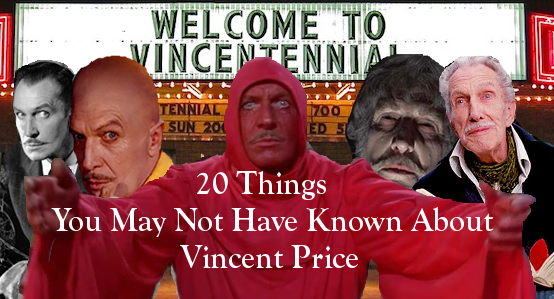
20 Things You May Not Have Known About Vincent Price!
No Halloween season is a true Halloween season without a
healthy dose of Vincent Price movies. But wait! Don’t sit down to shudder along
with House of Wax or The Abominable Dr. Phibes just yet! To
truly appreciate the man and his work, you’ll first want to bolster your
Priceducation with these 20 Things You
May Not Have Known About Vincent Price!
1. That Vincent
Price was a gourmet chef and cookbook author is well known among fans, but they
might not be aware that culinary interests ran deep in his bloodline. His
grandfather, Vincent C. Price, invented baking powder and pioneered cornstarch
as a baking ingredient, and his father, Vincent Leonard Price, was the
president of the National Candy Company.
2. Vincent
Price’s first wife, Edith Barrett, didn’t become as synonymous with horror as
her husband did, but she did star in the creepy classic I Walked with a Zombie.
3. Price’s
daughter Victoria is a serious writer who wrote scripts about Richard Widmark
and her dad’s old friend Roddy McDowall for A&E’s Biography series and an extensive and refreshingly objective
biography about her dad. She also had a brief role as a reporter in Price’s
final film, Edward Scissorhands.
4. As a young man
from an unquestioningly conservative St. Louis family, Price expressed sympathy
with this burgeoning Nazi party. However, he underwent a major liberal
awakening upon moving to Hollywood where he became active in such causes as the
Jewish Anti-Defamation League. Ironically, Joseph McCarthy targeted Price as a
possible communist in the fifties, citing Price’s anti-Nazi inclinations as
proof that he was some sort of dangerous radical. McCarthy was one loony piece
of work.
Thursday, May 12, 2016
366 Days at the Drive-In: Day 225

The Date: May 12
The Movie: One Flew Over the Cuckoo’s Nest (1975)
What Is It?: Jack
Nicholson brings a little anarchic spirit to the local mental institution and
goes toe-to-toe with the toughest nurse in cinema history. And all he loses is
his frontal lobe.
Why Today?: Today
is International Nurses Day.
Wednesday, April 27, 2016
Review: 'Easy Rider' Blu-ray

Hopper is Billy and co-screenwriter Peter Fonda is Wyatt, outlaws in cowboy hats and leather jackets riding across the wide-open west on their iron horses. Just like the cowboys of frontier times, they are also doomed to extinction. They visit a hippie commune lapsed into depression and destitution. Instead of changing hearts and minds with their in-your-face freedom, they meet a succession of unmovable, hostile, long-hair-hating rednecks. They end up weeping on acid. They end up in jail. There they meet a short-haired, tie-wearing lawyer (Jack Nicholson in the performance that rightfully made him a star) who’d never even smoked pot but seems to understand and embrace the joys of freedom more than they ever could. Wyatt sums up the film’s true message when Billy crows about a drug deal that will make them “rich” and able to “retire in Florida” (hardly hippie ideals) with a deflated “We blew it.” Things get worse from there.
Easy Rider is a defeated
survey of sixties Utopianism. It packs a particular punch because
it’s made by two guys who’d believed in that ideology. The general failure
of that ideology largely led to the cynicism that plagued seventies cinema. Yet
there is joy in its songs (The Byrds, The Band, Steppenwolf, Jimi Hendrix), László
Kovács’s gorgeous panoramic
cinematography, and Jack Nicholson’s exuberant performance. The set piece in
which the guys sell drugs to Phil Spector as heavy airplane traffic roars
twenty feet above their heads is an ingenious piece of ultra-noisy “silent”
filmmaking. The haunting graveyard acid trip is cinema’s first— and
perhaps only— psychedelic sequence that does not feel like a comic strip parody.
Don Camber’s flashing editing creates tension in the most serene scenes.
In 2010, The Criterion Collection gave Easy Rider a major hi-def renovation as part of the America Lost and Found: The BBS Story blu-ray/DVD box set. Last
year, Criterion began the process of breaking up that collection with a
stand-alone release of Five Easy Pieces,
and it continues this year by putting out Easy Rider on its own (Head,
meanwhile, will be part of Rhino’s endlessly upcoming Monkees Complete Series box set). This release is identical to the
one in The BBS Story with the same hi-def
restoration, extras (two commentaries; two documentaries from the nineties; a
revealing interview with BBS’ Steve Blauner, who gives some fascinating
information on his days working with The Monkees; two minutes of B&W
footage from Cannes 1969 featuring Hopper and Fonda), and even booklet essay.
Fortunately, all of that stuff was great in The
BBS Story, so if you wanted Easy Rider but didn’t want to spring for
the whole box, this new release is ideal.
Wednesday, February 3, 2016
Review: 'The Last Detail' Blu-ray

18-year old sailor Larry (Randy Quaid) gets eight years in
the brig for stealing forty bucks that he doesn’t even get to pocket from a
polio donation box. Billy “Bad Ass” Buddusky (Jack Nicholson in one of his most
Jack Nicholsony roles) is one of the naval officers tasked with transporting
Larry to the brig, and he intends to treat the trip as R&R, spending his
per diems on shitty beer, diner food, porno, and a trip to a depressing
brothel. Mule (Otis Young) is along too, but he just wants to do the job
without getting into any trouble that might jeopardize a naval career that is arguably
preferable to whatever fate he would have otherwise faced as a black man in
1970s America. For all his boasting of being a bad ass, Buddusky does his grim
duty and doesn’t really get to have much fun. In the end, his fate isn’t much
different from Larry’s or most of the other folks’ in this picture. The brig,
active service in the military, a brothel— in the end they’re all jails of one
kind or another.
However, the warm camaraderie between the three men makes The Last Detail fun despite its doomed
atmosphere and degraded settings. And Ashby allows us a couple of fleeting
glimpses of liberation. Although we seem to be invited to laugh at the members
of a Shōshū chanting
meet-up (Hi, Gilda Radner! Hi, guy who played Andy Andy on “Cheers”!) the
sailors stumble into, the fact that the chanters seem so genuinely happy fascinates
Larry and baffles Buddusky, who wrongfully believes he knows what living is
about. The closest he comes is a jolly punch up with some marines in a train
station crapper. But at least it is a happy moment for him. Sometimes a happy
moment here or there is the most any of us can ask for.
The Last Detail
comes to blu-ray from Twilight Time, and the picture is very grainy, pretty
soft, and consistently dark. The blacks of the sailors’ P-coats and uniforms
tend to blob together in an undifferentiated mass. These issues are probably more due to Ashby’s intended aesthetic than any mastering blunders. The print is very
clean without any significant blemishes to speak of. Special features are
limited to a trailer and isolated score track. Get the blu-ray here on Twilight Time's official site.
Wednesday, December 30, 2015
366 Days at the Drive-In: Day 91

The Date:
December 30
The Movie: Head (1968)
What Is It?: Director
Bob Rafelson, screenwriter Jack Nicholson, and stars The Monkees put a vicious end to Monkeemania with an avant-garde
pop movie that makes Magical Mystery Tour
look like that Britney Spears movie. Micky, Davy, Mike, and Peter commit
suicide, smoke hash while ogling belly dancers, blow up a Coke machine, degrade
themselves in a dandruff commercial, get imprisoned in a black box over and
over, whistle “Strawberry Fields Forever”, sing some other truly spectacular
pieces of psychedelic pop, and ruin Mike’s 26th birthday by throwing
him a 26th birthday party.
Why Today?: On
this day in 1942, Mike Nesmith is actually born (and Davy Jones is born this day in 1945!).
Wednesday, December 2, 2015
366 Days at the Drive-In: Day 63

The Movie: The Shining (1980)
What Is It?: No
amount of Stephen King’s whining can make Stanley Kubrick’s hotel-sized horror
less iconic or enjoyable. Ghosts, cabin fever, anger, and tumblers of imaginary
scotch send Jack Nicholson into an axe-swinging fit of redrum.
Why Today?: December
2nd is the day the redrum shit hits the fan in King’s novel.
Thursday, September 19, 2013
Review: 'Crab Monsters, Teenage Cavemen, and Candy Stripe Nurses—Roger Corman: King of the B Movie'

Cult, horror, and schlock freaks will always think of Roger
Corman primarily as the producer of some of their favorite cheap-o’s, whether
they be Little Shop of Horrors, Attack of the Crab Monsters, or Grand Theft Auto. Serious cinephiles
feel no guilt in praising the artistry of the best Poe pictures he directed,
particularly House of Usher and The Masque of the Red Death, or his even
less celebrated venture into message films, the remarkable anti-segregation The Intruder. They also appreciate how
he distributed works by European artists such as Federico Fellini, Akira
Kurosawa, and Ingmar Bergman (who loved the dubbed version of Cries and Whispers Corman put in
drive-ins!) in the U.S. Many of our most respected filmmakers—Scorsese,
Coppola, Bogdanovich, Demme, Nicholson— revere Corman as the guy who gave them
their real starts in Hollywood. Feminists who know more about him than his
insistence on stuffing gratuitous nudity into his movies appreciate the
opportunities he afforded women directors, producers, writers, and crew people
in an industry infamous for its sexism. Indie filmmakers of every stripe should
bow down to Roger Corman for his pioneering the frugal business practices that
made thousands of low-budget pictures possible.
Thursday, August 5, 2010
The Nuggets Record Buying Guide: The Monkees

I’d certainly heard music from the ‘60s before discovering The Monkees during their massive 20-year-anniversary revival in 1986, which saw their TV series snare a new generation on MTV, all of their original albums reenter the Billboard Hot 100 chart, and three of the original members mount a hugely successful tour. But, as much as Dylan and Beatles songs appealed to me, it was still my dad’s music. Seeing my grammar school peers dig The Monkees made them OK for me too dig, too, and their jangly guitars, irresistible pop hooks, and sweet harmonies were a welcome antidote to the shit purveying the contemporary pop scene. I was too young for college radio, so my love of R.E.M., Throwing Muses, Elvis Costello, and other great mid-‘80s acts that didn’t receive the air-time that Lionel Richie, Mr. Mister, and Peter Cetera did was still years away. The organic, guitar-based pop of The Monkees appealed to my twelve-year-old self far more than the glossy synthesized garbage that then littered top-forty radio and MTV.
As they were for twelve year-olds in the mid-‘60s, The Monkees served as a gateway to my interest in more sophisticated Rock bands during the mid-‘80s. They also sparked my obsession with '60s pop: The Monkees begat The Beatles, who begat The Rolling Stones, who begat The Who, who begat The Pretty Things, and so on, and so on. I did go through a phase in which I scoffed at The Monkees when I grew a bit older, but after rediscovering them a few years after the Listen to the Band box set appeared in 1990, I found that many of my favorite hooks were right where I left them. I was shocked by how well much of The Monkees’ music held up, even as I now recognized what critics had been hating about them for almost thirty years.
And here lies The Monkees problem. Their best music is often their least known. Their best known songs threaten to confirm the major criticisms lobbed at the group: (1) they were put together by cynical TV-producers bent on cashing in on the success of A Hard Day’s Night, a film starring a group that came together organically to make the decade’s greatest music, (2) they didn’t play their instruments (“Last Train to Clarksville”, “I’m a Believer”), and (3) they played lightweight, saccharine bubblegum sung with a mere trace of competence (“A Little Bit Me, A Little Bit You”, “Daydream Believer”).
The first of these complaints is the easiest to dismiss: the same thing could be said about The Sex Pistols, and no one questions their credibility just because they were assembled by Malcolm McLaren. The “Monkees don’t play they own instruments and therefore are completely illegitimate” gripe has always been a hollow one, too. The Beach Boys, one of pop’s most respected bands, rarely played the instruments on their records. Not a Beach Boy touched an instrument during the SMiLE sessions. Groups less monumental than The Beach Boys, but still more respected than The Monkees, used studio players at times, as well: The Byrds and Love being two (I’d never lump in, say, The Mamas and the Papas, with these groups as others do, because no one should expect a vocal group to play the instruments on their recordings). And as anyone with the slightest knowledge of pop history knows, The Monkees successfully fought for the right to play on their records after existing for little over six months. That is quite a feat, but one that never won them an iota of respect from the hip music press.
The final complaint is perhaps more legitimate, but one that can be traced to a single individual: Davy Jones. Davy’s little-boy good looks obviously won the group a gargantuan following of pre-teen girls, but his equally prepubescent voice did the music no favors. Much of his material is fluff, and that includes big hits like “Daydream Believer” and “A Little Bit Me”. Davy’s cloying numbers mar the best Monkees records. The fact that his material is better known by non-fanatics than Mike Nesmith’s sophisticated contributions has done immeasurable damage to The Monkees’ reputation.

Not surprisingly, when Rhino Records chose a Monkees track to include on Where The Action Is! Los Angeles Nuggets 1965-1968
 (2009) they went for a Nesmith composition. “Daily Nightly” was a good selection not just because of its quality, but because of its relevance to the box set’s theme (it is a surreal yet oddly journalistic report on the Sunset Strip curfew riots between hippies and cops in the summer of ’66). The track also helps counter The Monkees’ bubblegum image with its razor sharp bass lick, psychedelic poeticism, and genuinely cutting-edge squalls of Moog synthesizer (another well-traveled nugget of Monkees-lore is that Micky Dolenz was only the third person to own one of these futuristic instruments, the first being Paul Beaver and the second being, strangely enough, country legend Buck Owens).
“Daily Nightly” is nestled in the album most likely to entice non-believers into a serious Monkees habit. The Monkees (number one on Billboard for 13 weeks) and More of the Monkees (number one on Billboard for an astounding 18 weeks) may have sold more copies, and Headquarters may be the only album on which The Monkees serve as their own backing band on every track, but Pisces, Aquarius, Capricorn & Jones Ltd.
 (1967) is the most consistently fine Monkees album.
As much as Peter Tork— the Monkee who most craved legitimacy— wanted the group to continue working together as they had on Headquarters, their intense schedule (which included media appearances, TV filming, and live performances, as well as recording sessions) and diverging interests made it impossible. As a result, Tork rates Pisces below Headquarters, but The Monkees’ fourth record offers a more confident selection of compositions and performances. And, in all fairness, The Monkees are still the backing band for the most part here. Chip Douglas, the former Turtle who played bass on Headquarters and produced that album and Pisces, was essentially a fifth Monkee spared having to appear on the hit-and-miss TV show. His consistently excellent bass playing can be heard on Pisces, as well. Micky Dolenz, who basically learned to play the drums while making Headquarters, sits out most of Pisces (he only contributes the fairly simple beat on “Cuddly Toy”). Instead, The Monkees used ace session man “Fast” Eddie Hoe, whose playing made the sessions run smoother and delivered monumental performances on tracks such as “Pleasant Valley Sunday” and “Salesman” that could never be matched by Dolenz’s rudimentary chops. Otherwise, that’s still Nesmith playing guitar throughout the record and Tork playing keyboards and even Jones whacking his tambourine. This mixed approach suited The Monkees best, but the real strength of Pisces, Aquarius, Capricorn, and Jones Ltd. comes from its great songs and the ever-increasing presence of Mike Nesmith.
No other Monkees record contains as many lead vocals by the very adult-sounding Nesmith as Pisces does. Oddly, most of his vocals are on songs written by others, but the songs he chose to sing are all top-notch: the funky Tex-Mex twanging “Salesman”, a put-down of drug pushers written by Nes’s buddy Craig Smith from The Penny Arcade, Barry Mann and Cynthia Weil’s spectacular “Love Is Only Sleeping”, on which Nesmith plays an infectiously wiry guitar riff and hits his eeriest falsetto, Lewis and Clarke’s Byrds-like “What Am I Doing Hangin’ ‘Round?”, which is among The Monkees’ most beloved album tracks, and Chip Douglas and Bill Martin’s transcendentally beautiful folk-rocker “The Door Into Summer”, my vote for the group’s greatest creation.
Nesmith also sings his own “Don’t Call On Me”, a lounge-lizard experiment that manages to be both genuinely pretty and ironically amusing (his breathy sigh before the velveteen organ solo is hilarious). He handed “Daily Nightly” to Dolenz, who also played the avant garde Moog part, which starkly contrasts the more musical lines played by Paul Beaver on Goffin and King’s “Star Collector”. That particular track contains one of Davy Jones’s more bearable vocals, possibly because he mostly shouts it (no vomit-inducing whispers of “I love you” here) and possibly because the fabulously chaotic backing track still threatens to overwhelm him. Jones also does a fairly respectable job on the Tom Jones-like rocker “She Hangs Out”, a superior remake of a song that briefly appeared on the B-side of “A Little Bit Me, A Little Bit You”. His other two performances are a bit harder to stomach: “Hard to Believe”, a smarmy bossa nova he co-wrote (and tellingly, the only Pisces track on which the other Monkees do not play), and Harry Nilsson’s sleazy combo of bubblegum melody and porno lyricism, “Cuddy Toy”. Despite recalling “a Hell’s Angels’ gang-bang” while trumpeting Jones’ sticky sweetness, “Cuddly Toy” became a sort of minor Monkees classic.
Micky Dolenz, who so dominated The Monkees’ first three records, makes less of an impression here, but each of his contributions are major. Aside from “Daily Nightly” he takes co-lead on the two tracks that made up the group’s best double-sided hit: Gerry Goffin and Carol King’s “Pleasant Valley Sunday”, one of the few Monkees tracks on which all members of the band make upfront vocal contributions, and Tommy Boyce and Bobby’s Hart’s spooky “Words”, which features a tasty call-and-response between Dolenz and Tork.
So, if you’re quick on the draw when it comes time to skip “Cuddly Toy” and “Hard to Believe”, Pisces, Aquarius, Capricorn, and Jones, LTD. is the album most likely to convert you into a Monkees fan. The next step would be Headquarters
 (1967). Not as consistently rich as Pisces, HQ houses the pleasure of hearing a damn good garage band coming to life. Nesmith’s “You Told Me” and “Sunny Girlfriend” and the Little Richard-inspired band composition “No Time” rock hard and mean. The sweet and sour “Shades of Gray” and Boyce and Hart’s Simon & Garfunkle-esque “Mr. Webster” offer moments of true gravity off-set by the “we realize we’re just winging this” goofs of “No Time”, “Band 6”, and the weird a cappella experiment “Zilch”. Micky Dolenz’s “Randy Scouse Git” works as both comedy and a thrillingly inventive track. It’s the best thing he’s ever written and among the best Monkees recordings. Headquarters really only has one bad cut, the Jones-sung "I Can't Get Her Off My Mind", but it is considerably worse than anything on Pisces.
Bold listeners should then check out Head
 , the avant garde soundtrack to The Monkees’ avant grade 1968 cult film. The album contains the highest percentage of excellent Monkee songs, but the fact that there are only six of them on the record makes it less of an easy listen than Pisces and Headquarters. Aside from Nesmith’s ferocious “Circle Sky” (as far as I’m concerned, this studio version pulverizes the more lauded live one from the film), Tork’s exotic “Can You Dig It?” and exhilarating “Long Title: Do I Have to Do This All Over Again?”, the gorgeous ballad “As We Go Along” (with guitar by Neil Young), the monumental psychedelic excursion “Porpoise Song”, and “Daddy’s Song”, a better Nilsson/Jones confluence than “Cuddly Toy”, the record is filled out with bizarro montages of sound effects and dialogue from the Head film edited with cheeky mischievousness by co-screenwriter Jack Nicholson.
 The Monkees' two biggest sellers lack the adventure of their albums that followed, but both The Monkees
 (1966) and More of the Monkees
 (1967) still have much to recommend them. No one but those addicted to TV theme songs needs to listen to “(Theme from) The Monkees”, and Davy commits two of his worst crimes with “I Wanna Be Free” on the first album and “The Day We Fall In Love” on the second, but Nesmith’s pioneering country-rock work-outs “Papa Gene’s Blues”, “The Kind of Girl I Could Love”, and especially “Sweet Young Thing” are great. So are the more garagey numbers, such as “Saturday’s Child”, “Tomorrow’s Gonna Be Another Day”, “Let’s Dance On”, “She”, “Mary Mary”, and “(I’m Not Your) Steppin’ Stone”. Davy even manages to get off one terrific bubblegummer with his rendition of Neil Diamond’s “Look Out (Here Comes Tomorrow)” on More.
 The remainder of The Monkees’ catalogue is sketchier. Each album contains a handful of tracks essential for true-believers, but the less committed should stop with the first four records and Head. The Birds, The Bees, & The Monkees
 (1968) is the best of the remainder, but it’s a hodgepodge with Nesmith’s freakiest experiments rubbing elbows with Jones’s fluffiest bubblegum. Still, you wouldn’t want to be without “Tapioca Tundra” or “Auntie’s Municipal Court”, Nesmith’s two greatest fusions of country and psych. The Monkees Present
 (1969) is more consistent, with Jones finally hitting on a more adult approach to his brand of pop and Dolenz discovering light jazz-pop, but the material is less exciting. Instant Replay
 (1969) is an unfortunately assembled outtakes compilation. The Monkees had a slew of great stuff in the can, so there’s no excuse for the inclusion of “Me Without You”, “Just a Game”, and “Don’t Listen to Linda” aside from attempting to confirm The Monkees’ reputation as pap for teenyboppers. Dolenz’s suite “Shorty Blackwell” may have been an attempt to cast the group as heavyweight freaks, but it isn’t particularly listenable. But “I Wont’ Be the Same Without Her”, a leftover from The Monkees’ earliest sessions, is gorgeous, and the lacerating “You and I”, which features a more prominent Neil Young lead than “As We Go Along”, is hands down Jones’s best song and vocal. Changes
 (1970), The Monkees’ last gasp after Nesmith finally quit the group (Tork departed after Head), is the worst of the bunch, but even this thin platter contains one great rocker, the Jones-sung “99 Pounds”, and one last superb Dolenz raver, “Midnight Train”. Anything released as “The Monkees” after this shouldn’t even be touched with a twenty-foot, poo-covered cattle prod.
Sunday, July 25, 2010
January 8, 2010: Five Classic Monster Movies for a Snowy Day
I don’t know where you are, but here in Jersey City, there’s a thin layer of snow on the ground. While this is hardly the product of some punishing blizzard, it’s still early in the season, and if the amount of snow we’ve gotten so far is any indication, this is going to be another snowy winter. That means there will be plenty of opportunities to watch some snowbound monster flicks.
Watching a film that captures the desolation of a snow-swathed landscape or the paranoia of being snowbound as a winter storm rages outside your window really heightens the horror of such a film. It’s like watching a haunted house flick in an actual haunted house. Here are five classic monster movies you might consider watching today or the next time your area gets the business end of a blizzard.
1. The Invisible Man (1932)
The first sound monster film to really take advantage of snowy landscapes is James Whale’s masterful adaptation of H.G. Wells’s The Invisible Man. Snow plays a rather practical role in the film: without it, the cops wouldn’t stand a chance of capturing a creature who can only be detected via his footprints, therefore there would be no sense of risk. And let’s face it: Whale wants us to identify with Claude Rains’s Dr. Griffin, who is simply bursting with malevolent mischievousness and nasty humor, not the dull cretins who would foil his diabolical plans to “rule the world…” to “rob and rage and kill!” Still, I’ve always wondered why Griffin doesn’t just die of the flu long before the end of the picture, since he spends so much time running around in the snow buck naked.
2. The Abominable Snowman (1957)
Released just a few months after The Curse of Frankenstein, Val Guest’s The Abominable Snowman was only the second genuine monster movie produced by Hammer Studios. As such, it is quite a different beast from the colorful Gothic horror pictures for which the studio was best known, yet its minimalism and the bleakness of its Himalayan setting make it no less creepy. There is also a subtlety and poetry to The Abominable Snowman that is lacking in some of Hammer’s more lavish productions. Studio mainstay Peter Cushing and Forrest Tucker play scientists on a quest to find the fabled snow creature, who has been leaving his size-18 footprints all over the surrounding area. While the creature is not among Hammer’s more expertly executed creations, the film provides one of the studio’s most intriguingly sensitive denouements.
3. The Shining (1980)
Stephen King was no fan of Stanley Kubrick’s The Shining, but fans know that it is not only the greatest adaptation of King’s work, but it’s also the ultimate snowbound horror film. We can debate whether or not Jack Nicholson was the right choice to play a character who is supposed to go mad gradually, rather than come off like a wacko right out of the gate (which was King’s main gripe about the movie), but The Shining is still a masterpiece of palpable cabin fever. Notice how the snowy environment incrementally devolves from the picturesque-quality of the opening sequence, as Jack Torrance (Nicholson) and his little family head to the cursed Overlook Hotel, to the more blanched-out haze seen when son Danny (creepy Danny Lloyd) and wife Wendy (frantic Shelley Duvall) go for a pleasant walk in the hedge-maze to ultimate darkness and overwhelming nothingness when Torrance goes completely off his rocker and hunts his son through that maze at the picture’s climax. As is the case with a few other Kubrick films (2001, Eyes Wide Shut…), the environment is just as much of a character in the picture as any of the humans, and while The Overlook may be the most obvious environmental character in The Shining, the snow-laden world that surrounds it is an equally complex and terrifying entity.
4. John Carpenter’s The Thing (1982)
Howard Hawks’s 1951 sci-fi monster picture The Thing From Another World is generally rated as one of the great films of its ilk, but I actually prefer John Carpenter’s 1982 remake in spite of my yen for all things really, really old. With its cast of grizzled, hard-drinking, tough-talking dudes, John Carpenter’s The Thing is as much a macho action movie as it is a monster picture, but a suffocating air of doom ensures that the picture’s true agenda is to horrify. The ostensible enemy in the film is a grotesquely metamorphosing alien that can take the shape of any living thing it sees, which exacerbates the trigger-happy paranoia of the research team quarantined at a station in Antarctica. However, the barren environment is just as formidable as the monster bumping off the men (and causing them to bump off each other). As the picture reaches its cynical, hopeless conclusion, that unforgiving tundra seems like it will be the beast that will wipe out humanity for good.
5. Gremlins (1984)
In contrast to the grim landscapes present in most of the other movies on this list, the environment in Joe Dante’s Gremlins is a winter wonderland straight out of a Courier and Ives print. Placing the demonic, havoc-raising gremlins in such a pleasantly bucolic location is fully in-step with the film’s ironic tone, and the Christmas setting provides plenty of opportunities for grotesque set-pieces: the gremlins going door-to-door to shriek shrill carols, a dog strung up in Christmas lights, the beasties swarming a hapless dude in a Santa suit, Phoebe Cates’s positively awful story about how her father croaked after jamming himself in his own chimney while playing Santa for his kids. And, lest we forget, Gizmo, the fluffy little thing responsible for much of this violent mayhem, was, itself, a Christmas gift.
Watching a film that captures the desolation of a snow-swathed landscape or the paranoia of being snowbound as a winter storm rages outside your window really heightens the horror of such a film. It’s like watching a haunted house flick in an actual haunted house. Here are five classic monster movies you might consider watching today or the next time your area gets the business end of a blizzard.
1. The Invisible Man (1932)
The first sound monster film to really take advantage of snowy landscapes is James Whale’s masterful adaptation of H.G. Wells’s The Invisible Man. Snow plays a rather practical role in the film: without it, the cops wouldn’t stand a chance of capturing a creature who can only be detected via his footprints, therefore there would be no sense of risk. And let’s face it: Whale wants us to identify with Claude Rains’s Dr. Griffin, who is simply bursting with malevolent mischievousness and nasty humor, not the dull cretins who would foil his diabolical plans to “rule the world…” to “rob and rage and kill!” Still, I’ve always wondered why Griffin doesn’t just die of the flu long before the end of the picture, since he spends so much time running around in the snow buck naked.
2. The Abominable Snowman (1957)
Released just a few months after The Curse of Frankenstein, Val Guest’s The Abominable Snowman was only the second genuine monster movie produced by Hammer Studios. As such, it is quite a different beast from the colorful Gothic horror pictures for which the studio was best known, yet its minimalism and the bleakness of its Himalayan setting make it no less creepy. There is also a subtlety and poetry to The Abominable Snowman that is lacking in some of Hammer’s more lavish productions. Studio mainstay Peter Cushing and Forrest Tucker play scientists on a quest to find the fabled snow creature, who has been leaving his size-18 footprints all over the surrounding area. While the creature is not among Hammer’s more expertly executed creations, the film provides one of the studio’s most intriguingly sensitive denouements.
3. The Shining (1980)
Stephen King was no fan of Stanley Kubrick’s The Shining, but fans know that it is not only the greatest adaptation of King’s work, but it’s also the ultimate snowbound horror film. We can debate whether or not Jack Nicholson was the right choice to play a character who is supposed to go mad gradually, rather than come off like a wacko right out of the gate (which was King’s main gripe about the movie), but The Shining is still a masterpiece of palpable cabin fever. Notice how the snowy environment incrementally devolves from the picturesque-quality of the opening sequence, as Jack Torrance (Nicholson) and his little family head to the cursed Overlook Hotel, to the more blanched-out haze seen when son Danny (creepy Danny Lloyd) and wife Wendy (frantic Shelley Duvall) go for a pleasant walk in the hedge-maze to ultimate darkness and overwhelming nothingness when Torrance goes completely off his rocker and hunts his son through that maze at the picture’s climax. As is the case with a few other Kubrick films (2001, Eyes Wide Shut…), the environment is just as much of a character in the picture as any of the humans, and while The Overlook may be the most obvious environmental character in The Shining, the snow-laden world that surrounds it is an equally complex and terrifying entity.
4. John Carpenter’s The Thing (1982)
Howard Hawks’s 1951 sci-fi monster picture The Thing From Another World is generally rated as one of the great films of its ilk, but I actually prefer John Carpenter’s 1982 remake in spite of my yen for all things really, really old. With its cast of grizzled, hard-drinking, tough-talking dudes, John Carpenter’s The Thing is as much a macho action movie as it is a monster picture, but a suffocating air of doom ensures that the picture’s true agenda is to horrify. The ostensible enemy in the film is a grotesquely metamorphosing alien that can take the shape of any living thing it sees, which exacerbates the trigger-happy paranoia of the research team quarantined at a station in Antarctica. However, the barren environment is just as formidable as the monster bumping off the men (and causing them to bump off each other). As the picture reaches its cynical, hopeless conclusion, that unforgiving tundra seems like it will be the beast that will wipe out humanity for good.
5. Gremlins (1984)
In contrast to the grim landscapes present in most of the other movies on this list, the environment in Joe Dante’s Gremlins is a winter wonderland straight out of a Courier and Ives print. Placing the demonic, havoc-raising gremlins in such a pleasantly bucolic location is fully in-step with the film’s ironic tone, and the Christmas setting provides plenty of opportunities for grotesque set-pieces: the gremlins going door-to-door to shriek shrill carols, a dog strung up in Christmas lights, the beasties swarming a hapless dude in a Santa suit, Phoebe Cates’s positively awful story about how her father croaked after jamming himself in his own chimney while playing Santa for his kids. And, lest we forget, Gizmo, the fluffy little thing responsible for much of this violent mayhem, was, itself, a Christmas gift.
Subscribe to:
Posts (Atom)