Showing posts with label Psychobabble’s 31 Favorite Universal Horrors. Show all posts

Wednesday, October 31, 2018

Psychobabble’s 31 Favorite Universal Horrors: #1


Halloween season simply isn’t Halloween season without a regular dose of golden age Universal horror (1923-1963). Every day this October, I’ll be giving you a steady IV drip of it by counting down Psychobabble’s 31 Favorite Universal Horrors!

#1. Bride of Frankenstein (1935- dir. James Whale)

There could be no other number-one in this series. It is widely regarded as the crown jewel of Universal horror and one of the few sequels to best its original predecessor. It is an explosion of imagination, special effects, pathos, humor, camp, and sheer madness. Every scene offers something delightful to behold: the glittering, self-referential prologue in the home of Mary Shelley and spouse; the mock-scary re-introduction of Karloff’s monster; the unveiling of wonderfully withering and withered Dr. Pretorius; Elizabeth Frankenstein’s weird freak-out in her bedroom; Minnie; Pretorius’s astounding homunculi; the Monster’s strangely moving visit with a blind hermit; the birth of the magnificent Bride and the Monster’s ill-fated attempt to court her. Bride of Frankenstein is not as scary as Frankenstein or as pungent as Dracula or as consistently funny as Abbott & Costello Meet Frankenstein or as sophisticated as Psycho and The Birds, yet it is a movie that feels like it has it all and then some. It is a monster masterpiece and such dizzying fun that it will keep you sugar-buzzed for a week after Frankenstein’s castle explodes. It is Psychobabble’s favorite Universal horror, favorite horror, favorite movie, and the best prescription for having a happy Halloween. Hope you have one yourself.

Tuesday, October 30, 2018

Psychobabble’s 31 Favorite Universal Horrors: #2


Halloween season simply isn’t Halloween season without a regular dose of golden age Universal horror (1923-1963). Every day this October, I’ll be giving you a steady IV drip of it by counting down Psychobabble’s 31 Favorite Universal Horrors!

#2. Abbott & Costello Meet Frankenstein (1948- dir. Charles Barton)

The monster rallies of Erle C. Kenton were basically pulling the entire Golden age of Universal horror into the grave of self-parody. Why not get out the shovel and finish the job? Once and for all, the monsters would be laughing stocks, and Karloff himself was so offended by the notion that he refused to appear in or even see the final appearances of the Frankenstein monster, Dracula, and the Wolf Man in Abbott & Costello Meet Frankenstein. The thing is, the monsters weren’t laughing stocks. They basically play it straight despite a couple of fleeting comedic moments such as the Monster shuddering at the sight of Costello or the count cracking wise once or twice. The humor was all up to Bud and Lou, and though they were hesitant about their first full-bore horror comedy, the blend of serious threats and screwball insanity was magical. After all, the monsters’ main allure was never really their scariness. It was the fun lying just beneath their scarred or furry surfaces. Abbott & Costello Meet Frankenstein draws that fun right out into the air and makes no apologies for it. Bud and Lou and Glenn Strange get top billing, but Bela Lugosi and Lon Chaney, Jr., give this movie real legitimacy as an essential Universal horror film. The only possible way to have more fun while watching a movie is to check out the one in the next and final installment of Psychobabble’s 31 Favorite Universal Horrors…

Monday, October 29, 2018

Psychobabble’s 31 Favorite Universal Horrors: #3


Halloween season simply isn’t Halloween season without a regular dose of golden age Universal horror (1923-1963). Every day this October, I’ll be giving you a steady IV drip of it by counting down Psychobabble’s 31 Favorite Universal Horrors!

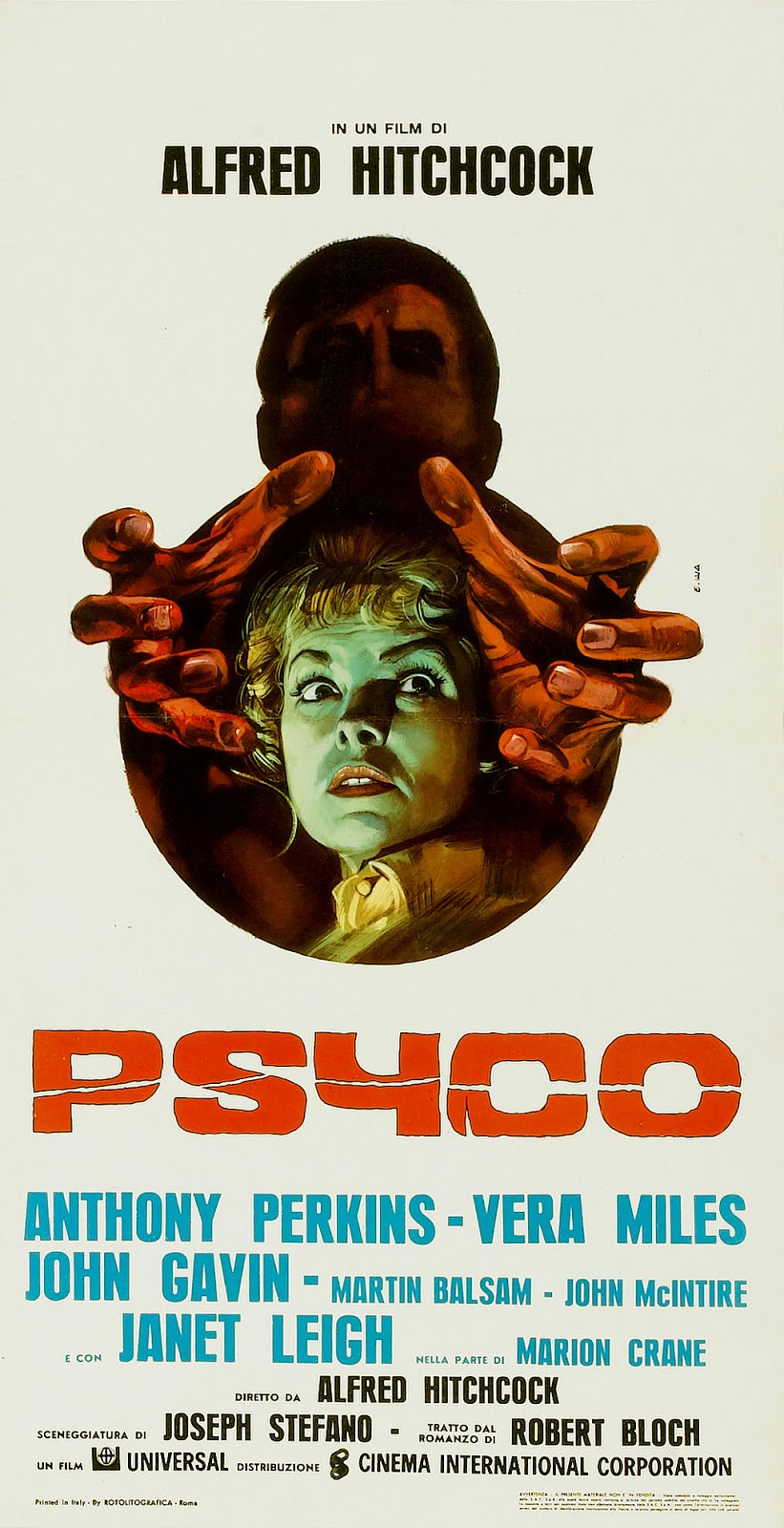
#3. Psycho (1963- dir. Alfred Hitchcock)

As I said in my discussion of The Birds a few days ago, Hitchcock’s horrors of the early sixties didn’t as much wrap up an age of horror as they launched a new one. With the possible exception of Franju’s gory Le yeux sans visage, Psycho was the ultimate shot across the bow for horror’s new age. After subsisting on years of vampires, ghosts, giant spiders, and other humbugs, 1960s audiences must have been utterly rattled by this unsparing portrait of a human monster. The film’s sexuality, the viciousness of the attacks, the grotesqueness of Mother’s corpse, and the sympathetic way Norman Bates is presented surely reconfigured the minds of movie audiences and made them capable of digesting even hardier stuff such as Night of the Living Dead, A Clockwork Orange, and The Exorcist. Hitchcock maximizes his film’s shocks with tricky, bait-and-switch storytelling, and Anthony Perkins aids and abets that assault with his completely ingratiating portrayal of Norman Bates. As far as I’m concerned, horror cinema’s two greatest decades are the 1930s and 1960s, and Universal was responsible for setting both of them in motion.

Sunday, October 28, 2018

Psychobabble’s 31 Favorite Universal Horrors: #4


Halloween season simply isn’t Halloween season without a regular dose of golden age Universal horror (1923-1963). Every day this October, I’ll be giving you a steady IV drip of it by counting down Psychobabble’s 31 Favorite Universal Horrors!

#4. The Invisible Man (1933- dir. James Whale)

James Whale found his voice with The Old Dark House. He started shouting from the rooftops with The Invisible Man. Its blend of horror and humor are seamless. The plot is pretty faithful to H.G. Wells, but that guy didn’t have a funny bone in his body. Whale and writer R.C. Sheriff find the humor in a mad scientist who can do as he pleases—so long as he’s totally naked— without going in any of the obvious gross or prurient directions. Really, Dr. Jack Griffin just wants to have fun, whether that means dancing down a road as a pair of floating pants while singing “Here we go gathering nuts in May” or throwing a few beer mugs about. OK, he takes the joke too far when he derails a train and murders his arch rival for the affections of Gloria Stuart, but can you blame him for that last one? That Dr. Kemp is such a bore! The same cannot be said of Griffin, and Claude Rains fleshes out his invisible role with a brilliantly expressive voice. However, the real stars of The Invisible Man may very well be the special effects team of John P. Fulton, John J. Mescall, and Frank D. Williams, whose disappearing act will still make you marvel “How did they do that?” Oh…and Una O’Connor. Never forget Una O’Connor.

Saturday, October 27, 2018

Psychobabble’s 31 Favorite Universal Horrors: #5


Halloween season simply isn’t Halloween season without a regular dose of golden age Universal horror (1923-1963). Every day this October, I’ll be giving you a steady IV drip of it by counting down Psychobabble’s 31 Favorite Universal Horrors!

#5. Dracula (1931- dir. Tod Browning)

Scoff if you will. Many have. They call it static, stagy, and hammy. They call it boring and inept. They can stake themselves as far as I’m concerned. Dracula is flawed in some ways, but the film’s overall effect is profound. This movie is so Gothic, so alluringly archaic, so deeply creepy you can practically smell the dank crypt air. Dracula builds atmosphere like few other films, and a horror movie is nothing without atmosphere. It also has Bela Lugosi, the man who embodies the count so completely that it is always unsatisfying seeing another actor portray him no matter how technically better the actor’s performance is. As iconic as Bela is, Dwight Frye arguably steals the film as Renfield. He’s crazed, but he is also funny, frightening, fearful, and strangely sympathetic. The entire opening sequence in Dracula’s castle is masterful: Dracula’s awe-inspiring appearance on his massive stairway, Renfield and Dracula’s sickly humorous dinner, the dreadful appearance of the vampire’s famished brides. Critics complain that the film loses all steam after it leaves Transylvania, but I prefer to think that the steam that opening sequence builds powers the rest of the picture. Frankenstein is technically a better movie, but no serious horror puts me in the Universal spirit like Dracula.

Friday, October 26, 2018

Psychobabble’s 31 Favorite Universal Horrors: #6


Halloween season simply isn’t Halloween season without a regular dose of golden age Universal horror (1923-1963). Every day this October, I’ll be giving you a steady IV drip of it by counting down Psychobabble’s 31 Favorite Universal Horrors!

#6. Frankenstein (1931- dir. James Whale)

The definitive Universal monster movie. James Whale was a great wit, but he plays Frankenstein very seriously (in fact, the only comic relief character, Baron Frankenstein, is a complete dim wit and not particularly funny). You won’t miss the cheekiness of Bride, Invisible Man, or The Old Dark House because you will be completely transfixed by Boris Karloff’s devastating portrayal of the Monster. He can be terrifying, as he is in his disturbing jump-cut introduction, but he is mostly deeply moving and sympathetic. It is a beautiful performance heavily indebted to silent film but without a lick of the over-emoting/over-gesticulating that marked much pre-sound acting. Karloff is completely, modernly naturalistic whether tragically trying to connect with a little girl or reaching for rays of sunlight as if they’re tangible love. Colin Clive is also great as frantic, obsessed Dr. F., and Dwight Frye is at his nastiest as the doctor’s sadistic assistant Fritz. Whale’s Gothic style is impeccable, and the inventive editing and staging make this a monster movie as towering, solid, and timeless as the creature himself.

Thursday, October 25, 2018

Psychobabble’s 31 Favorite Universal Horrors: #7


Halloween season simply isn’t Halloween season without a regular dose of golden age Universal horror (1923-1963). Every day this October, I’ll be giving you a steady IV drip of it by counting down Psychobabble’s 31 Favorite Universal Horrors!

#7. The Birds (1963- dir. Alfred Hitchcock)

Hitchcock’s horrors of the early sixties really mark the beginning of a new age of horror distinct from the days of Dracula, Frankenstein, The Wolf Man, and The Gill Man. They are utterly contemporary, psychologically complex, graphically violent, and overtly sexual. In the case of The Birds, Hitchcock’s brand of horror is also very colorful. Because of its complete cinematic sophistication, it may be a little unfair to rank The Birds against most of the other movies in this series, but it does deserve a place here. Hitchcock was a shit, and it’s hard to find Melanie Daniels’s terror entertaining knowing what we know about what the director put Tippi Hedren through, but his artistry is unassailable. The playground, children’s party, and yes, attic sequences constitute a master’s class in establishing suspense, delivering terrifying action, editing, sound, acting, and everything else that goes into making a superior horror movie. The Birds is one of the most superior of all.  

Wednesday, October 24, 2018

Psychobabble’s 31 Favorite Universal Horrors: #8


Halloween season simply isn’t Halloween season without a regular dose of golden age Universal horror (1923-1963). Every day this October, I’ll be giving you a steady IV drip of it by counting down Psychobabble’s 31 Favorite Universal Horrors!

#8. The Black Cat (1934- dir. Edgar Ulmer)

Universal horror did not always rely on supernatural horror. In fact, what may be it’s most horrifying horror of all had no supernatural elements, though its characters deeply believe in the powers of evil. Karloff is no longer the conflicted creature of Frankenstein. He’s all evil as an Alistair Crowley stand-in who matches wits with Bela Lugosi as a psychiatrist out for revenge. Universal tried to pass The Black Cat off as a Poe adaptation, but it has zilch to do with its namesake story. Yet, as many have pointed out, Poe would likely have approved of the film’s perversity and bleakness. Edgar Ulmer’s noir-ish style and the Art Deco sets give The Black Cat a personality distinct from any of the other Universal horrors of its era. However, it is Karloff and Lugosi who make this picture such delicious fun, and they get to wrap their tongues around some of the most memorable dialogue they ever spoke: “Supernatural perhaps, boloney perhaps not.” “The phone is dead; even the phone is dead.” Even when the dialogue isn’t especially clever, the actors’ relish makes it so, as when Karloff makes the line “He has an intense and all-consuming horror of cats” sings like a Stradivarius.

Tuesday, October 23, 2018

Psychobabble’s 31 Favorite Universal Horrors: #9


Halloween season simply isn’t Halloween season without a regular dose of golden age Universal horror (1923-1963). Every day this October, I’ll be giving you a steady IV drip of it by counting down Psychobabble’s 31 Favorite Universal Horrors!

#9. The Wolf Man (1941- dir. George Waggner)

Having exhausted literary sources during the first phase of its Golden Age of monsters, Universal managed an original creation to really bring its next phase into focus. More rooted in the practical/tragic human issues of turning into a snarling beast beneath the moon than Werewolf of London had been, The Wolf Man finally got the werewolf picture right. The originality of its story is not the only thing that sets The Wolf Man apart from Universal’s earlier horrors: it also eschews a Gothic, period setting in favor of a contemporary, fairy tale milieu. Yet the new monster was such an instant smash that he was deemed an acceptable playmate for Frank and Drac. Lon Chaney, Jr., gets to do what he does best as he grimaces and wrings his hands as Larry Talbot. Jack Pierce gets to do what he does best as he covers Chaney’s face in yak fur, fashioning his final memorable monster. The Wolf Man also stands out from most of the earlier Frankenstein and Dracula pictures because of its consistently interesting cast. Dracula was a touch of a drag whenever Bela or Dwight Frye wasn’t on screen, but you never feel as though The Wolf Man is wasting your time as long as Claude Rains, Evelyn Ankers, the unforgettable Maria Ouspenskaya, and yes, Bela, are on screen.

Monday, October 22, 2018

Psychobabble’s 31 Favorite Universal Horrors: #10


Halloween season simply isn’t Halloween season without a regular dose of golden age Universal horror (1923-1963). Every day this October, I’ll be giving you a steady IV drip of it by counting down Psychobabble’s 31 Favorite Universal Horrors!

#10. The Mummy (1932- dir. Karl Freund)

It’s a tried and true Hollywood formula: you score big once; you attempt to carbon copy that success. It doesn’t always work, but it did when Universal practically remade Dracula as The Mummy. Once again you have a long-in-the-tooth monster crossing an ocean to ensnare a specific women in its thrall while contending with Edward Van Sloan and David “Mr. Personality” Manners. The Mummy isn’t very original, but it does make certain stylistic improvements over Dracula with its sumptuous sets, elaborate monster make up, less static staging, and heightened air of romance. Karloff makes the most of a monster without much pep, and between his naturally mesmerizing gaze and some well-positioned pin lights, he’s also the center of some of the creepiest shots in a golden age Universal monster movie. Zita Johann and the flashback-pool sequence are similarly mesmerizing.

Sunday, October 21, 2018

Psychobabble’s 31 Favorite Universal Horrors: #11


Halloween season simply isn’t Halloween season without a regular dose of golden age Universal horror (1923-1963). Every day this October, I’ll be giving you a steady IV drip of it by counting down Psychobabble’s 31 Favorite Universal Horrors!

#11. The Old Dark House (1932- dir. James Whale)

James Whale played it straight with Frankenstein and delivered a solidly scary movie. But it wasn’t very Jimmy. Now that he’d established himself as a horror master, he could work his personality into his pictures more assuredly, and he first did so with The Old Dark House, which strikes a brilliant balance between Whale’s creepy imagery (Karloff’s grunting butler, twisted Saul lurking about and setting fires, Rebecca’s disturbingly distorted reflections) and his delicious humor. Those images, that humor, and a fab cast turn clichés so hoary that the title of this film became a genre unto itself into something deliriously fresh, funny, and freaky.

Saturday, October 20, 2018

Psychobabble’s 31 Favorite Universal Horrors: #12


Halloween season simply isn’t Halloween season without a regular dose of golden age Universal horror (1923-1963). Every day this October, I’ll be giving you a steady IV drip of it by counting down Psychobabble’s 31 Favorite Universal Horrors!

#12. The Creature from the Black Lagoon (1954- dir. Jack Arnold)

Just when Universal horror seemed dead in the water, this little gem from Jack Arnold came bubbling to the surface. The supposition that there might be some sort of missing link between fish and person is goofy, but that’s okay since it spawned the Gill Man, and he may be the most interesting looking of all Universal monsters. Good work, Millicent Patrick! The underwater sequences are lovely, though they do tend to go on and on. The film really works best above lagoon level when the Gill Man is shuffling across the deck of the Rita, Nestor Paiva is gnawing his cigar and refusing to take shit from irritating Richard Denning, and Julie Adams is being Julie Adams.

Friday, October 19, 2018

Psychobabble’s 31 Favorite Universal Horrors: #13


Halloween season simply isn’t Halloween season without a regular dose of golden age Universal horror (1923-1963). Every day this October, I’ll be giving you a steady IV drip of it by counting down Psychobabble’s 31 Favorite Universal Horrors!

#13. The Phantom of the Opera (1925- dir. Rupert Julan)

Lon Chaney’s definitive character is still really scary. What did those audiences in the earliest days of cinema think when they witnessed Chaney’s Phantom staring them down, marching forward with dreadful relentlessness, his finger pointing accusingly right at them? Probably something like, “Oh, rhatz. I do believe I’ve soiled my golf knickers.” There’s something a bit off about a silent movie about opera, but the big bonus is that we don’t have to listen to any opera. Plus, the Phantom’s sewer lair is super cool.

Thursday, October 18, 2018

Psychobabble’s 31 Favorite Universal Horrors: #14


Halloween season simply isn’t Halloween season without a regular dose of classic Universal horror (1923-1963). Every day this October, I’ll be giving you a steady IV drip of it by counting down Psychobabble’s 31 Favorite Universal Horrors!

#14. Hold That Ghost (1941- dir. Albert S. Rogell)

Is this reeeally a ghost story? Yes, it is. Allow me to refer you to the moving-candlestick gag. How’s that thing moving? Wires? Hardly! Now that your doubts are quelled, let’s just focus on the tremendous fun abounding in Abbott & Costello’s admittedly tentative first outing in the realm of the supernatural. The boys inherit an old dark house from a gangster and hilarity ensues. Much of that hilarity rises not from the team of Bud and Lou but the team of Lou and Joan Davis. She’s spectacular in this picture. More sparks fly during her dance routine with Costello than all of Evelyn Ankers and Richard Carlson’s forced romantic scenes put together.

Wednesday, October 17, 2018

Psychobabble’s 31 Favorite Universal Horrors: #15


Halloween season simply isn’t Halloween season without a regular dose of classic Universal horror (1923-1963). Every day this October, I’ll be giving you a steady IV drip of it by counting down Psychobabble’s 31 Favorite Universal Horrors!

#15. House of Frankenstein (1944- dir. Erle C. Kenton)

I don’t care if they’re schlocky—Universal’s monster rallies scratch a sweet spot that movies with just one creature never could. The Mummy? That guy’s totally lonesome. Frankenstein Meets the Wolf Man? Closer, but not quite there yet, guys. Erle C. Kenton’s House movies? Ahh, that’s the sweet relief I’ve been craving. One of the best and most monster-crammed rallies is House of Frankenstein. “FRANKENSTEIN'S MONSTER! WOLF MAN! DRACULA! HUNCHBACK! MAD DOCTOR!... All the Screen's Titans of Terror - Together in the Greatest of All SCREEN SENSATIONS!” went the ballyhoo. The cast is killer with Chaney Jr. as the Wolf Man, Glenn Strange as the monster, John Carradine making his elegant debut as the count, and Karloff taking one last bow in a Frankenstein picture a the mad scientist. The one major flaw is the film’s split structure that prevents all of the monsters from ever sharing screen time together.  If you see any other flaws in this big heap of wonderful, I’m not sure if we can be friends anymore.

Tuesday, October 16, 2018

Psychobabble’s 31 Favorite Universal Horrors: #16


Halloween season simply isn’t Halloween season without a regular dose of classic Universal horror (1923-1963). Every day this October, I’ll be giving you a steady IV drip of it by counting down Psychobabble’s 31 Favorite Universal Horrors!

#16. Son of Frankenstein (1939- dir. Roland V. Lee)

Universal’s second Frankenstein sequel, and its final Frankenfilm with Karloff as the Monster, is too long by 30 minutes and that little kid is a menace, but boy oh boy, is Bela Lugosi ever a blast to watch as Ygor! Tired of the franchise and an increasingly limited role to play, Karloff seems to cede the film to Lugosi, who is only too happy to steal the show as the diabolical survivor of a botched hanging. Ygor uses the Monster as a pliable tool of revenge in a sheepskin vest. Lionel Atwill is also terrific as the police inspector with a chip on his shoulder and splinters in his arm.

Monday, October 15, 2018

Psychobabble’s 31 Favorite Universal Horrors: #17


Halloween season simply isn’t Halloween season without a regular dose of classic Universal horror (1923-1963). Every day this October, I’ll be giving you a steady IV drip of it by counting down Psychobabble’s 31 Favorite Universal Horrors!

#17. The Mummy’s Hand (1940- dir. Christy Cabanne)

The neat thing about The Mummy’s Hand is that it may be Universal’s only monster movie in which the screenwriter wrote some actual people to go along with the monster. In fact, the heroes are much more fun than the monster, who has officially lapsed into the mindless shuffling and strangling with which the Mummy is now most associated. No matter when Dick Foran and Wallace Ford as archaeologists and Peggy Moran, and Cecil Kellaway as magicians are such a gas. It’s a pleasure watching characters who so genuinely like each other. I loathe the next Mummy sequel, The Mummy’s Tomb, because of the cruel way it reimagines this delightful cast.

Sunday, October 14, 2018

Psychobabble’s 31 Favorite Universal Horrors: #18


Halloween season simply isn’t Halloween season without a regular dose of classic Universal horror (1923-1963). Every day this October, I’ll be giving you a steady IV drip of it by counting down Psychobabble’s 31 Favorite Universal Horrors!

#18. The Raven (1935- dir. Lew Landers)
Like Son of Frankenstein, The Raven gives Bela Lugosi the opportunity to upstage Boris Karloff, which must have given Lugosi no end of pleasure. He plays a sadist and Poe enthusiast with his very own pit and pendulum. The film has nothing to do with the title poem aside from a rather haunting dance performance inspired by “The Raven. ” So what? Karloff is low key as a criminal who attempts to skirt the law by getting plastic surgery. Note to Karloff and everyone else: do not hire Bela Lugosi to perform plastic surgery on you.

All written content of Psychobabble200.blogspot.com is the property of Mike Segretto and may not be reprinted or reposted without permission.