

Psychobabble: For Groovy Ghouls & Retro Rockers.
Showing posts with label The Shining. Show all posts
Showing posts with label The Shining. Show all posts
Friday, August 22, 2025
Review: 'The Book of Horror: The Anatomy of Fear in Film'


Thursday, May 1, 2025
Review: 'Ghost of an Idea: Hauntology, Folk Horror and the Spectre of Nostalgia'

Sunday, August 1, 2021
Review: 'Adapting Stephen King Volume 1: Carrie, 'Salem's Lot, and The Shining from Novel to Screenplay'

Maddrey's approach is as resourceful as his information is thorough and insightful. Adapting Stephen King Volume 1 is mainly a novel-to-script-to-screen study, but it also includes oral history interludes and interviews with the screenwriters responsible for the most significant adaptations (the only screenwriter he does not personally interview is King himself; oddly, he selects an interview from the run-up to Kubrick's Shining in 1979 to illustrate the section on the Shining miniseries King spearheaded in 1997). Clearly, a lot of work went into this book which means it will likely be years before he gets around to my favorite King novel, It. Get cracking, Maddrey.
Thursday, September 5, 2019
Review: 'Stephen King at the Movies: A Complete History of the Film and Television Adaptations from the Master of Horror'

Early in Stephen King
at the Movies: A Complete History of the Film and Television Adaptations from
the Master of Horror, Ian Nathan drops some stunning statistics.
Apparently, the Master has written or inspired some 65 movies, 30 TV programs,
and 7 episodes of TV anthology series. That must be some sort of record, and it
certainly justifies the existence of a book like Nathan’s. Fortunately, the
author knew just what to do with this overdue project.
Stephen King at the
Movies is part photo book, sneering with nasty full-color images culled
from the many King screen works, as well as some neat behind-the-scenes looks
at these films and shows’ creations. Nathan does not allow the photos to do all
the heavy lifting though. He supplies satisfying making-of accounts and
critiques of each of the numerous pictures he discusses in an entertaining tone
appropriate to his subject matter and with the critical distance to acknowledge
that Stanley Kubrick’s The Shining is
great despite what King says and that the King-approved mini-series version is thoroughly mediocre.
For the most part, Nathan allows a couple of pages to pore
over each film, but for the cream of this creepy crop—Carrie, The Shining, Misery, Stand by Me, etc.—he devotes as many as eight pages. Along the way,
there’s some interesting trivia, such as a nuggets about how Warner Bros.
offered Stanley Kubrick The Exorcist
and Warren Beatty almost played the James Caan role in Misery. Visual and textual fun, Stephen
King at the Movies should keep fans occupied as they suffer the always
brief wait for another King project to splatter across the screen.
Thursday, May 16, 2019
Review: 'Eyes Wide Shut: Stanley Kubrick and the Making of His Final Film'

From his decision to adapt the scandalous Lolita to the
world-annihilating cynicism of Dr.
Strangelove to the unflinching anti-storytelling of 2001 to the horrific physical and psychological violence of A Clockwork Orange, The Shining, and Full Metal
Jacket, Stanley Kubrick made a career of shocking viewers. He
seemed to save up his most unrelenting succession of shocks for what turned out
to be his final film. Kubrick’s decision to film a lengthy orgy extreme enough for U.S. censors to demand its actions be obscured with digital censors was
shocking. That the film required an excruciating 18 months to shoot
was shocking. The way the long, long, long awaited film from the man many rated
as cinema’s greatest living artist baffled, repelled, and bored many viewers
was shocking. Kubrick’s sudden death shortly after completing the first cut of Eyes Wide Shut was the biggest shock of all.
Even if you are among those viewers who loathe Eyes Wide
Shut, the shocking nature of its making may still compel you to read Eyes Wide Shut: Stanley Kubrick and the
Making of His Final Film. Robert P. Kolker and Nathan Abrams uncover new
shocks that enrich the story of an already labyrinthian film. Although I knew
that the film gestated in Kubrick’s mind for a long time, I was surprised that
it did so for as many as 40 years. Kolker and Abrams imply that Kubrick’s
obsession with bringing Arthur Schnitzler’s Traumnovelle
to the screen may have infused much of his earlier work, including Lolita, A Clockwork Orange, and The
Shining (Kubrick annotated his copy of Stephen King’s novel with ideas for
scenes that seem straight out of Schnitzler’s), and unproduced projects such as
Burning Secret and Laughter in the Dark. Though there is a
lot of humor in the finished product (particularly in its oft-misunderstood orgy sequence), I was also surprised by the wealth of
evidence that Kubrick seriously considered adapting Traumnovelle as a comedy, and that he’d considered casting Woody
Allen and Steve Martin in the lead role and communicated with Terry Southern
about writing it.
While I noticed at least one exaggeration (Kolker and Abrams called the Eyes Wide
Shut shoot history’s longest, but the 12-year shoot of Boyhood and the 5-year shoot of Eraserhead
easily beat its 18 months), the book is well researched (materials include
Kubrick’s personal faxes and notes he made on scripts and in books) and doesn’t
oversell its conclusions. I’m not sure if it will spur Eyes Wide Shut haters to reevaluate the film, but Eyes Wide Shut: Stanley Kubrick and the Making of His Final Film will give them
some fresh insight into the seemingly impenetrable mind of Stanley Kubrick.
Monday, September 24, 2018
Review: 'Kubrick’s Music—Selections from the Films of Stanley Kubrick'

Stanley Kubrick’s work is often more like world’s you visit
than movies you watch. The galactic emptiness of 2001: A Space Odyssey. The grimy yet candy-colored near-future
dystopia of A Clockwork Orange. The
cavernous, ice-encrusted hotel of The
Shining. The opulent dream vision of NYC in Eyes Wide Shut. The oil painting landscapes and chiaroscuro
interiors of Barry Lyndon. Even the
desolate suburbs of Lolita are
inhabitable environments that engulf you, shutting out any trace of our real
world for two or three hours. Kubrick put an absurd amount of thought into how
to best create these fully dimensional worlds visually, but he put a great deal
of thought into the sounds swirling between their borders as well. He’d spend
hour upon hour researching music, and the fruits of his labors are clear to
anyone who cannot separate the visuals of great spacecraft tumbling through the
cosmos without hearing “The Blue Danube Waltz” or a tiny car traversing a
treacherous path swarmed by foreboding forests without hearing Wendy Carlos and
Rachel Elkind’s “Dies Irae”.
Much of the music to which Kubrick bestowed additional
dimensions can be heard on El Records’ Kubrick’s
Music—Selections from the Films of Stanley Kubrick. This set is both
fascinating and frustrating. It is frustrating because so many essentials are
not present. The Shining’s sprawling
soundtrack is largely reduced to the jazz-age tracks Kubrick used to stir the
ghosts of the Overlook’s bloody past. “Dies Irae” only appears within Berlioz’s
“Symphonie Fantastique”, a stirring piece of bombast far removed from The Shining’s brooding tone. Carlos and
Elkind’s chilling synth production is not present. The same is true of the
synthesized music from A Clockwork Orange:
the pieces only appear in traditionally orchestrated versions. While we get an
eerie prelude by Ralph Vaughan Williams that Kubrick considered using in the
stargate sequence of 2001, we do not
get the more transformative and disturbing Ligeti piece he ultimately used in
the film. While pop songs are present in the use of Vera Lynn’s “We’ll Meet
Again” (Dr. Strangelove), Gene
Kelly’s “Singin’ in the Rain” (A
Clockwork Orange), and a non-soundtrack song Sue Lyon sang on the B-side of
the “Lolita Ya-Ya” single, none of the great pop songs used in Full Metal Jacket appear. In fact, that
film, as well as Killer’s Kiss and The Killing, is completely
unrepresented.
However, some of these issues also point to one of the more
fascinating aspects of Kubrick’s Music
since we get to hear much of what inspired Kubrick to use the music he
ultimately used, and the inclusion of discarded ideas such as the Ralph Vaughan
Williams prelude makes Kubrick’s Music
a sort of enlightening look at Kubrick’s musical sketchpad. So while this is
hardly a definitive collection of Kubrick soundtracks, it is an educational
one, and with such great pieces as John Coltrane’s “Greensleeves”, Nelson
Riddle’s “Lolita Ya Ya”,
Rimskey-Korsokav’s “The Sea and Sinbad’s Ship” (incidentally, a piece
shut out of the original Clockwork Orange
soundtrack), and several movements from Ludwig Van’s glorious “Ninth”, there is
quite a lot of gorgeousness and gorgeousity made flesh to slooshy, o my
brothers.
Monday, October 23, 2017
5 Superior Adaptations of Horror Lit
Adapting literature for the cinema is always tricky, and
this can be especially true when dealing with stories intended to raise
shivers. What is terrifyingly evocative on the page can flop like a sack of wet
leaves when realized with a dude in a zip-up monster suit on screen. Acts
unimaginably awful when described cease to play on the imagination when
depicted with a rubber knife and karo-syrup blood. Some of horror’s greatest
literary works, such as “The Legend of Sleepy Hollow”, It, and I Am Legend, have
never received ideal screen adaptations. Some page-to-screen trips have been
more lateral with stories such as Frankenstein
and Dracula offering very different
yet equally essential elements when turned into movies or ones such as The Haunting of Hill House and Rosemary’s Baby being faithful enough to
be genuine cases of “six of one/half dozen of another.” On occasion, a film
goes above and beyond, reinventing the story upon which it is based in ways
that make the original text virtually irrelevant. Here are five of those
superior horrors.
Monday, October 24, 2016
Monsterology: Monster Houses
In this ongoing feature on Psychobabble, we’ve been looking at the history of Horror’s archetypal monsters.

But wouldn’t it be a stone drag if you were settling in to
relax in your sanctuary and the walls started bulging unnaturally or bleeding
even more unnaturally? Wouldn’t it simply ruin your night if that thing you
haven’t even finished paying the mortgage on yet sucked your precious little
daughter into the electrical system or made you want to pick up an axe and chop
up your precious little son?
Monsters come in all shapes, sizes, and smells, but one
thing that unites the mass of them from werewolves to robots is that they
somehow resemble organic beings. One of the few exceptions is the monstrous
house. The fact that it has no arms or legs or teeth makes the monster house
highly unusual and really very wrong (though not completely beyond anthropomorphization, as we shall see). The fact that a house is such a mundane
thing, a thing intended to protect and comfort, makes it highly insidious, especially when it turns against the children who dwell in it, as it so often does.
First of all, we must distinguish the monster house from the
haunted house. In a haunted house, the monster is some form of ghost. It may
make the windows rattle or the chairs fall over, but that ghost is the central
threat, not the place it chooses to haunt. That would be like blaming Dracula’s
castle for the vampire’s poor behavior, which would be unfair to a perfectly
fine castle. The nasty things a ghost does can be accomplished by any
breathing, visible asshole. Ghosts or other such entities may be responsible
for making a monster house monstrous, but a true monster house takes on a life
of its own; it is the threat.
The first truly enduring monster house remains the
definitive one. Published in 1839, Edgar Allan Poe’s “The Fall of the House of
Usher” largely passed over specifics to dwell on off putting descriptions of
the title building. The unnamed narrator approaches the house, and it instantly
casts its spell on him, bashing him with waves of depression and unease. He has
not even interacted with its weird inhabitants before getting a very strong
sense that the House of Usher is a bad place. He even emphasizes its inherent
monstrousness by trying to describe it in anthropomorphic terms, noting its
“vacant and eye-like windows.”
Is it the house that has seemingly poisoned Roderick and
Madeline Usher, both of whom suffer from odd maladies such as Roderick’s
intense aversion to sound and his sister’s general malaise and tendency to
lapse into catatonic states? Is it responsible for the subtextual moral decay
of the siblings, whose relationship may not be entirely platonic? As the
narrator drifts through the foreboding house, it reacts violently to the
presence of one who might uncover its strange and dirty secrets. It begins
cracking in disapproval. When the ultimate abomination comes to
light—Roderick’s premature burial of catatonic Madeline—the house has a total
nervous breakdown. As the short story’s title spoils, the House of Usher
falls—quite literally. The building collapses, claiming the poisoned siblings
as its victims while the narrator manages to escape the domestic tomb. In a perversion of home security, the house would rather self-destruct than allow its family’s ugly secrets come to life, even if that means wiping out the family in the process.
Wednesday, December 2, 2015
366 Days at the Drive-In: Day 63

The Movie: The Shining (1980)
What Is It?: No
amount of Stephen King’s whining can make Stanley Kubrick’s hotel-sized horror
less iconic or enjoyable. Ghosts, cabin fever, anger, and tumblers of imaginary
scotch send Jack Nicholson into an axe-swinging fit of redrum.
Why Today?: December
2nd is the day the redrum shit hits the fan in King’s novel.
Thursday, March 6, 2014
Review: 'A Brief Guide to Stephen King'
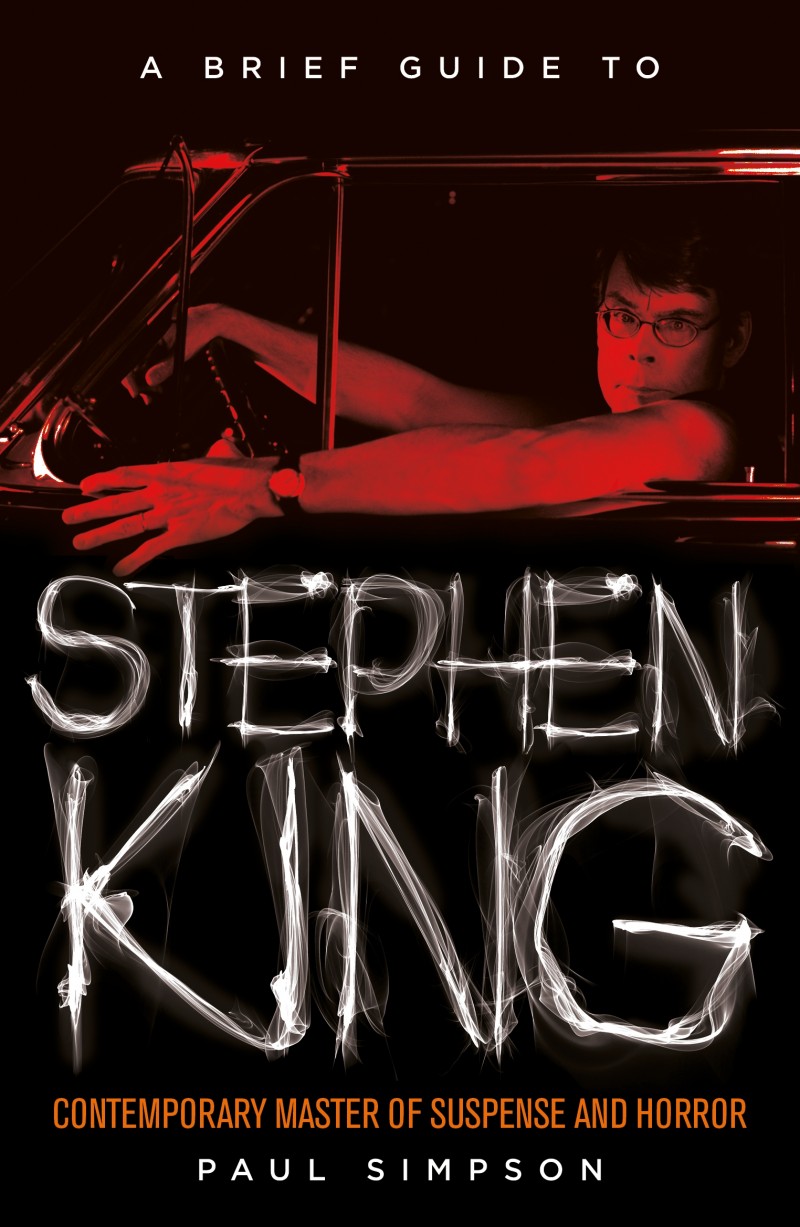
Don’t fret over the title of A Brief Guide to Stephen King, or the idea of the writer’s
gargantuan body of work being boiled down to a mere 265 pages. Paul Simpson’s
career overview may be brief, but it is satisfying. He covers every one of
King’s novels, novellas, short story collections, digital and other uncollected
stories, screenplays, and comic book scripts to date, as well as a nuts-and-bolts
biography and overview of select non-fiction work. Each entry includes a short
synopsis before getting to the goods with a pretty lengthy look at the tales’
genesis, the reactions it provoked, and adaptations it inspired (yes, that does
include the Shining porno spoof Naughty Little Nymphos 5). The structure
and content reminded me quite a bit of Marc Scott Zicree’s essential Twilight Zone Companion right down to
his refusal to hold back spoilers. Simpson is less critical though. Since he
clearly knows his King, it would have been nice if he’d provided a bit more
personal assessment for each title so that his book could also provide
recommendations better. For the most part, he remains neutral, allowing quotes
from the critics of the past—many of whom are most certainly not Stephen King
fans— to give each work the “yay” or “nay.” So you may just have to make up
your own mind about whether or not you should read about preteen sewer orgies
and shit weasels.
Thursday, October 10, 2013
Review: 'Crazy4Cult: Cult Movie Art 2'

If boring stuff like a pond of water lilies, some girl
wearing pearl earrings, and Jesus having dinner can inspire great works of art,
then who’s to say that awesome stuff like Rock
‘n’ Roll High School, Pee Wee’s Big
Adventure, and Twin Peaks: Fire Walk
with Me can’t do the same? Not me, brothers and sisters. In fact, some of
the most eye-bursting contemporary art you’ll see is compiled in Crazy4Cult: Cult Movie Art 2, Gallery
1988’s follow-up to their first installment published in 2011. Snobs expecting
to see a bunch of sub-tattoo-parlor smudges will be knocked out by the breadth
and technique on display in this collection, with pieces owing to the expected
comic book and graphic arts, but also splashing into photorealism, surrealism,
pop art, and Soviet art, as well as three-dimensional mixed-media, sculpted,
and plush works. The quality is as (for the most part) consistent as the styles and subject matter
are diverse. As Seth Rogen points out in his foreword, this is an art book for
people who usually don’t care too much about art. What he doesn’t note is that
it is also an art book for people who care deeply about art, and at this point
in history, anyone close-minded enough to not accept Monty Python and the Holy Grail, The Shining, or even Scott Pilgrim vs. The World—a lousy movie that still inspired some very
good pieces scattered across the six-page spread that concludes Crazy4Cult: Cult Movie Art 2— as viable
art topics has no business judging art in the first place.
Thursday, November 8, 2012
Review: 'The Stanley Kubrick Archives'
 Stanley Kubrick’s background as a still photographer was
fully apparent in his cinematic works. His images held up magnificently when
editor Alison Castle floated them from the screen to the pages of her 2004 book
The Stanley Kubrick Archives. These
shots “scanned directly from the film reels” constitute Part 1 of Castle’s
massive tribute to our most awe-striking filmmaker. She allows these iconic
images—Jamie Smith wielding a mannequin in Killer’s
Kiss, Sterling Hayden watching his fortune blow down a runway in The Killing, James Mason painting Sue
Lyons’s toes in Lolita, Slim Pickens
riding a bomb in Dr. Strangelove, the
moon and sun aligning with a looming monolith in 2001, the 50mm paintings of Barry
Lyndon, the blood-flooding elevator of The
Shining—to speak for themselves, reminding us of how the essence of
filmmaking is pictures not words and how often dialogue was unneeded in so many
of Kubrick’s most powerful scenes.
Stanley Kubrick’s background as a still photographer was
fully apparent in his cinematic works. His images held up magnificently when
editor Alison Castle floated them from the screen to the pages of her 2004 book
The Stanley Kubrick Archives. These
shots “scanned directly from the film reels” constitute Part 1 of Castle’s
massive tribute to our most awe-striking filmmaker. She allows these iconic
images—Jamie Smith wielding a mannequin in Killer’s
Kiss, Sterling Hayden watching his fortune blow down a runway in The Killing, James Mason painting Sue
Lyons’s toes in Lolita, Slim Pickens
riding a bomb in Dr. Strangelove, the
moon and sun aligning with a looming monolith in 2001, the 50mm paintings of Barry
Lyndon, the blood-flooding elevator of The
Shining—to speak for themselves, reminding us of how the essence of
filmmaking is pictures not words and how often dialogue was unneeded in so many
of Kubrick’s most powerful scenes.
Monday, September 17, 2012
Review: 'Horror Films of the 1980s'

Yet there is the occasional disconnect between his star ratings and his analyses. His four-star write-up of Fatal Attraction briefly prefaces the film as “brilliant” before launching into an extended finger-wagging session aimed at its “shameful” and “despicable” agenda. We get no sense of what is allegedly “brilliant” about this movie aside from its ability to manipulate the audience, which may make for a brilliant con man but not necessarily a brilliant film. Perhaps Muir based his star ratings on his uncritical enjoyment of the films while saving his more impartial insights for the reviews. It’s a little confusing though.
There are some strange entry choices too— this is certainly the first time I’ve ever seen the Coen Brothers’ Blood Simple studied as a horror film—but when you’ve read enough about horror, you come to realize how subjective its definition can be. Like any critical collection, Horror Films of the 1980s is ultimately subjective despite instances like the Fatal Attraction entry discussed above, but Muir balances that nicely by including other perspectives of these films. Each entry is introduced with a selection of period review excerpts and new ones written by his fellow critics and horror fanatics. The juxtapositions can be really fascinating, as when an assortment of terrible and glowing reviews lead into the entry on The Shining. Today it’s easy to forget that this classic—and its creator, Stanley Kubrick—were not always universally revered. It’s also easy to forget that Reagan— that pioneer of contemporary extreme conservatism— swelled the federal government, the number of American’s living in poverty, and the national debt, as Muir reminds us. Often, Horror Films of the 1980s is just as valuable as a history lesson as it is an appraisal of horror movies, and it’s praiseworthy for that reason too. In fact, it might be a good book to buy for kids who can’t stomach cracking that social studies text.
Friday, September 2, 2011
Psychobabble’s 200 Essential Horror Movies Part 7: The 1980s
In this feature, Psychobabble creeps through 100 years of horror cinema to assemble a highly personal list of the genre’s 200 most monstrous works, decade by decade.

(Updated in September 2021)
122. The Shining (1980- dir. Stanley Kubrick)

(Updated in September 2021)
122. The Shining (1980- dir. Stanley Kubrick)
Sunday, July 25, 2010
January 8, 2010: Five Classic Monster Movies for a Snowy Day
I don’t know where you are, but here in Jersey City, there’s a thin layer of snow on the ground. While this is hardly the product of some punishing blizzard, it’s still early in the season, and if the amount of snow we’ve gotten so far is any indication, this is going to be another snowy winter. That means there will be plenty of opportunities to watch some snowbound monster flicks.
Watching a film that captures the desolation of a snow-swathed landscape or the paranoia of being snowbound as a winter storm rages outside your window really heightens the horror of such a film. It’s like watching a haunted house flick in an actual haunted house. Here are five classic monster movies you might consider watching today or the next time your area gets the business end of a blizzard.
1. The Invisible Man (1932)
The first sound monster film to really take advantage of snowy landscapes is James Whale’s masterful adaptation of H.G. Wells’s The Invisible Man. Snow plays a rather practical role in the film: without it, the cops wouldn’t stand a chance of capturing a creature who can only be detected via his footprints, therefore there would be no sense of risk. And let’s face it: Whale wants us to identify with Claude Rains’s Dr. Griffin, who is simply bursting with malevolent mischievousness and nasty humor, not the dull cretins who would foil his diabolical plans to “rule the world…” to “rob and rage and kill!” Still, I’ve always wondered why Griffin doesn’t just die of the flu long before the end of the picture, since he spends so much time running around in the snow buck naked.
2. The Abominable Snowman (1957)
Released just a few months after The Curse of Frankenstein, Val Guest’s The Abominable Snowman was only the second genuine monster movie produced by Hammer Studios. As such, it is quite a different beast from the colorful Gothic horror pictures for which the studio was best known, yet its minimalism and the bleakness of its Himalayan setting make it no less creepy. There is also a subtlety and poetry to The Abominable Snowman that is lacking in some of Hammer’s more lavish productions. Studio mainstay Peter Cushing and Forrest Tucker play scientists on a quest to find the fabled snow creature, who has been leaving his size-18 footprints all over the surrounding area. While the creature is not among Hammer’s more expertly executed creations, the film provides one of the studio’s most intriguingly sensitive denouements.
3. The Shining (1980)
Stephen King was no fan of Stanley Kubrick’s The Shining, but fans know that it is not only the greatest adaptation of King’s work, but it’s also the ultimate snowbound horror film. We can debate whether or not Jack Nicholson was the right choice to play a character who is supposed to go mad gradually, rather than come off like a wacko right out of the gate (which was King’s main gripe about the movie), but The Shining is still a masterpiece of palpable cabin fever. Notice how the snowy environment incrementally devolves from the picturesque-quality of the opening sequence, as Jack Torrance (Nicholson) and his little family head to the cursed Overlook Hotel, to the more blanched-out haze seen when son Danny (creepy Danny Lloyd) and wife Wendy (frantic Shelley Duvall) go for a pleasant walk in the hedge-maze to ultimate darkness and overwhelming nothingness when Torrance goes completely off his rocker and hunts his son through that maze at the picture’s climax. As is the case with a few other Kubrick films (2001, Eyes Wide Shut…), the environment is just as much of a character in the picture as any of the humans, and while The Overlook may be the most obvious environmental character in The Shining, the snow-laden world that surrounds it is an equally complex and terrifying entity.
4. John Carpenter’s The Thing (1982)
Howard Hawks’s 1951 sci-fi monster picture The Thing From Another World is generally rated as one of the great films of its ilk, but I actually prefer John Carpenter’s 1982 remake in spite of my yen for all things really, really old. With its cast of grizzled, hard-drinking, tough-talking dudes, John Carpenter’s The Thing is as much a macho action movie as it is a monster picture, but a suffocating air of doom ensures that the picture’s true agenda is to horrify. The ostensible enemy in the film is a grotesquely metamorphosing alien that can take the shape of any living thing it sees, which exacerbates the trigger-happy paranoia of the research team quarantined at a station in Antarctica. However, the barren environment is just as formidable as the monster bumping off the men (and causing them to bump off each other). As the picture reaches its cynical, hopeless conclusion, that unforgiving tundra seems like it will be the beast that will wipe out humanity for good.
5. Gremlins (1984)
In contrast to the grim landscapes present in most of the other movies on this list, the environment in Joe Dante’s Gremlins is a winter wonderland straight out of a Courier and Ives print. Placing the demonic, havoc-raising gremlins in such a pleasantly bucolic location is fully in-step with the film’s ironic tone, and the Christmas setting provides plenty of opportunities for grotesque set-pieces: the gremlins going door-to-door to shriek shrill carols, a dog strung up in Christmas lights, the beasties swarming a hapless dude in a Santa suit, Phoebe Cates’s positively awful story about how her father croaked after jamming himself in his own chimney while playing Santa for his kids. And, lest we forget, Gizmo, the fluffy little thing responsible for much of this violent mayhem, was, itself, a Christmas gift.
Watching a film that captures the desolation of a snow-swathed landscape or the paranoia of being snowbound as a winter storm rages outside your window really heightens the horror of such a film. It’s like watching a haunted house flick in an actual haunted house. Here are five classic monster movies you might consider watching today or the next time your area gets the business end of a blizzard.
1. The Invisible Man (1932)
The first sound monster film to really take advantage of snowy landscapes is James Whale’s masterful adaptation of H.G. Wells’s The Invisible Man. Snow plays a rather practical role in the film: without it, the cops wouldn’t stand a chance of capturing a creature who can only be detected via his footprints, therefore there would be no sense of risk. And let’s face it: Whale wants us to identify with Claude Rains’s Dr. Griffin, who is simply bursting with malevolent mischievousness and nasty humor, not the dull cretins who would foil his diabolical plans to “rule the world…” to “rob and rage and kill!” Still, I’ve always wondered why Griffin doesn’t just die of the flu long before the end of the picture, since he spends so much time running around in the snow buck naked.
2. The Abominable Snowman (1957)
Released just a few months after The Curse of Frankenstein, Val Guest’s The Abominable Snowman was only the second genuine monster movie produced by Hammer Studios. As such, it is quite a different beast from the colorful Gothic horror pictures for which the studio was best known, yet its minimalism and the bleakness of its Himalayan setting make it no less creepy. There is also a subtlety and poetry to The Abominable Snowman that is lacking in some of Hammer’s more lavish productions. Studio mainstay Peter Cushing and Forrest Tucker play scientists on a quest to find the fabled snow creature, who has been leaving his size-18 footprints all over the surrounding area. While the creature is not among Hammer’s more expertly executed creations, the film provides one of the studio’s most intriguingly sensitive denouements.
3. The Shining (1980)
Stephen King was no fan of Stanley Kubrick’s The Shining, but fans know that it is not only the greatest adaptation of King’s work, but it’s also the ultimate snowbound horror film. We can debate whether or not Jack Nicholson was the right choice to play a character who is supposed to go mad gradually, rather than come off like a wacko right out of the gate (which was King’s main gripe about the movie), but The Shining is still a masterpiece of palpable cabin fever. Notice how the snowy environment incrementally devolves from the picturesque-quality of the opening sequence, as Jack Torrance (Nicholson) and his little family head to the cursed Overlook Hotel, to the more blanched-out haze seen when son Danny (creepy Danny Lloyd) and wife Wendy (frantic Shelley Duvall) go for a pleasant walk in the hedge-maze to ultimate darkness and overwhelming nothingness when Torrance goes completely off his rocker and hunts his son through that maze at the picture’s climax. As is the case with a few other Kubrick films (2001, Eyes Wide Shut…), the environment is just as much of a character in the picture as any of the humans, and while The Overlook may be the most obvious environmental character in The Shining, the snow-laden world that surrounds it is an equally complex and terrifying entity.
4. John Carpenter’s The Thing (1982)
Howard Hawks’s 1951 sci-fi monster picture The Thing From Another World is generally rated as one of the great films of its ilk, but I actually prefer John Carpenter’s 1982 remake in spite of my yen for all things really, really old. With its cast of grizzled, hard-drinking, tough-talking dudes, John Carpenter’s The Thing is as much a macho action movie as it is a monster picture, but a suffocating air of doom ensures that the picture’s true agenda is to horrify. The ostensible enemy in the film is a grotesquely metamorphosing alien that can take the shape of any living thing it sees, which exacerbates the trigger-happy paranoia of the research team quarantined at a station in Antarctica. However, the barren environment is just as formidable as the monster bumping off the men (and causing them to bump off each other). As the picture reaches its cynical, hopeless conclusion, that unforgiving tundra seems like it will be the beast that will wipe out humanity for good.
5. Gremlins (1984)
In contrast to the grim landscapes present in most of the other movies on this list, the environment in Joe Dante’s Gremlins is a winter wonderland straight out of a Courier and Ives print. Placing the demonic, havoc-raising gremlins in such a pleasantly bucolic location is fully in-step with the film’s ironic tone, and the Christmas setting provides plenty of opportunities for grotesque set-pieces: the gremlins going door-to-door to shriek shrill carols, a dog strung up in Christmas lights, the beasties swarming a hapless dude in a Santa suit, Phoebe Cates’s positively awful story about how her father croaked after jamming himself in his own chimney while playing Santa for his kids. And, lest we forget, Gizmo, the fluffy little thing responsible for much of this violent mayhem, was, itself, a Christmas gift.
Subscribe to:
Posts (Atom)