

Psychobabble: For Groovy Ghouls & Retro Rockers.
Showing posts with label Alfred Hitchcock. Show all posts
Showing posts with label Alfred Hitchcock. Show all posts
Wednesday, October 12, 2022
Review: 'Horror Hotel' DVD


Monday, December 14, 2020
Review: 'Film Noir Style: The Killer 1940s'

Kimberly Truhler surveys film noir style in her new book Film Noir Style. This is more than an analysis of the costumes the actors wore in films such as The Postman Always Rings Twice and Gilda, though it is that. Truhler occasionally discusses how lighting, set design, and camera angles fashioned the instantly identifiable noir aesthetic.
Sunday, January 13, 2019
Review: 'Notorious' Blu-ray

Eight months after the end of World War II, Alicia
Huberman’s dad is convicted of spying on the U.S. for the Nazis. An agent named
Devlin recruits her to infiltrate the home of her dad’s pal Alex Sebastian, a
Nazi industrialist hiding out in Rio who has long carried a torch for Alicia. Since
Ingrid Bergman plays Alicia and Cary Grant is Devlin, they’re just too damned
good looking to keep their hands off of each other, and the budding romance
complicates her dangerous liaison with Alex, played by a unsettlingly
sympathetic Claude Rains.
This bizarre love triangle is the backbone of Alfred
Hitchcock’s Notorious. Without the
Gothic feverishness, luridness, wild set pieces, or high adventure of
Hitchcock’s most celebrated work, Notorious
may stand as his most low-key and adult film. Grant even suppresses his usually
uncontainable charm to play Devlin as a cold fish whose actual motivations do
not become clear until the very end of the film. All of this does not render Notorious similarly chilly. Hitchcock
still manages to electrify his imagery with flashes of disorienting camerawork
and wrings classic moments of suspense out of such subtle actions as a palmed
key and a dwindling champagne supply. However, it is Bergman who really ignites
the atmosphere. She was rarely better than she is here as a fierce alcoholic
determined to outpace her father’s reputation but ends up as a pawn in a
potentially fatal scheme.
The Criterion Collection is now giving Notorious a 4k upgrade, and the film looks good with a natural grain
and no noticeable flaws. At times sharpness and contrast are a tad weak, but
the picture looks very fine overall. The supplements constitute a veritable
crash course in cinema studies. Chief among them is David Thompson’s 2009
documentary Once Upon a Time… “Notorious”,
which spends 52-minutes analyzing the filmmaking, describing making of details,
and placing the picture in historical/political context…some of which will
require a very strong stomach as it includes actual concentration camp footage.
There are also plenty of new exclusives, such as David Bordwell’s video essay
focusing on the film’s style and chillingly subtle ending, an interview with
cinematographer John Bailey on the look of the picture, and additional
featurettes starring Hitchcock’s biographer Donald Spoto and David Raim. There
is also an hour-long radio adaptation of Notorious
starring Ingrid Bergman and Joseph
Cotton, a very brief pathe reel featuring Bergman and Hitchcock, and Marian
Keane’s audio commentary ported over from Criterion’s 2001 DVD.
Monday, October 29, 2018
Psychobabble’s 31 Favorite Universal Horrors: #3
Halloween season simply
isn’t Halloween season without a regular dose of golden age Universal horror
(1923-1963). Every day this October, I’ll be giving you a steady IV drip of it
by counting down Psychobabble’s 31
Favorite Universal Horrors!
#3. Psycho (1963-
dir. Alfred Hitchcock)
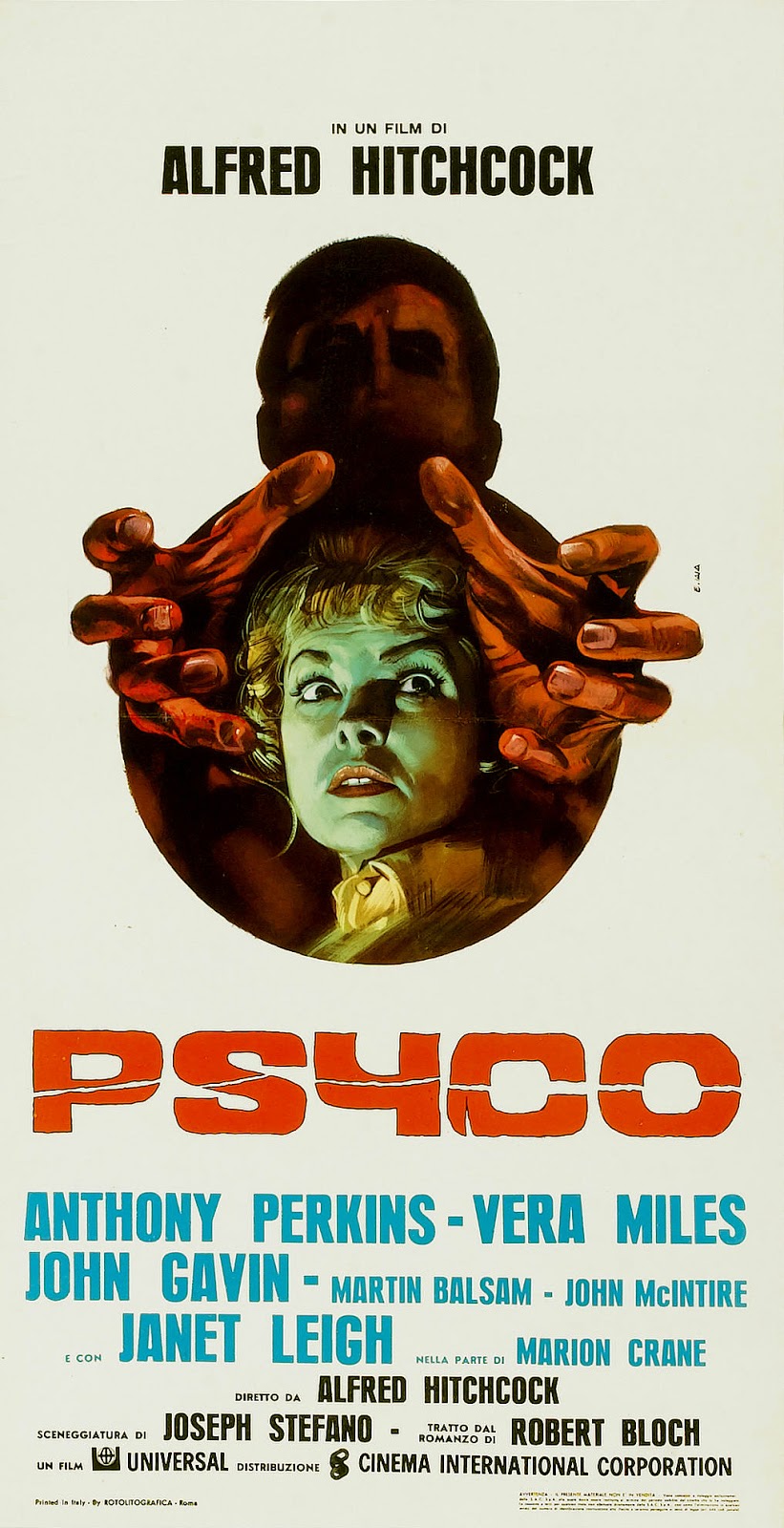
As I said in my discussion of The Birds a few days ago, Hitchcock’s horrors of the early sixties didn’t
as much wrap up an age of horror as they launched a new one. With the possible
exception of Franju’s gory Le yeux sans
visage, Psycho was the ultimate
shot across the bow for horror’s new age. After subsisting on years of
vampires, ghosts, giant spiders, and other humbugs, 1960s audiences must have
been utterly rattled by this unsparing portrait of a human monster. The film’s
sexuality, the viciousness of the attacks, the grotesqueness of Mother’s
corpse, and the sympathetic way Norman Bates is presented surely reconfigured
the minds of movie audiences and made them capable of digesting even hardier stuff
such as Night of the Living Dead, A Clockwork Orange, and The Exorcist. Hitchcock maximizes his
film’s shocks with tricky, bait-and-switch storytelling, and Anthony Perkins
aids and abets that assault with his completely ingratiating portrayal of
Norman Bates. As far as I’m concerned, horror cinema’s two greatest decades are
the 1930s and 1960s, and Universal was responsible for setting both of them in
motion.
Thursday, October 25, 2018
Psychobabble’s 31 Favorite Universal Horrors: #7
Halloween season
simply isn’t Halloween season without a regular dose of golden age Universal
horror (1923-1963). Every day this October, I’ll be giving you a steady IV drip
of it by counting down Psychobabble’s
31 Favorite Universal Horrors!
#7. The Birds
(1963- dir. Alfred Hitchcock)

Hitchcock’s horrors of the early sixties really mark the
beginning of a new age of horror distinct from the days of Dracula,
Frankenstein, The Wolf Man, and The Gill Man. They are utterly contemporary,
psychologically complex, graphically violent, and overtly sexual. In the case
of The Birds, Hitchcock’s brand of
horror is also very colorful. Because of its complete cinematic sophistication,
it may be a little unfair to rank The
Birds against most of the other movies in this series, but it does deserve
a place here. Hitchcock was a shit, and it’s hard to find Melanie Daniels’s
terror entertaining knowing what we know about what the director put Tippi
Hedren through, but his artistry is unassailable. The playground, children’s
party, and yes, attic sequences constitute a master’s class in establishing
suspense, delivering terrifying action, editing, sound, acting, and everything
else that goes into making a superior horror movie. The Birds is one of the most superior of all.
Monday, October 23, 2017
5 Superior Adaptations of Horror Lit
Adapting literature for the cinema is always tricky, and
this can be especially true when dealing with stories intended to raise
shivers. What is terrifyingly evocative on the page can flop like a sack of wet
leaves when realized with a dude in a zip-up monster suit on screen. Acts
unimaginably awful when described cease to play on the imagination when
depicted with a rubber knife and karo-syrup blood. Some of horror’s greatest
literary works, such as “The Legend of Sleepy Hollow”, It, and I Am Legend, have
never received ideal screen adaptations. Some page-to-screen trips have been
more lateral with stories such as Frankenstein
and Dracula offering very different
yet equally essential elements when turned into movies or ones such as The Haunting of Hill House and Rosemary’s Baby being faithful enough to
be genuine cases of “six of one/half dozen of another.” On occasion, a film
goes above and beyond, reinventing the story upon which it is based in ways
that make the original text virtually irrelevant. Here are five of those
superior horrors.
Friday, October 21, 2016
31 TV Shows for 31 Days of Halloween Season: Day 21

Episode: “Final
Escape”, in which Season Hubley plays a convicted murder who plots a foolproof
escape that involves hiding in a coffin and getting buried in the prison
graveyard. Ha! Most of the shows featured in 31 TV Shows for 31 Days of Halloween Season have some sort of
supernatural angle, but “Final Escape” may be the scariest of them all because
of its realism. The final image will give you nightmares even if you see it
coming. Hubley sure didn’t.
Sunday, October 9, 2016
31 TV Shows for 31 Days of Halloween Season: Day 9

Episode: “The
Jar”, in which a good ol’ boy buys a jar containing a mysterious object at a
carny show and become a local celeb when all his friends and neighbors swarm to
his house to take a gander at the bizarre thing. The Alfred Hitchcock Hour
usually delivered clever, twisty murder mysteries, but “The Jar” is kind of
something else. Directed by Norman Lloyd (who played the weasley title character
in Hitchcock’s Saboteur), its story
and execution are much weirder than usual. Lloyd’s queasy blend of the farcical and
the utterly grotesque make it something special and the ideal hour for
Halloween season.
Thursday, September 29, 2016
366 Days at the Drive-In: Day 365

The Movie: The Wrong Man (1956)
What Is It?: Although
it explores the director’s pet topic to the point that its title basically
translates to Generic Alfred Hitchcock Movie, The Wrong Man is one of Hitch’s
more unusual films because it is based on a true story and manages more
sympathy for its characters than his usual brilliant exercises in style do.
Really, there are no more heartbreaking people in the Hitchcock cannon than
Manny Balestrero (Henry Fonda), a bass player wrongfully accused of being a
“hold up man” (I can’t help but find that designation hilarious and wonder if
there is a less awkward term for someone who holds places up), and his wife
Rose (Vera Miles), who loses her grip on reality while going through the ordeal
of her husband’s incarceration and trial. Wrenching stuff.
Why Today?: On
this day in 1909, the real Manny
Balestrero is born.
Wednesday, June 29, 2016
366 Days at the Drive-In: Day 273

The Movie: Vertigo (1958)
What Is It?:
Fear-addled Jimmy Stewart is made to believe that Kim Novak has been possessed
by the ghost of a woman named Carlotta Valdes. This proves a ruse, but it
allows Hitchcock to indulge in a sort of California-Gothic sensibility. Stewart’s
acrophobic episodes (his vertigo doesn’t seem as acute, but I guess Acrophobia isn’t a very catchy movie
title) are made horrific with Hitchcock’s distorted camera effects. His
psychedelic nightmare is like something from one of Roger Corman’s Poe pictures
and Bernard Herrmann’s score is disorienting and romantic.
Why Today?: On
this day in 1911, Bernard Herrmann is
born.
Saturday, May 14, 2016
366 Days at the Drive-In: Day 227

The Movie: Strangers on a Train (1950)
What Is It?: Robert
Walker meets Farley Granger on a train and wants to do a little criss-cross.
Dim, dim Granger does not realize that means swapping murders. A-doy! One of
Hitchcock’s nastiest and funniest movies, and daughter Pat Hitchcock is priceless as
the little sister of Granger’s fiancé.
Why Today?: Today
is National Train Day.
Monday, April 18, 2016
366 Days at the Drive-In: Day 201

The Movie: Shadow of a Doubt (1943)
What Is It?: Hitchcock
named this disturbing story of a beloved uncle who turns out to be not-so-great
as his favorite of his own films. Teresa Wright and Joseph Cotton are brilliant
as a niece/uncle team with a pretty strange bond.
Why Today?: The
railway station in the film’s climax was one of the few structures to survive
the earthquake of April 18, 1906.
Sunday, January 31, 2016
366 Days at the Drive-In: Day 123

The Movie: Lifeboat (1944)
What Is It?: Alfred
Hitchcock makes his first great gimmick picture by dropping the divine Tallulah
Bankhead, William Bendix, Hume Cronyn, Henry Hull, Walter Slezak, and the rest (sung to the tune of
“Gilligan’s Island”, of course) into a lifeboat for 96 minutes and seeing what
happens. There’s a definite reality-show dynamic going on here as the survivors
of a U-boat attack decide whether or not to vote Slezak off the boat. Look out
for Hitch’s requisite cameo in a diet-pill ad!
Why Today?: On
this day in 1902, Tallulah Bankhead is
born.
Monday, January 18, 2016
366 Days at the Drive-In: Day 110

The Movie: North by Northwest (1959)
What Is It?: In
the midst of his darkest run of movies (Vertigo
through Marnie), Hitch has a lot of
fun by running Cary Grant through a mistaken-identity gauntlet of kidnapping,
drunk driving, cornfield stalking, and Mt. Rushmore climbing.
Why Today?: On
this day in 1904, Cary Grant is
born.
Tuesday, January 5, 2016
366 Days at the Drive-In: Day 97

The Movie: The Birds (1963)
What Is It?: The
petty problems of a spoiled debutante and a condescending mama’s boy cease to
matter when our fine feathered friends start trying to peck their and
everyone’s eyes out. A moment of psyche-scarring horror occurs when they
succeed.
Why Today?: Today
is National Bird Day.
Saturday, December 12, 2015
366 Days at the Drive-In: Day 73

The Date:
December 12
The Movie: Psycho (1960)
What Is It?: Janet
Leigh is Marion Crane, a secretary charged with depositing a $40,000 real
estate deposit in the bank. Marion decides to make off with the cash, but she
has a change of heart before taking a shower. Honestly, I can’t remember what
happens after that.
Why Today?: This
is the date that Marion Crane takes her shower.
Sunday, November 29, 2015
366 Days at the Drive-In: Day 60

The Movie: Suspicion (1941)
What Is It?: Alfred
Hitchcock’s kooky noir flummoxes expectations by casting Cary Grant as a
potential creep who may be plotting to moider perpetually anxious Joan
Fontaine. That glowing glass of milk is certainly suspicious…
Why Today?: On
this day in 1986, Cary Grant dies.
Thursday, November 12, 2015
366 Days at the Drive-In: Day 43

The Movie: Rear Window (1954)
What Is It?: Hitchcock’s
most satisfying formal experiment locks Jimmy Stewart in an apartment and leg
cast for two hours, allowing Grace Kelly to embody the film’s adventurous
spirit. The backyard set is one of cinema’s most enchanting.
Why Today?: On
this day in 1929, Grace Kelly born.
Sunday, January 25, 2015
Review: 'The Bride Wore Black' Blu-ray

When The Bride Wore
Black (based on a novel by William Irish, who also wrote “It Had to Be
Murder”, which Hitch adapted into Rear
Window) begins by showing generally mundane images set to Bernard Herrmann’s overwhelming
and overwhelmingly recognizable score, it’s as if
Truffaut is trying to shove a signifier of Hitchcock’s most melodramatic scenes
into scenes nearly devoid of melodrama despite the fact that the woman on
screen tries to kill herself at one point.
That woman is Julie Kohler (Jeanne Moreau), who soon sets
about her own obsessive mission by insinuating herself into the lives of
various men and killing them. Her motive remains a mystery for a quarter of the
film, but since the title of the movie is The
Bride Wore Black, I don’t feel like I’m spoiling too much by saying she’s
on a mission of revenge against the creeps she blames for her groom’s death.
While Truffaut seems to drop clues about his movies’ apparent
main influence (we see such locations of iconic Hitchcock scenes as a
schoolyard, a speeding train, and a concert hall), Julie differs from the mass
of Hitch’s charming main characters because she is a husk (it is telling that
she shares a surname with the similarly emotion-drained title character of Shoot the Piano Player). She carries on with her grim mission devoid of
emotion, something that could not be said of even sketchy characters like
Norman Bates and Marnie Edgar. This means The
Bride Wore Black is not as fun to watch as your average Hitchcock movie,
but maybe revenge, murder, and soul-destroying grief are not supposed to be fun
(or maybe they are—just see how Quentin Tarantino reshaped this movie’s premise
into Kill Bill). It is, however, a
suspense film worthy of the master when obstacles such as an unexpected visit
from a redheaded model, a sweet little boy, and even the possibility that she
may have found a new love fall into Julie’s vengeful path. These are the film’s
most powerful moments.
I’ve been wanting to see The
Bride Wore Black ever since I saw Kill
Bill ten years ago. It’s finally available on blu-ray via Twilight Time,
and in a beautiful transfer with strong blacks, strong color (though this is not
a strikingly colorful movie), and strong grain. Supplementing the film
(presented in both subtitled and English dubbed versions—the dubbed one
contains different musical cues) is a commentary by film historians Julie Kirgo
and Nick Redman and Herrmann biographer Steven C. Smith. Smith’s presence puts a
lot of the focus on the score, and he discusses the clashes between Hermann and
Truffaut over the director’s choices in this film—as well as Herrmann’s clashed
with Hitchcock. Kirgo tries to pull the focus away from Hitchcock, whose
influence she does not see as strongly in the film as a lot of other commentators
do, and discusses the more meaningful role gender dynamics play in the film. There
is also a supplementary CD featuring a 79-minute interview with Bernard Herrmann
that spotlights the composer’s short temper. The blu-ray disc’s isolated score
track spotlights his art.
Get The Bride Wore
Black on Screenarchives.com here.
Thursday, March 20, 2014
Review: 'A Companion to Alfred Hitchcock'

Although Thomas Leitch and Leland Poague don’t dare say as
much in their introduction to A Companion
to Alfred Hitchcock, they certainly seemed to have compiled their essay
anthology to be a sort of final word on Hitchcock scholarship. Now this is no
more likely than the idea that Mark Lewisohn’s sprawling All These Years series will put an end to Beatles books, but there
is a similar sweeping scope to A
Companion that could keep a lot of students from bothering with another
Hitchcock study.
Our two editors are well aware of all the other anthologies
on the market and selected their essays accordingly. There have already been ample
discussions of Hitchcock’s macguffins and his storyboarding and his theories
about suspense vs. surprise and his cynicism, misogyny, and so on. Any new
volume can only serve its purpose by approaching this well-exhausted topic in
fresh ways without overreaching. A satisfying number of the thirty essays
contained in A Companion to Alfred
Hitchcock accomplish that, as when Lesley Brill counters the usual
accusations of cynicism by convincingly repainting Hitchcock as a romantic both
in his treatment of love and his charming reliance on fairy tale structure.
Richard Allen reaches beyond the usual noir suspects to look at the director’s
influence on less recognized followers, such as Last Year at Marienbad, Blow
Up, The Tenant, Something Wild, and Jurassic Park. In general, the writers also do a decent job of looking beyond the most over-analyzed Hitchcock films (Vertigo, Psycho, The Birds, etc., which are well-represented here too) and into such relative obscurities as The Pleasure Garden, I Confess, and The Lodger, making for a fuller picture of his work than we often receive. Teachers and students
alike will find much to keep themselves busy in A Companion to Alfred
Hitchcock... at least until the next heavy-duty study of his work arrives.
Subscribe to:
Posts (Atom)