Showing posts with label Batman. Show all posts

Monday, May 19, 2025

Review: 'Stupid TV, Be More Funny: How the Golden Era of The Simpsons Changed Television-And America-Forever''


When a schoolmate convinced me that The Simpsons was more than just some fad prime-time kid's cartoon/T-shirt sales device, and I actually watched the show, I was hooked and I was amazed. Even three decades later, having watched all of the episodes from its eight-season "golden age" countless times, The Simpsons still seems like magic to me. How did the writers pack so many jokes into those first 178 episodes? How did the rhythm seemingly never go slack (especially when we're talking about seasons 2 through 7)? How did it pile in so much wit, originality, and genuine hilarity when every other comedy on TV was lucky to squeak out a couple of good laughs over the course of an entire season? Were its writers some sort of alien beings like Kang and Kodos? Had they been enchanted like some sort of pacifier-producing monkey's paw? Were they the biggest men in the world and covered in gold...14-karat gold?

Wednesday, August 21, 2024

Review: 'Zowie!: The TV Superhero Craze in '60s Pop Culture'

Crashing into a Gilligan-and-Jeannie-populated TV scene too dumb to fully recognize how dumb it was, Batman dropped a big load of camp--distinct from Gilligan and Jeannie's kitsch--onto TV screens. Whether you were a hyperactive six year old or a hyper-hip sixteen year old, Batman had appeal, doing dual work as a sincere superhero adventure and a genuine and genuinely funny comedy at a time when such things simply didn't exist on American television. 

Tuesday, June 6, 2023

Review: 'Cliffhanger! Cinematic Superheroes of the Serials: 1941-1952'

Well before superheroes became staples of feature films, or even TV shows like the Superman series of the fifties or the Batman one of the sixties, muscled men in tights most regularly appeared on screen in matinee serials. Both Superman and Batman got their live-action starts in serials. So did future TV and movie stars such as Captain Marvel, Captain America, Flash Gordon, and Dick Tracy. It was a very sensible way to bring these characters to the screen, as the short, action-packed, cliffhanger-beholden structure of a serial episode was pretty similar to that of a comic issue. 

Friday, November 4, 2022

Review: Prince's 'The Hits 1' and 'The Hits 2' Vinyl Reissues

In 1993, Prince's relationship with Warner Brothers Records began to sour, he changed his name to an unpronounceable glyph, and frankly, began nearing the end of his most artistically and commercially vital era. To commemorate the transition, WB put out two compilations simply and accurately titled The Hits. After sixteen years of record making, Prince certainly had enough hits to pack two CDs. There wasn't even room for his number one smash "Batdance", possibly because of rights issues tied to the Batman movie or possibly because it's the weirdest song ever to hit Billboard's number one spot (contrary to popular opinion, it's also awesome).

Sunday, October 16, 2022

Review: 'The Team-Up Companion'

In 1954, DC halved the page count of its World's Finest Comics and forced Superman and Batman into the same book as if they were a couple of recently divorced bozos sharing a flat. They mostly kept to their own sides of the room, but a new format was inadvertently born: the team-up. This was distinct from crossovers or guest appearances because both heroes were on equal footing in a shared title with both their logos on display. Pretty soon, team ups of everyone from Green Arrow and Martian Manhunter to Supergirl and Wonder Woman to Aqualad and Robin to Richie Rich and Casper to Spider-Man and Dracula (!) began proliferating funny books. 

Friday, March 18, 2022

Review: 'Batman: The Ultimate Guide (New Edition)'

With yet another Batman movie being the most hyped new release, it is a fine time to get more new Bat-product onto shelves. Although Batman: The Ultimate Guide is apparently not 100% new since it is an update of a book originally published in 2001 (though, it must be pretty different since it was written by a totally different author and details a lot of Bat business that went down in the past twenty years), and it is only an ultimate guide if we forget that Batman has had a very active life off of comics pages (which would require some sort of Hugo Strange brain-eraser thingy), it is still a neat, if brief, trip through 80-something years of Batmania. 

Author Matthew K. Manning had a potentially difficult task in distilling Batman's many, many, many iterations in the comics down to a history that could fit on 200 image-crowded pages. He included profiles of the Batmobile, the Batcostume, the Batcave, the Justice League, and Gotham City,  as well as various friends, foes, and love interests. There are a few profiles of key comic issues with synopses and illustrative panels. There's a spread on that time Green Lantern turned Batman into a zombie. I even learned a few things (I had no idea False-Face appeared in the comics in 1958 and was not an invention of the sixties TV-series), but the book's main draw is it's colorful, spectacular, and varied rogue's gallery of images.

Wednesday, May 19, 2021

Review: 'Underexposed! The 50 Greatest Movies Never Made'

Films that stall out before production have always held an allure for cineastes. What might have been if Hammer Films really had made that adaptation of Vampirella starring Barbara Leigh in the seventies? What if The Beatles really did star in an adaptation of The Lord of the Rings for Stanley Kubrick? What if the Stones played the droogs in a Kubrick-less Clockwork Orange or if Robert Rodriguez had remade Barbarella with Rose McGowan or David Lynch and Mark Frost had made a zany Steve Martin/Martin Short comedy called One Saliva Bubble

Joshua Hull runs through 50 of these "what ifs" in Underexposed! The 50 Greatest Movies Never Made. The crypto-movies he discusses are always most interesting when there is sufficient details about what they would have entailed. An entry on Neill Blomkamp's Alien 5 is essentially pointless since Hull provides no information about the treatment or script aside from a description of a few pieces of concept art. When details are sparse, the author provides synopses of the attached filmmakers' movies that were actually produced, which doesn't really scratch the itch this book promises to scratch, and his pun-heavy text is an acquired taste. But when Hull relays sufficient details about a Tim Burton-era Batman sequel featuring Nicolas Cage as Scarecrow and Courtney Love as Harley Quinn, a William Dozier-era one in which Adam West's Batman and Yvonne Craig's Batgirl would have faced off against Godzilla, and Steven Soderbergh's proposed 3-D musical about Cleopatra with songs by Guided by Voices, Underexposed! earns its keep. 

The book's what-if poster art is generally very cool too, but it would have been even cooler if all of the artists had made an effort to recapture the poster art style of the given film's era as Dave O'Flanagan (the unproduced John Hughes romp Oil & Vinegar), Nick Taylor (David Cronenberg's pre-Schwarzenegger Total Recall), Rachael Sinclair (Vampirella), and Mary Levy (Batman vs. Godzilla) did.

Thursday, November 5, 2020

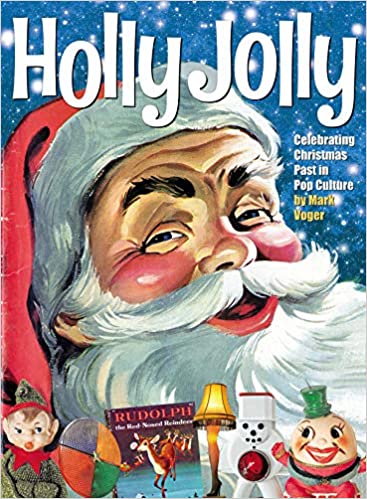
Review: 'Holly Jolly: Celebrating Christmas Past in Pop Culture'

John Waters once said, “If you don’t have yourself a merry little Christmas, you might as well kill yourself.” While I wouldn’t go quite that far, I do agree that there’s something pointlessly self-spiting about refusing the tinsely, tacky joys of Christmas. After all, are you really living if you deny yourself the pleasure of yucking it up when Ralphie nearly shoots his eye out with a Red Ryder BB gun? Are you really living if you don’t get a lump in your throat when Darlene Love wails “They’re singing ‘Deck the Halls,’ but it’s not like Christmas at all” or the Monkees harmonize like angels on “Riu Chiu”? Are you really living if you don’t ensconce yourself in pine and fairy lights every December?

I’ve been a stalwart atheist since my teens, and Christmas is the one vestige of a Catholic upbringing I still enjoy. Actually, I agree with seasonal-icon Charles Schulz, who once said, “I doubt very much that Christmas was ever a religious holiday in the first place.” The holiday was always more about the cartoon specials and very special episodes, pop songs and Scrooge movies, Coke and toy ads anyone can dig than magical mangers.

Thursday, April 16, 2020

Review: 'The World of Twomorrows: Celebrating 25 Years of the Future of Fandom'

In his introduction to The World of Twomorrows: Celebrating 25 Years of the Future of Fandom, Mark Evanier rewrites a quote from playwright George S. Kaufman to declare, “If you want to get revenge on a publisher, convince them there’s an audience out there for books and magazines about comic book history.”

Monday, September 23, 2019

Farewell, Sid Haig


The stars may get the asses in the theater seats, but it's often the weird character actors and actresses who make watching movies fun. Few character actors were weirder or more fun to watch than Sid Haig. 


After starting his entertainment career drumming with The T-Birds ("Full House", a tune that suggests Angelo Badalamenti found more than a little inspiration from it when he wrote the opening jitterbug for Mulholland Dr.), Haig settled into a long-run as a small and big screen fixture, and he has a special place in we Psychobabblers' hearts for his multitudinous roles in culty and horrory TV and films. The cat found a place in Batman as one of the few henchmen almost as colorful as the villain for whom he henched (the hilarious King Tut), Star Trek, The Man from U.N.C.L.E., the amazing Spider Baby, C.C. & Company, THX 1138, The Big Doll House, Coffy, The Six Million Dollar Man, Electra Woman and Dyna Girl, Mary Hartman Mary Hartman, Jason of Star Command (in which he starred as Jason's arch nemesis Dragos), Fantasy Island, Jackie Brown, a bunch of Rob Zombie movies, and well over 130 other things. 

While he was known for his over-the-top strangeness in these parts, Haig always came off as gracious, kind, and humble when discussing his lengthy career. Sadly, Sid Haig died of a lung infection this past Saturday. He was 80.

Tuesday, August 13, 2019

Review: 'American Comic Book Chronicles: 1940-1944'


The lingering aftermath of the Great Depression, a rise in organized crime, and especially, the country’s entry into World War II ensured that the early 1940s was a tumultuous time for the U.S. With such grim business rushing around them, many Americans found solace in escapist entertainment, and few entertainment mediums exploded as comics did between 1940 and 1944.

A timeline of this period is like a checklist of the most important developments in comics. These brief five years saw the debuts of Wonder Woman, The Flash, Green Arrow, Archie and his gang, Captain America, Sheena Queen of the Jungle, Hawkman and Hawkwoman, Sub-Mariner, Aquaman, Plastic Man, The Green Lantern, Captain Marvel, Dick Briefer’s Frankenstein, Pogo (before moving to newspapers), and many more of comics’ most celebrated characters. While we’d have to extend the timeline back just a year or two to include the medium’s two-most famous heroes, we would not have to in order to account for such foes and friends as Robin, The Joker, Catwoman, The Penguin, Alfred the Butler, Lex Luthor, Perry White, Clay Face, Hugo Strange, Scarecrow, and Two Face. This period also saw the first significant rumblings of a major backlash against funny books with Wonder Woman as the most frequent whipping-girl. Was there ever a more crucial half-decade for comics?

Interestingly, TwoMorrows Publishings’ American Comic Book Chronicles series has been issuing volumes for six years but is only now getting around to this key period of 1940-1944. Because so much happened during these years, the storytelling seems to rush through the material faster than a speeding bullet, but Kurt F. Mitchell and Roy Thomas actually make the tale reasonably thorough, reasonably critical, and politically sharp. Along with the cavalcade of legendary characters, the writers make room to name-check such forgotten oddballs as Supermouse, Kangaroo Man, super-witch Spider Widow, and Snowbird, the Strangler’s coke-addicted lackey. Mitchell and Thomas refuse to succumb to the thoughtless jingoism that defined so many of the comics of the era they cover. Like all volumes in this series, American Comic Book Chronicles: 1940-1944 is also a gorgeous, hardcover package, swelling with tons of full-color art beautifully and authentically reproduced.

Tuesday, March 12, 2019

Farewell, Hal Blaine


A session musician becoming a household name is almost unheard of, but the name "Hal Blaine" is probably as close as it comes. This is the guy who thumped out what may be the most iconic beat of all: the two bass hits/one snare snap that launched "Be My Baby". That startling moment is just one of many, many startling ones. 

The list of songs Blaine helped bring to life is absolutely staggering. He was responsible for scattering majestic fills all over Simon & Garfunkel's "America". He brought orchestral grandeur to Pet Sounds and SMiLE. He funked up The Monkees' "Mary Mary". He pummeled out those rolls that make Neal Hefti's "Batman Theme" go POW! That's him on Elvis's "Bossa Nova Baby", The Association's "Along Comes Mary", The Beach Boys' "Good Vibrations", Paul Revere and the Raiders' "Hungry", Love's "Andmoreagain", The Mamas and Papas' "Go Where You Wanna Go", The Crystals "Da Doo Ron Ron", The Byrds' "Mr. Tambourine Man", The Vogue's "You're the One"... the theme from Three's Company! Phil Spector and Brian Wilson would have been nowhere without Hal Blaine. By his own estimation, he played on some 6,000 tracks.

Blaine was also a big personality, as evidenced in the numerous documentaries to which he contributed his memories, such as The Wrecking Crew! and Beautiful Dreamer: Brian Wilson and the Story of SMiLE. Sadly, the world just lost that beat and that personality because Hal Blaine died at the age of 90 yesterday. You can't say the guy didn't live a full life though.

Wednesday, February 27, 2019

Review: The Joker: Talking Bust and Illustrated Book


Hmm…how do I review “The Joker: Talking Bust and Illustrated Book”? It is produced by publisher Running Press, which suggests I should approach this package as a book, though DC Comics historian Matthew K. Manning’s The Joker: Behind the Smile is no taller than my thumb, and by my estimate, approximately 7,000 words shorter than the Wikipedia page devoted to the Clown Prince of Crime. There are some nice pictures illustrating such milestones as The Joker’s debut in Batman #1, Bill Finger’s creation of an official back story in the classic Red Hood storyline, the Neal Adams years, the Frank Miller and Alan Moore years, Batman: The Animated Series, and a few twenty first century comics.


The real star of this package is a plastic Joker bust the height of my middle finger that says several Jokery phrases (in either Mark Hamill’s voice or a reasonable facsimile) at the push of a button. As just a book or just a collectible, there would not be much to say about this mini box set, but taken together for a fairly reasonable price, “The Joker: Talking Bust and Illustrated Book” makes a decent souvenir from your latest trip to Gotham.

Saturday, December 22, 2018

Psychobabble’s 12 Days of X-Mas Episodes: Day 9


Does the mere idea of stepping into another mall, watching It’s a Wonderful Life for the zillionth time, or talking to your loved ones make you throw up? Then settle your bowlful of jelly into the La-Z-Boy® and deck your hall with today’s installment of Psychobabble’s 12 Days of X-Mas Episodes instead! Merry vegetating!

Series: Batman: The Animated Series


Episode: “Christmas with the Joker”, in which the cartoon many consider to be the ultimate screen adaptation of the Dark Knight saga layers on the silliness as assuredly as it delivers the darkness. The animators and voice actor Mark Hamill have a blast bringing The Joker to life for the first time in the series. The Clown Prince of Crime does some fucked up things like kidnapping Commissioner Gordon, reporter Summer Gleeson, and sleazy Detective Bullock and vowing to slaughter them if Batman does not intervene by midnight on Christmas. But he also perpetrates some serious silliness when he breaks into a chorus of “Jingle Bells, Batman Smells”. I’ve always been fascinated with that song, which so tenaciously spread throughout the world without having an identifiable composer. A few years ago, Cracked.com attempted to ferret out the true origin of “Jingle Bells, Batman Smells”. You can read the article here.

Monday, December 10, 2018

Review: 'American Comic Book Chronicles: The 1990s'


Considering how forcefully comics have driven the pop culture of the twenty-first century, it is kind of amazing to review the state of the industry at the very end of the twentieth. Comics companies were stuck in a rut, catering to collectors rather than readers with cheesy “limited edition” stunts or pandering to audience’s basest instincts with brutal vigilante violence and bra-bursting sexism. Cinematic adaptations of The Phantom, Judge Dredd, Barb Wire, The Shadow, and Steel were sucking wind at the box office while The Flash could barely complete a single season on TV. Marvel, the company that practically holds a monopoly over the Hollywood of today, filed chapter 11. Comics sales as a whole slumped.

However, the nineties was also the decade when comics buying went totally mainstream as the tale of Superman’s (extremely temporary) demise flew off shelves and his romance with Lois Lane (by way of Teri Htacher) lit up small screens. It was when Batman did more than very well in theaters and shook up the state of TV cartoons with his Animated Series. It was the decade that saw the debuts of such innovations as The Maxx, The Tick, Hellboy, the artist-owned Image Comics, and the racially diverse Milestone Comics.

In the latest installment of TwoMorrows Publishing’s comics history overviews, Jason Sacks and Keith Dallas survey that topsy-turvy landscape of the nineties. While too many comics storyline summaries trip up the narrative, the fascinatingly troubled tale of the comics industry in the nineties still manages to come together in American Comic Book Chronicles: The 1990s. Sacks and Dallas not only cover the major companies and upstarts but also get deep enough into underground titles to forge a pretty complete portrait of a complex decade. And if you find yourself zoning out while reading those plot summaries that never seem to stick to the consciousness, you can just shift your eyes over an inch or two, because there is always some fabulous piece of full-color art to re-focus on.

Sunday, September 30, 2018

Review: 'Mike Grell: Life Is Drawing without an Eraser'

Comic writer/artist Mike Grell is best known for his work on Green Arrow, but he had an eclectic career that also saw him pitting Batman against a vampire, introducing the first African American member of the Legion of Super-Heroes, doing work on Aquaman, Brenda Starr, and Green Lantern, while also cooking up such original creations as Dawnstar, Sable, The Warlord, and Shaman's Tears.

Grell gets to tell his own story through the extensive interviews with Dewey Cassell in Mike Grell: Life Is Drawing without an Eraser. His candid personality and willingness to pore over his career will fascinate fans, while there is also extensive color and B&W artwork depicting his muscular men and chronically underdressed women. I would have liked a little more than one page about his specific artist process, but it's still a very thorough sit down. A few interviews with colleagues such as Paul Levitz, Dan Jurgens, and Denny O'Neill flesh out the story with extra perspectives.

Wednesday, November 1, 2017

Review: 'Star Trek: The Book of Lists'


Star Trek was one of the most thoughtful American shows from a pre-Golden Age period when most series didn’t share a single brain between them (I’m looking at you, Gilligan and Jeannie). Nevertheless, you shouldn’t really expect great thoughtfulness from a book with a title like Star Trek: The Book of Lists. Even as far as a book of 100 lists about topics such as “Kirk’s Most Memorable Kisses” and all the times Shatner appeared on screen shirtless goes, Chip Carter’s Book of Lists is pretty simple-minded. Commentary is minimal, and in some cases, non existent, as lists of characters who appeared in mirror universes and time travel episodes consist of nothing but names and titles.

But the nice thing about Star Trek is that it was thoughtful and fun, and while Star Trek: Book of Lists doesn’t try to deliver thoughtfulness, it does a fairly good job of bringing the fun. Lists of props and costumes that were remade and reused from episode to episode, 21st century devices and technology Star Trek predicted, merchandise, and actors and actresses who appeared on both Star Trek and Batman are a kick. Since the design is image heavy, graphically appealing run downs of the series’ various uniforms and most outré fashions, as well as side by side comparisons of how various aliens were depicted across various Star Trek incarnations, are groovy too. Some of this stuff is even informative. I hadn’t realized the Shari “Lambchop’s Mom” Lewis co-wrote the “Lights of Zetar” episode or that none other than MLK was a Trekkie.

There are some questionable inclusions too, though, as “Assignment: Earth” guest star Teri Garr is erroneously credited as a star of High Anxiety and Ronald Reagan is listed among famous Star Trek fans simply because he once screened The Search for Spock at the White House (he didn’t even like it). However, a photo of the U.S.’s last functional president, Barack Obama, snuggling with Nichelle Nichols and flashing the Vulcan salute is a geeky gas, and that’s really the kind of thing you should be hoping for from a book like Star Trek: The Book of Lists.

Friday, July 28, 2017

Review: 'Pop Sixties: Shindig!, Dick Clark, Beach Party, and Photographs from the Donna Loren Archives'


Donna Loren’s resume isn’t super substantial but it does swing. She was a regular on Shindig!, did guest appearances on the sixties’ too coolest series—Batman and The Monkees—, sang fun surf pop tunes, shimmied in goofy beach flicks, and shilled for delicious Dr. Pepper. Her new book Pop Sixties: Shindig!, Dick Clark, Beach Party, and Photographs from the Donna Loren Archives is similarly slight and groovy. She contributes some quotations and photo captions, but her biggest text load is a skimpy eight-page memoir. However, it is a juicy one as she explains how her parents essentially forced her into show business, forced her to get a nose job to look less “ethnic” (ugh), and wouldn’t allow her out of the house without makeup. Loren discusses such semi-dark material with the kind of cheerful you’d expect from a Pepper, though she clearly realizes her upbringing was messed up. She did make the most of it though, and the proof of that is in an abundance of fab B&W and color photos that find her rubbing elbows with The Supremes, Teri Garr, Davy Jones, Adam West, Burt Ward, The Dixie Cups, Brenda Holloway, La La Brooks, Dick Dale, Tina Turner, The Righteous Brothers, Paul Revere and the Raiders, and a bunch of other people cooler than anyone you or I will ever meet. Loren is groovy and photogenic enough on her own to carry the book when she isn’t flanked by her fellow pop stars. I can’t say this skinny 148-page volume exactly justifies its heavy $34.95 cover price, especially since both her Batman and Monkees stints are represented by mere two-page spreads, but it’s definitely fun to flip through. Bobby Sherman contributes the foreword and ace Sunset Strip historian Domenic Priore assists with the history and captions.

Saturday, June 10, 2017

Farewell, Adam West


You can take your dark Dark Knights and take a holy jump in a bat lake. To many of us, Batman was funny--not the butt of jokes, but the maker of them with a straight-faced brand of comedy that prognosticated the Zucker Brothers and others of their ilk who never mastered the form as Adam West did. Adam West made Batman fun as no other actor who personified the Caped Crusader did, and by embracing that character throughout his career, he endeared himself to fans with humility, honesty, and eternal good humor. That humor will live on even though Adam West has died at the age of 88 after suffering from leukemia. No one will ever fill out the cape and cowl like he did... Pure. West.

Thursday, June 1, 2017

Review: 'The Many Lives of Catwoman: The Felonious History of a Feline Fatale'


With the exception of The Joker, Catwoman has to be the most popular super villain in superdom—more infamous than Lex Luthor, the Green Goblin, Dr. Doom, or Batman’s other top nemeses, The Penguin and The Riddler, neither of whom has received his own comic series. And even The Joker has never been the title character of his very own feature film— though I’m pretty sure Catwoman isn’t too proud of that ammonia-scented stink bomb starring Halle Berry.

Nevertheless, Selina Kyle has had a decidedly rocky history. Despite debuting as an atypically in-control and unpunished woman at a time when virtuous female characters tended to reflect the extremely limited concepts of femininity common in the forties and femme fatales always received their comeuppance, Catwoman eventually succumbed to the nasty whims of her mostly male creators. She might be declawed in plot lines that wed her to bland Bruce Wayne or tortured luridly. Even when more progressive minded writers gave Catwoman something to do, childish artists depicted her as a sex object to be ogled. And on the number of occasions when she became too much of a handful, she was erased altogether. In fact, after she had the distinction of being Gotham’s only villain to get a mention in Frederic Wertham’s comics-industry-rocking excoriation Seduction of the Innocent in 1954, Catwoman was isolated in the kennel for twelve years until Julie Newmar repopularized her on TV.

Needless to say, the fact that Catwoman is a woman is intrinsically tied to her difficult history, which Tim Hanley relates in his new book The Many Lives of Catwoman: The Felonious History of a Feline Fatale. The author studies how his topic was treated in comics, television, film, and video games, noting the positive depictions (her initial appearances in the comics and later ones in The Long Halloween and Catwoman: When in Rome, her treatment on Bill Dozier’s sixties TV series and today’s Gotham, as well as Tim Burton’s Batman Returns) and the less positive ones that objectified and patronized her. The take away from this book is that Catwoman was a great female character full of potential, but the small minds in the patriarchal comics industry rarely knew what to do with her.

Hanley supports his thesis with an intense look at Catwoman’s many appearances (and absences). This can get a tad tedious since he spends a lot of time summarizing comics arcs, and while his constant quoting of the awful dialogue in Batman Returns doesn’t undermine his argument that the film offers a positive, feminist depiction of Catwoman, it does fog up a discussion of the film’s most positive attribute by continuously reminding us of its shittiest one.

The Many Lives of Catwoman still manages to be an excellent study as a whole, achieving a skillful balance of history and analysis. Hanley integrates his cultural findings with neat details about the Catwoman film Burton and Michelle Pfeiffer intended to make, the original casting choice for her first TV incarnation (not Julie Newmar), and the woman who quite possibly inspired her in the first place (not Jean Harlow or Hedy Lamarr as Bob Kane would have you believe). The Many Lives of Catwoman definitively captures Catwoman’s history, compellingly explains how she has bucked and reflected society’s treatment of women, and relates it all with attentiveness and humor. Hanley
All written content of Psychobabble200.blogspot.com is the property of Mike Segretto and may not be reprinted or reposted without permission.