

Psychobabble: For Groovy Ghouls & Retro Rockers.
Showing posts with label Peter Lorre. Show all posts
Showing posts with label Peter Lorre. Show all posts
Wednesday, June 21, 2023
Review: 'Corman/Poe: Interviews and Essays Exploring the Making of Roger Corman's Edgar Allan Poe Films, 1960-1964'


Monday, October 10, 2016
20 Things You May Not Have Known About Vincent Price!
No Halloween season is a true Halloween season without a
healthy dose of Vincent Price movies. But wait! Don’t sit down to shudder along
with House of Wax or The Abominable Dr. Phibes just yet! To
truly appreciate the man and his work, you’ll first want to bolster your
Priceducation with these 20 Things You
May Not Have Known About Vincent Price!
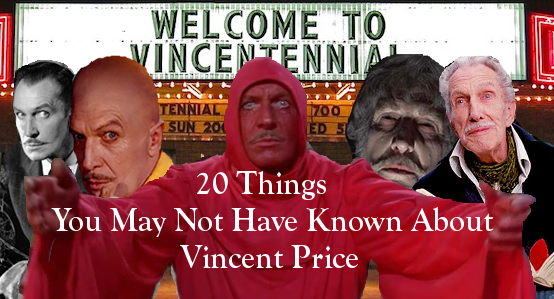
1. That Vincent
Price was a gourmet chef and cookbook author is well known among fans, but they
might not be aware that culinary interests ran deep in his bloodline. His
grandfather, Vincent C. Price, invented baking powder and pioneered cornstarch
as a baking ingredient, and his father, Vincent Leonard Price, was the
president of the National Candy Company.
2. Vincent
Price’s first wife, Edith Barrett, didn’t become as synonymous with horror as
her husband did, but she did star in the creepy classic I Walked with a Zombie.
3. Price’s
daughter Victoria is a serious writer who wrote scripts about Richard Widmark
and her dad’s old friend Roddy McDowall for A&E’s Biography series and an extensive and refreshingly objective
biography about her dad. She also had a brief role as a reporter in Price’s
final film, Edward Scissorhands.
4. As a young man
from an unquestioningly conservative St. Louis family, Price expressed sympathy
with this burgeoning Nazi party. However, he underwent a major liberal
awakening upon moving to Hollywood where he became active in such causes as the
Jewish Anti-Defamation League. Ironically, Joseph McCarthy targeted Price as a
possible communist in the fifties, citing Price’s anti-Nazi inclinations as
proof that he was some sort of dangerous radical. McCarthy was one loony piece
of work.
Thursday, October 6, 2016
31 TV Shows for 31 Days of Halloween Season: Day 6

Episode: “Lizard’s
Leg and Owlet’s Wing”, in which itinerant Corvette-enthusiasts Martin Milner
and George Maharis run into Boris Karloff, Peter Lorre, and Lon Chaney, Jr.,
who are not-so-secretly hashing out the specifics of a monster movie project
together at a Chicago hotel. Milner and Maharis’s Tod and Buzz assist the triumvirate
of horror legends in making their cases for the most effective ways to scare
modern audiences. This involves Karloff donning his Frankenstein Monster makeup
for the first time in over thirty years and Chaney dressing up as his own Wolf
Man and Mummy, as well as his dad’s Quasimodo. Lorre wears a top hat and cape
for some reason. I guess Dr. Gogol’s shades and mechanical hands weren’t iconic
enough for CBS. There are also some fascinating discussions of workplace sexism
among women attending a secretaries convention at the hotel, but they’re neutralized
by dumb gags suggesting women really just want to get married and are a ditzy
lot who believe in werewolves. Don’t expect too much progressivism from a show
inspired by On the Road.
Wednesday, March 23, 2016
366 Days at the Drive-In: Day 175

The Movie: Mad Love (1935)
What Is It?: MGM
couldn’t top Universal’s horrors in terms of pure iconography and majesty, so
instead the studio swiped Karl Freund and Colin Clive, topped up the kink and
craziness, and tossed in Peter Lorre as a mad doc in this nutso adaptation of
Maurice Renard’s The Hands of Orlac.
Why Today?: On
this day in 1964, Peter Lorre dies.
Thursday, July 28, 2011
Review: 'The Beast with Five Fingers'
Spoilers ahead…
 American horror spent the ‘40s running on fumes. In the wake of The Wolf Man and the 1935 departure of monster-champion and production-chief Carl Laemmle, Jr., Universal Pictures put less stock in its horror films, churning out a succession of increasingly half-hearted sequels. The films by the genre’s new golden boy, producer Val Lewton of RKO, were atmospheric and cerebral but shied away from the paranormal. The supernatural spook pictures emerging elsewhere were either tempered with humor (Paramount’s The Uninvited) or sheer lethargy (MGM’s Dr. Jekyll and Mr. Hyde). All of these problems are grasped in the disembodied paw of Warner Bros.’ The Beast with Five Fingers. Had it been produced in the previous decade, this adaptation of W.F. Harvey’s short story might have been a first-rate chiller. It certainly has a lot going for it: stylish direction from Robert Florey (Murders in the Rue Morgue), a script by Curt Siodmak (The Wolf Man), a lush score by Max Steiner (King Kong), and meaty lead parts for Peter Lorre and J. Carrol Naish (doing an Italian caricature worthy of Chef Boyardee).
The glitch is that The Beast with Five Fingers isn’t quite sure if it’s man or beast. After a long, long lead up to the death of a crusty pianist (Victor Francen), his personal secretary Hilary (Lorre) starts seeing the dead man’s disembodied hand scurrying all over the place and people start getting choked. Although the hour preceding the hand’s appearance receives able support from fine performances by Francen, the ever-clammy Lorre, Robert Alda (Alan’s dad) as a wisenheimer musician, and Naish as a cop, it drags badly. Those who came to the picture for horror will note a decided reluctance to leap into those waters, possibly because the genre was such a pariah at the time. When the hand finally crawls out of a box like Thing, the terrific visual effects (which recall The Invisible Man) render the previous, humdrum 60 minutes irrelevant and the fun begins.
But even now it’s difficult to suss where the filmmakers were aiming. The hand’s exploits are played dead-seriously, yet the sight of it tapping out a Bach partita on a grand piano is pretty silly. The ultimate cop-out arrives when we learn that the five-fingered beasty was nothing more than a psychotic hallucination of Hilary, who’d been committing the killings he attributed to the pianist’s nefarious mitt. As if tasked with helping us decide whether we should laugh, shriek, or shrug, Naish turns to the camera and drops a few creaky one-liners in his “that’s a spicy meat-a-ball!” accent. So it’s a comedy after all? Were the filmmakers shoehorning in jokes at the last minute to deflate the potentially heart attack-inducing horrors we just witnessed? Or were they working overtime to avoid having their picture filed in the career-killing horror drawer? Shrug. One thing is for sure: it’s a good thing the Brits were on the verge of taking horror seriously. Otherwise the genre may not have survived beyond the ‘40s.
 American horror spent the ‘40s running on fumes. In the wake of The Wolf Man and the 1935 departure of monster-champion and production-chief Carl Laemmle, Jr., Universal Pictures put less stock in its horror films, churning out a succession of increasingly half-hearted sequels. The films by the genre’s new golden boy, producer Val Lewton of RKO, were atmospheric and cerebral but shied away from the paranormal. The supernatural spook pictures emerging elsewhere were either tempered with humor (Paramount’s The Uninvited) or sheer lethargy (MGM’s Dr. Jekyll and Mr. Hyde). All of these problems are grasped in the disembodied paw of Warner Bros.’ The Beast with Five Fingers. Had it been produced in the previous decade, this adaptation of W.F. Harvey’s short story might have been a first-rate chiller. It certainly has a lot going for it: stylish direction from Robert Florey (Murders in the Rue Morgue), a script by Curt Siodmak (The Wolf Man), a lush score by Max Steiner (King Kong), and meaty lead parts for Peter Lorre and J. Carrol Naish (doing an Italian caricature worthy of Chef Boyardee).
 The glitch is that The Beast with Five Fingers isn’t quite sure if it’s man or beast. After a long, long lead up to the death of a crusty pianist (Victor Francen), his personal secretary Hilary (Lorre) starts seeing the dead man’s disembodied hand scurrying all over the place and people start getting choked. Although the hour preceding the hand’s appearance receives able support from fine performances by Francen, the ever-clammy Lorre, Robert Alda (Alan’s dad) as a wisenheimer musician, and Naish as a cop, it drags badly. Those who came to the picture for horror will note a decided reluctance to leap into those waters, possibly because the genre was such a pariah at the time. When the hand finally crawls out of a box like Thing, the terrific visual effects (which recall The Invisible Man) render the previous, humdrum 60 minutes irrelevant and the fun begins.
But even now it’s difficult to suss where the filmmakers were aiming. The hand’s exploits are played dead-seriously, yet the sight of it tapping out a Bach partita on a grand piano is pretty silly. The ultimate cop-out arrives when we learn that the five-fingered beasty was nothing more than a psychotic hallucination of Hilary, who’d been committing the killings he attributed to the pianist’s nefarious mitt. As if tasked with helping us decide whether we should laugh, shriek, or shrug, Naish turns to the camera and drops a few creaky one-liners in his “that’s a spicy meat-a-ball!” accent. So it’s a comedy after all? Were the filmmakers shoehorning in jokes at the last minute to deflate the potentially heart attack-inducing horrors we just witnessed? Or were they working overtime to avoid having their picture filed in the career-killing horror drawer? Shrug. One thing is for sure: it’s a good thing the Brits were on the verge of taking horror seriously. Otherwise the genre may not have survived beyond the ‘40s.
Subscribe to:
Posts (Atom)