Monday, March 24, 2014

Psychobabble Babbles with Robert Rodriguez About The Beatles' 'Solo Years'!


As the author of Fab Four FAQ, Fab Four FAQ 2.0: The Solo Years, The Beatles: Fifty Fabulous Years, and Revolver: How The Beatles Reimagined Rock ‘n’ Roll, Robert Rodriguez has emerged as one of the foremost Beatles scholars of the twenty-first century. His obsession continues in his podcast with fellow Fab Four freak Richard Buskin (Days in the Life: The Lost Beatles Archives; Beatles 101: The Need-to-Know Guide; Beatle Crazy! Memories and Memorabilia) and his most recent book, Solo in the 70s: John, Paul, George, Ringo 1970-1980, which fills in the cracks of Fab Four FAQ 2.0 with a feast of information on Beatles bootlegs released in the ’70s, songs they covered as solo artists and solo songs covered by others, their promotional films, studio collaborators, legal entanglements, and business associates, as well as an immersive 165-page timeline that places their solo achievements into historical context. Solo in the 70s is the first title on Robert’s new imprint ParadingPress (you are a true Beatles fan if you suss why he chose that name). He is also the creator of Backbeat Books’ FAQ series, of which my own upcoming book The Who FAQ is a part. So thanks again, Robert, for helping me get that job and thanks for Psychobabbling with me here on Psychobabble!

Psychobabble: I have the attention span of a housefly, and about halfway through writing The Who FAQ I started getting a little antsy with writing about the same band every day. You, however, have really committed to being a Beatles scholar, writing five books on them to date and conducting the ongoing Something About The Beatles Podcast. Do you ever find yourself with a serious Beatles hangover?

Robert Rodriguez: Well, it does sometimes blow people's minds when I only half-facetiously say that The Beatles aren't even my favorite band. I'm only partly kidding about that: while there are other artists whose work I enjoy equally as much, there aren't many that I have been so driven to explore in such depth as these guys. But when you've written five books on the same subject – something I never set out to do, by the way – there's often a presumption that that's all you live and breathe, 24/7. Or that my house is completely tricked out with Beatles, as far as the eye can see. No and no.
 Guess Who's one of Robert's other favorite bands.

Now obviously, you cannot steep yourself in The Beatles' history as long and as deeply as I have and not come away feeling like you would toward members of your own family: you always love them but you don't always like them. I think that the capacity for keeping a critical distance helps my ability to do what I do, processing their work analytically and not purely emotionally. It keeps the writing honest, and the readers deserve no less. That said, as John Lennon once noted, you don't fall in love intellectually. So I am quite sure that there are any number of things that I am fond of within their body of work that may strike people as indefensible. I'll cop to that!

A cool question came up the other day at the end of a podcast taping, one we'll probably address on a future show: if you could only listen to either Beatles music, or solo Beatles music, on a desert island for the remainder of your days, which would it be? Without hesitation, I said solo, which drew an incredulous response. Why would I want to listen to songs I already know inside and out, forever? That would be like reading the same twelve books over and over again: no matter how good they are, sooner or later the mystery tends to dissipate, you know what I mean? The Beatles group catalog has been inescapable – it's everywhere, and I am one of those people that will just as likely turn the dial if a Beatle song comes on.

The solo body of work, though – that's a whole other thing. Notwithstanding the fact that there's so much more of it, even my favorite solo albums are still fresher to me personally than The Beatles product. And I haven't even explored every single one in depth yet, truth be told.

So to circle back to your original question: while I may not listen to their stuff all the time, the story and the history I always find compelling. Especially the post-sixties era, which is at once so intriguing and less familiar.

PB: I imagine that there’s more to sink your teeth into with the solo years since there’s more to criticize.

RR: Well, there's that. The whole aspect of the period being unrelentingly fascinating, as well as – to a certain degree - uncharted territory and therefore, a challenge. It's one that I think the free-standing chapters as a structure is very well suited to. I hold onto the hope that no one that reads the book can come away thinking that they have a handle on who my favorite ex-Beatle is: I tried to diss them all equally!

Seriously though, contrasted with covering The Beatles as a group, I think that there's a natural tendency to look for patterns and some sort of arc. We find that when studying The Beatles, a subject whose story is already so familiar. When I was researching the Revolver book, the only real preconception I had was that it was on an undeniably higher artistic level as an achievement than was the much-lauded Sgt. Pepper – especially as a group effort. It was therefore striking to me to step back and see that it not only represented their high-water mark, but it came precisely at their half life: three years after Please Please Me and three years before Abbey Road. It was the end of the four-headed monster and the marking of group dominance passing from John to Paul.

Studying this first post-Beatles decade, one looks for similar patterns. Now George had been on an upward trajectory at least as far back as 1968 in terms of developing as an individual artist, outside The Beatles paradigm. I do believe that once he achieved world validation as this talent who had been hiding in plain sight all these years, he no longer tried as hard. It was as if once the world gave him the recognition that John and Paul had denied him, on some level he felt he'd done it and thereafter, made music for his own satisfaction, mostly. The achievement that was All Things Must Pass completely overshadowed the 1970 debuts of all three of his ex-bandmates.

John had been asserting his independence from The Beatles with his outside excursions well before the official split. I don't mean the experimental stuff with Yoko, but the Plastic Ono Band stuff. “Instant Karma” is as solid a piece of work as any of the singles the group issued during their final few years. But I do think that on some level, John missed facing a direct competition from Paul the way he had when they were in the same band. They paid close attention to each other's work, especially during those early years, but at the same time, they failed to recognize that what made The Beatles The Beatles was that in-house challenge they had to try harder. Furthermore, their respective spouses were, as George Martin was quick to point out, no substitute for what they had in each other.

Assuming that as artists they had in mind the goal of continuous growth and not repeating themselves, I think that they really could have benefited by, at the very least, putting themselves in the company of someone on their artistic level. I really don't think that studio session players, Elephants Memory or the members of Wings really qualify. At least – during that brief shining moment known as the “lost weekend” – John was intuitively seeking out other successful artists to work with: Nilsson, Bowie, Elton, Mick Jagger. He should have done more of that: found people to challenge him. Look at who George worked with, in comparison: Eric Clapton, Billy Preston, Gary Wright, the Dominoes, Leon Russell – all artists that had their own identities. It could not help but raise his game.

Thursday, March 20, 2014

Review: 'A Companion to Alfred Hitchcock'


Although Thomas Leitch and Leland Poague don’t dare say as much in their introduction to A Companion to Alfred Hitchcock, they certainly seemed to have compiled their essay anthology to be a sort of final word on Hitchcock scholarship. Now this is no more likely than the idea that Mark Lewisohn’s sprawling All These Years series will put an end to Beatles books, but there is a similar sweeping scope to A Companion that could keep a lot of students from bothering with another Hitchcock study.


Our two editors are well aware of all the other anthologies on the market and selected their essays accordingly. There have already been ample discussions of Hitchcock’s macguffins and his storyboarding and his theories about suspense vs. surprise and his cynicism, misogyny, and so on. Any new volume can only serve its purpose by approaching this well-exhausted topic in fresh ways without overreaching. A satisfying number of the thirty essays contained in A Companion to Alfred Hitchcock accomplish that, as when Lesley Brill counters the usual accusations of cynicism by convincingly repainting Hitchcock as a romantic both in his treatment of love and his charming reliance on fairy tale structure. Richard Allen reaches beyond the usual noir suspects to look at the director’s influence on less recognized followers, such as Last Year at Marienbad, Blow Up, The Tenant, Something Wild, and Jurassic Park. In general, the writers also do a decent job of looking beyond the most over-analyzed Hitchcock films (Vertigo, Psycho, The Birds, etc., which are well-represented here too) and into such relative obscurities as The Pleasure Garden, I Confess, and The Lodger, making for a fuller picture of his work than we often receive.  Teachers and students alike will find much to keep themselves busy in A Companion to Alfred Hitchcock... at least until the next heavy-duty study of his work arrives.


Sunday, March 16, 2014

Review: Flicker Alley's 'The Hunchback of Notre Dame' blu-ray


Regardless of the political implications of deeming Quasimodo—a disfigured human (though hardly a disabled one—the guy has more gymnastic skills than Mary Lou Retton)—a monster, there’s no question that Wallace Worsley’s The Hunchback of Notre Dame launched the Universal Monster age. And while the title characters’ monstrousness may be in question, the film’s horror element is not. None of its genre peers are as horrifically violent; none display such acts of cruelty—from the torture Quasimodo and his unattainable love Esmeralda suffer to his crazed molten lead retaliation against their would-be captors. Yet this is also a film of stark compassion and mercy, best conveyed by the divine Lon Chaney’s expression when Esmeralda gives him a drink after his whipping.

Mastered from a multi-tint 16mm print struck from the original negative, Flicker Alley’s new blu-ray edition of The Hunchback of Notre Dame gives us what will likely be the clearest details of Chaney’s nuanced performance we’ll see. Not that it will fool you into thinking it was filmed last week. Scratches and artifacts are pervasive. I don’t doubt that this 16mm print is beyond complete restoration, but I wonder if more could have been done about some of those blemishes. Nevertheless, compared to the utterly unwatchable reprints proliferating public domain collections, this improvement is striking. I’m not sure how marked the improvement is over Image Entertainment’s “Ultimate Edition” DVD from 2007 (which runs 117 minutes versus this blu-ray’s 110—additional speed correction could account for the time difference), but I do know that most of that edition’s extras reappear on Flicker Alley’s, including Robert Israel’s elegant realization of Donald Hunsberger’s compiled score, Chaney biographer Michael F. Blake’s audio commentary, stills galleries (sans the DVD’s 3-D content), and a short film of Chaney on set in his street clothes. The major new edition is the surviving thirteen minutes of Joseph De Grasse’s charming 1915 fairy tale Alas and Alack, in which Chaney briefly appears as a hunchback.


Friday, March 14, 2014

Review: 'The People’s Songs: The Story of Modern Britain in 50 Songs'


I subsist on a pretty steady diet of books about pop music because I like to help Psychobabble’s dear, dear pop-obsessed readers make informed book purchases and because I’m a pop-obsessed reader too. Yet reading book after book after book after book and The Beatles, Stones, Who, and so forth, I do crave an invigorating break from the norm, something that ventures beyond the usual bio, day-by-day diary, or song analysis.

Wednesday, March 12, 2014

Review: The Criterion Edition of 'The Hidden Fortress"


Considering the scope and scale of his films, it’s a little surprising that Akira Kurosawa didn’t explore widescreen—oops, I mean “Toho Scope”—until 1958’s The Hidden Fortress, a film that often fills the frame with vast, vacant vistas of sand and rock. That just makes us concentrate all the more on the four characters who are Kurosawa’s real interests. From the bottom of the class system are Tahei and Mataschichi (Minori Chiaki and Kamatari Fujiwara), a couple of greedy, endlessly scheming, and totally inept peasants. They want to score big by capturing the missing Princess Yuki Akizuki (Misa Uehara) and serving her up to the enemy that put a price on her head. Tahei and Mataschichi don’t realize she’s already in their company, masquerading as a mute girl under the watch of stern General Rokurōta (the ever awesome Toshiro Mifune). As the quartet traverse inhospitable landscapes and foes, there is much action and more comedic hijinks than you’ll find in any other Kurosawa picture, thanks to Chiaki and Fujiwara’s cartoonish capering. But this is still a Kurosawa movie and darkness pervades. 

Saturday, March 8, 2014

Review: 'Vamps et Vampire: The Songs of Serge Gainsbourg'


With a rep for being a droll smut-peddler who reveled in misogynistic objectification, Serge Gainsbourg was an unlikely savior for the female singers of sixties French pop. Yet, that is basically what he did when he gave the cheerfully innocent France Gall some dirty double-entendres to chirp and played into Francois Hardy’s darker persona with songs of melancholic doubt that revealed the poetic complexities of his writing.

Ace Records’ new compilation, Vamps et Vampire: The Songs of Serge Gainsbourg, gives ample airing to the variety in the man’s music as voiced by some of the many women who’ve interpreted it. For such singers, doing a Serge song was a fast track to scoring a hit and a bit of edge. Not every singer on this 25-track compilation fully grasps the Gainsbourg way, and this can be particularly apparent when they cover songs he also recorded in his sneering, Gitanes-stained croon. France Gall’s hit version of “Les Sucettes” is a Disney soundtrack cast-off compared to Serge’s sexed-up psychedelia. That probably only makes her version more subversive, which no doubt delighted the composer. However, the very best tracks are the ones on which the artists slip into more appropriate character. Brigitte Bardot is, of course, the very best Gainsbourg interpreter, infusing way ahead-of-their time rockers like “Harley Davidson” and “Contact” with the fizz he never would have mustered. April March delivers the wiry rocker “Laisse Tomber les Filles” with attitudinal glee. Marianne Faithfull sings the regretful “Hier Ou Demain” with a stiff upper lip that can’t mask the sadness underneath it. The cracks in Jane Birkin’s limited voice draw the eroticism out of “Jane B.” as they did with her duet and Serge’s duet on “Je t'aimeMoi Non Plus”. That most famous/infamous of Gainsbourg records is not included here, keeping the all-female voice pure.

The only time Vamps et Vampire: The Songs of Serge Gainsbourg really falters is when it stumbles into the eighties with tracks such as Isabelle Adjani’s “Pull Marine” and Birkin’s “Con C’est Con Ces Consequences”, both utterly sabotaged by the decade’s horrid pop production follies. These moments almost made me wish this album’s subtitle had been The Sixties Songs of Serge Gainsbourg, but then we wouldn’t have gotten that amazing April March track.


Thursday, March 6, 2014

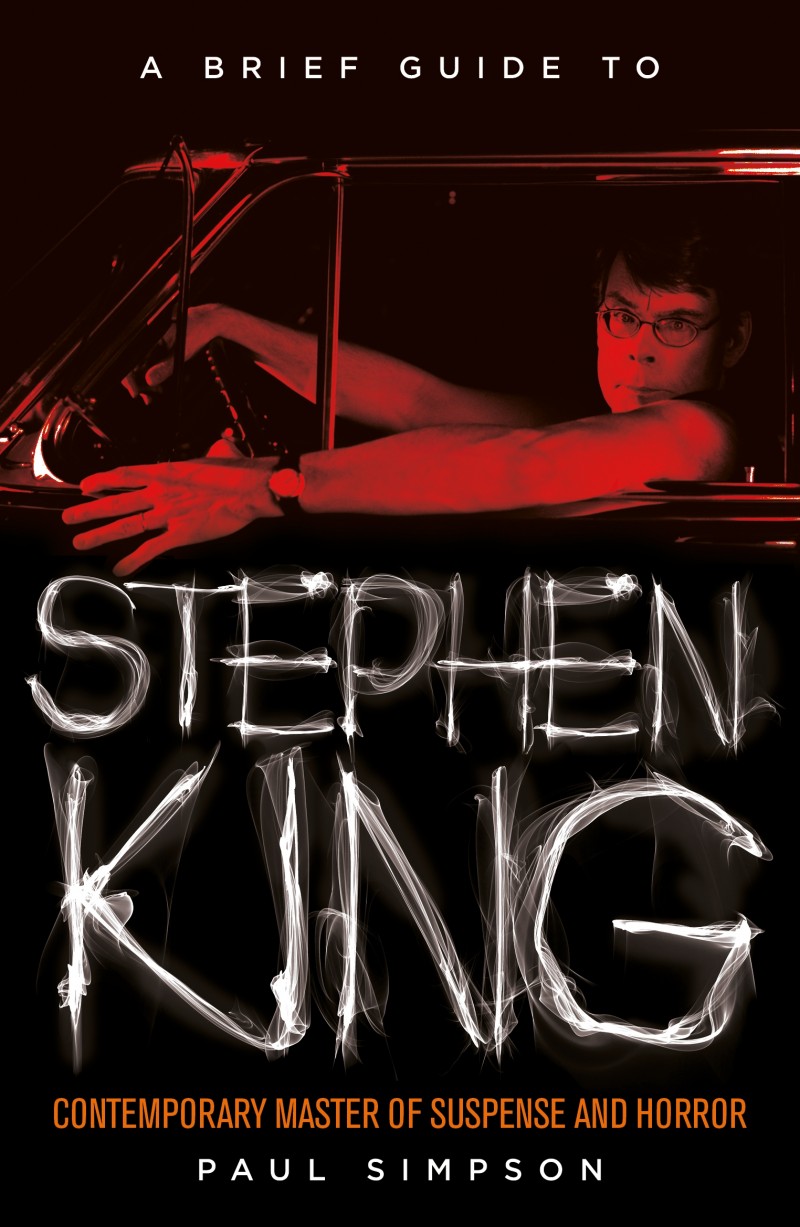
Review: 'A Brief Guide to Stephen King'


Don’t fret over the title of A Brief Guide to Stephen King, or the idea of the writer’s gargantuan body of work being boiled down to a mere 265 pages. Paul Simpson’s career overview may be brief, but it is satisfying. He covers every one of King’s novels, novellas, short story collections, digital and other uncollected stories, screenplays, and comic book scripts to date, as well as a nuts-and-bolts biography and overview of select non-fiction work. Each entry includes a short synopsis before getting to the goods with a pretty lengthy look at the tales’ genesis, the reactions it provoked, and adaptations it inspired (yes, that does include the Shining porno spoof Naughty Little Nymphos 5). The structure and content reminded me quite a bit of Marc Scott Zicree’s essential Twilight Zone Companion right down to his refusal to hold back spoilers. Simpson is less critical though. Since he clearly knows his King, it would have been nice if he’d provided a bit more personal assessment for each title so that his book could also provide recommendations better. For the most part, he remains neutral, allowing quotes from the critics of the past—many of whom are most certainly not Stephen King fans— to give each work the “yay” or “nay.” So you may just have to make up your own mind about whether or not you should read about preteen sewer orgies and shit weasels.

Wednesday, March 5, 2014

Online Petition to Get WB to Release Hammer Horror Blu-rays in the U.S.

In the U.S., the rights to Hammer Horror titles are as all over the place as the pre-op limbs of Frankenstein's Monster. Millennium Entertainment (Dracula: Prince of Darkness; Frankenstein Created Woman), Shout! Factory (The Vampire Lovers), and Synapse Films (Hands of the Ripper; Countess Dracula) have already gotten started on putting out some of these movies on blu-ray stateside. However, the two companies that own the most essential Hammers--Universal (Brides of Dracula; Curse of the Werewolf) and Warner Brothers (Horror of Dracula; The Curse of Frankenstein)-- continue to sit on their catalogs of classics. To call the latter company to task, Diabolique Magazine has started up one of those online petitions asking for the release of the following movies on Blu-ray:

The Curse of Frankenstein
Horror of Dracula
The Mummy
Dracula Has Risen from the Grave
Frankenstein Must Be Destroyed
Dracula, AD 1972
Taste the Blood of Dracula
Dracula Must Be Destroyed

 I'm not convinced that these kinds of petitions ever actually accomplish anything. I'm pretty sure Warner Brothers will release these films in hi-def when it damn well feels like it (or not). I signed the petition nevertheless. For what it's worth, you can too here.

Tuesday, March 4, 2014

Review: 'The Who – Sensation – The Story of Tommy'


Tommy was one prolific deaf, dumb, and blind boy. The Who’s 1969 double album didn’t just set their career on track at a time when it seemed to be sputtering and officially entered the term “rock opera” into the pop lexicon. It became an ace vehicle for the band’s stage shows, an all-star symphonic album and concert series, an overblown Ken Russell movie, and a Tony-winning Broadway musical. Fortunately, Martin R. Smith’s 2013 documentary The Who – Sensation – The Story of Tommy is really only concerned with the original album that— along with the rock performances it spawned—was the best thing about the phenomenon. Pete Townshend and his buddy and faithful Who-chronicler Richard Barnes do most of the heavy lifting, while Roger Daltrey, soundman Bob Pridden, artist Mike McInnerney, and a small clutch of rock critics contribute additional color.

Monday, March 3, 2014

Review: 'The Simon & Kirby Library: Horror!'


As if we needed any more proof of the insanity of the anti-comics Senatorial hearings of the 1950s, one of the comics called into question was Black Magic. E.C.’s horror comics were the most visible victims of the senate’s witch-hunt, both because William Gaines courageously/foolhardily challenged the subcommittee directly and because his comics were really, really gruesome. In comparison, Black Magic was a paragon of restraint. Most of the tales Joe Simon and Jack Kirby whipped up for the comic were tastefully illustrated, usually lacking in violence or even the explicitly supernatural. To put it in TV terms, if Tales from the Crypt was Boris Karloff’s Thriller, then Black Magic was One Step Beyond. 

A lot of the stories compiled into The Simon & Kirby Library: Horror!— part of a series compiling the guys’ work by genre— barely qualifies as horror. Pieces such as “The Girl Who Walked on Water” and “A Giant Walks the Earth” are squarely in the uncanny or fantasy drawers. “The Scorn of the Faceless People” is presented as a psychological study by a couple of cartoon shrinks. There’s also a short piece on Nostradamus’s vague predictions. Quite unlike Crypt’s menagerie of zombie and vampire tales, many of Simon & Kirby’s stories could have really happened. Even a tale about a mysterious werewolf lady is plausible. Although a few stories close in on the graphic muck the more committed horror comics deliver (“Freak”, “Nasty Little Man”, and the genuinely horrifying “Hungry as a Wolf”, for example), readers who really want to swim in that stuff might be a bit disappointed by the maturity of Simon & Kirby’s dalliances with the genre. The duo’s artwork is more in line with the gooey romance comics they pioneered than goopy horror.

Those who already count themselves among the artists’ fans will be most impressed with The Simon & Kirby Library: Horror! This is a great looking volume with restored artwork that doesn’t look absurdly digitized, as the recent volumes of Dark Horse’s The E.C. Archives do. You also get more thrills for your buck. There are over fifty stories collected here; everything Simon & Kirby contributed to Black Magic and the weirder (and wonderfully titled) The Strange World of Your Dreams, which featured illustrated dramatizations of the actual dreams of that comic’s founder, Mort Meskin!


All written content of Psychobabble200.blogspot.com is the property of Mike Segretto and may not be reprinted or reposted without permission.