

Psychobabble: For Groovy Ghouls & Retro Rockers.
Showing posts with label Roger Daltrey. Show all posts
Showing posts with label Roger Daltrey. Show all posts
Friday, July 4, 2025
Review: 'The Who Album by Album: Listening to You'


Monday, May 5, 2025
Review: 'Their Generation: The Who in America 1967-1969'

Thursday, October 17, 2024
Review: Vinyl Reissues of Pete Townshend's 'Iron Man: The Musical' and 'Psychoderelict (Music Only)'

Monday, February 26, 2024
Review: 'Teenage Wasteland: The Who at Winterland, 1968 and 1976'

Wednesday, July 12, 2023
Review: Vinyl Reissues of Pete Townshend's 'Rough Mix' and 'Empty Glass'
Because he wrote the vast majority of The Who's songs, Pete Townshend seemed less likely to need a solo career than frustrated songwriter John Entwistle. So, naturally, the bass player was the first member of the band to release a proper solo album, but Townshend had frustrations of his own. Incorrigibly prolific and eclectic beyond The Who's patented bash and bluster, Townshend ended up with a massive backlog of material. Some of it squeaked out on records mostly passed out to followers of his preferred spiritual leader, Meher Baba, and a more widely distributed release called Who Came First that was credited to Townshend but also included songs by fellow followers Billy Nicholls and Face Ronnie Lane.

Wednesday, October 13, 2021
Review: 'The Who: Much Too Much'

Its visual component is the main selling point of The Who: Much Too Much as long-time fans are not likely to learn much from Mike Evans's text. The selection of pictures is sharp. Many will be familiar, but the large, colorful layout of Much Too Much is particularly nice and shots of Pete hanging out with his parents while his mom wears a pop art jumper worthy of Keith Moon or Moon abusing his kit while wearing what looks like a tee proclaiming "Jesus Saves" are amusing and new to me.
Evans also provides a basically fine nutshell history of The Who (with the occasional fumbled date, apocryphal detail presented as fact, misinterpreted lyric, or other little gaffe, such as attributing Entwistle's vocal on "Twist and Shout" from Who's Last to Daltrey) and has the distinction of being the only writer to date to tell The Who's story up through that album they released a couple of years ago. Nearly half the book is set in the period following Moon's death.
Thursday, November 5, 2020
Review: 'Holly Jolly: Celebrating Christmas Past in Pop Culture'
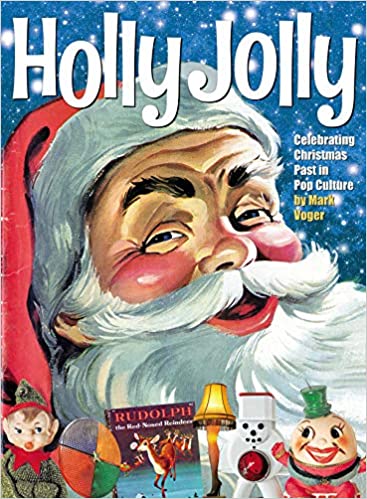
John Waters once said, “If you don’t have yourself a merry little Christmas, you might as well kill yourself.” While I wouldn’t go quite that far, I do agree that there’s something pointlessly self-spiting about refusing the tinsely, tacky joys of Christmas. After all, are you really living if you deny yourself the pleasure of yucking it up when Ralphie nearly shoots his eye out with a Red Ryder BB gun? Are you really living if you don’t get a lump in your throat when Darlene Love wails “They’re singing ‘Deck the Halls,’ but it’s not like Christmas at all” or the Monkees harmonize like angels on “Riu Chiu”? Are you really living if you don’t ensconce yourself in pine and fairy lights every December?
I’ve been a stalwart atheist since my teens, and Christmas is the one vestige of a Catholic upbringing I still enjoy. Actually, I agree with seasonal-icon Charles Schulz, who once said, “I doubt very much that Christmas was ever a religious holiday in the first place.” The holiday was always more about the cartoon specials and very special episodes, pop songs and Scrooge movies, Coke and toy ads anyone can dig than magical mangers.
Monday, March 16, 2020
Review: 'The Ox: The Authorized Biography of The Who’s John Entwistle'

One of the many things that made The Who so unique is that
each member of the band had such a distinct and iconic personality.
Consequently, Pete the Genius, Roger the Tough Guy, and Keith the Madman have
all been the topics of multiple biographies. As the Quiet One, John Entwistle
had not. Had he been, the flimsiness of that oft-used label may be
better known. Entwistle may have been a man of few words and the one member of
The Who who refrained from leaping around on stage, but he was also the most
enduring Rock & Roll animal in the group. He remained a restless,
relentless partier, an incorrigible spender seemingly dedicated to materialism
above all else, and a serial philanderer right up until his death in 2002.
Friday, April 13, 2018
Review: 'The Who Live at the Fillmore East 1968'

The Who were essentially an unknown quantity in America until they distinguished themselves in 1967 with stateside performances at Murray the K’s concert series on the East Coast and the Monterey Pop Festival on the West Coast. When word of their autodestructive act got out, The Who rapidly developed a reputation as the ultimate Rock & Roll circus act. To capitalize on that deserved status, the planned follow up to The Who Sell Out would be a devastating live album recorded at New York’s Fillmore East in April 1968.
Monday, November 14, 2016
Review: The Who 'My Generation' Super Deluxe Edition

Thursday, September 15, 2016
366 Days at the Drive-In: Day 351

The Movie: The Kids Are Alright (1979)
What Is It?: This isn’t a “let’s sit back and
reflect nicely on what a nice band the nice, old Who were” documentary.” This is
complete anarchy. There are no gestures toward chronology, or telling the story
of the band properly, or finding out what The Who’s colleagues thought of them
(aside from a barely coherent rant from Tommy
filmmaker Ken Russell). This is a movie in which Keith Moon conducts an
interview while wearing a leather mask and getting whipped by a dominatrix.
This is a movie in which John Entwistle goes skeet shooting with his collection
of gold records (which he later joked were Roger Daltrey’s solo albums). This
is a movie in which a really, really drunk Pete Townshend regales his drummer
with a side-splitting story about how his doctor warned him that he’s going
deaf. This is The Kids Are Alright. Put it on your television. Then throw your television out the window.
Why Today?: On
this day in 1967, The Who appeared
on The Smothers Brothers Comedy Hour, which would be used as the first
sequence in The Kids Are Alright a
dozen years later.
Monday, June 22, 2015
Review: 'The Who: Live at Shea Stadium 1982'

In 1982, The Who released their first “farewell” album, It’s Hard, and undertook their first
“farewell” tour. Neither was the most beloved chapter in Who lore. Many fans,
and certain band members, didn’t rate Kenney Jones an adequate replacement for
the recently deceased Keith Moon. Pete seemed begrudging about the whole thing
and was wrestling with his own issues with substance abuse and depression. The
new material he offered to The Who wasn’t nearly as strong as the songs he kept
for his own records, which meant set lists were peppered with
less-than-classics.
Quite a few of these issues didn’t matter that much when The
Who took their act to New York’s Shea Stadium on October 12 and 13. Perhaps it
was playing at such a historic venue (on the 13th, they whipped out
two songs from The Beatles’ first album—that’s two more than they played from
their own two first albums combined!). Perhaps having The Clash as opening act
lit a fire under them. As evidenced from Eagle Vision’s new disc, The Who: Live at Shea Stadium 1982, The
Who didn’t exactly put on the ultimate performance during their NYC stint, but
they do burn through quite a lot of it, particularly when playing more recent
material like “Sister Disco” and “The Quiet One”—both blinding showcases for
John Entwistle—or treasured obscurities like “The Punk and the Godfather”,
“Drowned”, and “Young Man Blues”. Otherwise, The Who mostly deliver the
professionalism that makes the show a good listen, if not an exhilarating one.
Mid set, that professionalism slips a tad with a version of “Tattoo” that
suffers from some dodgy harmonizing and a general lack of enthusiasm over the
number, but that kind of façade drop had always been an integral component of
their shows—nobody ever wanted to The Who to be nice (plus, the song is their best as far as I’m concerned). A slack
rendition of “Naked Eye” and a monotonous one of “Cry If You Want” are a little
less easy to forgive.
An interesting facet of the movie is how it reduces great,
big Shea Stadium to a more intimate venue by not dwelling on the elaborate
stage set up, leaving most of the huge audience in shadow (we only really
glimpse the first few rows), and muting their screams. It creates the illusion
that The Who said “farewell” by playing a mid-sized club.
The Who: Live at Shea
Stadium 1982 arrives on DVD and Standard Definition Blu-ray. That means it
was shot on video (complete with some awful “slo-mo” video effects), so the
picture cannot be in hi-def, but the music can at least be delivered without
loss. As far as video goes, it doesn’t look bad. The audio is pretty good, though I wish there was more John in the mix. The show from the 13th
is included in its entirety, as are five bonus numbers from the 12th,
three of which are songs not performed the following night (“A Man Is a Man”
and the essentials “My Generation” and “5:15”). Too bad the other two songs
exclusive to that night (“Magic Bus” and “Athena”) aren’t here too, but
overall, Live at Shea Stadium 1982
shines as positive a light on The Who’s rocky 1982 as one can expect.
Wednesday, December 3, 2014
Hear The Who Sing "A Quick One While He's Away" Live This Past November 30
Pete Townshend and Roger Daltrey promised to pull some odds and sods out of their hats for The Who's fiftieth anniversary/fiftieth farewell tour. So far, the setlists have still been pretty light on sixties rarities with the exceptions of "I Can See for Miles" (only a rarity on stage since it's one of their hugest hits) and "A Quick One While He's Away". That latter addition is the one that made me gasp, so I immediately went seeking it, and indeed, found the performance from their November 30 gig at Glasgow's SSE Hydro. It's a very impressive version of one of my favorite Who nuggets, and you can hear it below. Worth noting is that they do the whole song, complete with the full "Ivor the Engine Driver" section The Who usually halved in performances past.
Thursday, November 13, 2014
Review: 'The Who Hits 50!'

I’m pretty sure I’m not the only long-time Who fan who was
initially perplexed, eventually exasperated, that the most over-compiled band
in Rock & Roll was celebrating its fiftieth anniversary with yet another compilation. I was exasperated
because The Who’s discography in the U.K. and U.S. is in such a bad state. John
Astley and Andy Macpherson’s radical remixes were an interesting experiment in
the nineties, but they’ve been the only versions of The Who’s albums in the
West for way, way too long. In 2011, Astley remastered those albums, leaving
the original mixes intact, for Universal Japan. Finally, The Who’s back
catalogue was in shipshape with excellent sound, cool bonus tracks, and respect
to the albums we old-timers grew up hearing. A domestic release of these
expensive Japanese imports was what I wanted for the fiftieth anniversary, not
another greatest hits.
Tuesday, March 4, 2014
Review: 'The Who – Sensation – The Story of Tommy'

Tommy was one
prolific deaf, dumb, and blind boy. The Who’s 1969 double album didn’t just set
their career on track at a time when it seemed to be sputtering and officially
entered the term “rock opera” into the pop lexicon. It became an ace vehicle
for the band’s stage shows, an all-star symphonic album and concert series, an
overblown Ken Russell movie, and a Tony-winning Broadway musical. Fortunately,
Martin R. Smith’s 2013 documentary The
Who – Sensation – The Story of Tommy is really only concerned with the original
album that— along with the rock performances it spawned—was the best thing
about the phenomenon. Pete Townshend and his buddy and faithful Who-chronicler
Richard Barnes do most of the heavy lifting, while Roger Daltrey, soundman Bob
Pridden, artist Mike McInnerney, and a small clutch of rock critics contribute
additional color.
Saturday, March 1, 2014
10 Great Roger Daltrey Performances
Often dismissed as “the weak link” of The Who, accused of
“bluster” when sensitivity was required, of merely being “Pete’s mouthpiece,” Roger
Daltrey did not revolutionize his instrument quite as radically as John Entwistle
did the bass, Keith Moon did the drums, and Pete Townshend did the guitar.
However, to dismiss his contributions to the World’s Greatest Rock & Roll
Band would be unfair at best and bloody stupid at worst. His performances on
the following ten songs are not only great in and of themselves—powerful,
nuanced, sensitive, innovative, and all the other things he supposedly cannot
do—but they show how his style and ability have evolved and adapted throughout
the decades.
1. “My Generation”
Contrary to an often-expressed opinion, Roger Daltrey was a
strong singer from the start, swooning his way through “I Can’t Explain”
expressively and growling formidably on “Anyway, Anyhow, Anywhere”. It was on
The Who’s third single that he did something truly innovative. The origins of
that stutter are hard to pin down. Is it meant to mimic the affliction suffered
by many a pilled up mod? Is it an homage to John Lee Hooker’s “Stuttering
Blues”? Pete stammers a bit on one of his demos, so it does seem to have been
part of his plan for “My Generation”. As he often would, Roger exaggerated that
detail, made it less bashful, infused it with a level of defiance missing from
Pete’s home recording. It is the sound of a guy who doesn’t care that he can
barely get the words out; he’s going to express himself no matter what and pity
the punter who gives him guff about it. A speech impediment had never been so
threatening before.
In the early days, Roger was most comfortable when he got to
bellow like his idol “Howlin’ Wolf”. He wasn’t sure what to make of the
peculiarly “sweet” songs Pete started bringing to him. Gruffness would not work
on something like “The Kids Are Alright”. So Roger located a creamier tone he
may not have realized he possessed. His handle on it is slightly dodgy on “The
Kids Are Alright”, some of the notes not quite hitting their marks. He’d make
better use of it when he started consciously embodying the characters in Pete’s
songs. Pete gave him one of the best with Bill in “I’m a Boy”, a kid suffering
gender confusion when his mom decides to raise him as a girl. Roger’s boyish
delivery—best accomplished in the second version of the song recorded for The
Who’s scrapped sophomore LP, Jigsaw
Puzzle—is perfectly realized and just sinister enough to convey youthful
defiance without sounding inappropriately mannish.
3. “Tattoo”
Wednesday, February 26, 2014
Review: 'Cultographies: Quadrophenia'

Could Quadrophenia
be the ultimate cult movie? It’s a cult movie about a cult (the mod subculture
of early sixties England) that inspired a cult (the mod subculture of the early
eighties). Although Stephen Glynn selected Franc Roddam’s big-screen adaptation
of The Who’s 1973 rock opera as the topic of his entry in the Cultographies
series, he does not draw any such hasty conclusions. After all, Quadrophenia was a massive, mainstream
hit film in Britain (if only with audiences; critics weren’t too thrilled with
its violence and underage unrest). Images from the film popped up in
advertisements. On U.S. shores it has long been a legitimate cult item, even
enjoying screenings on the midnight movie circuit. And despite his declaration
that the film is the “most enduring manifestation” of Quadrophenia, this is not really true— at least in America where
the film continues to scuttle underground and the album is now regularly
regarded as one of The Who’s best, if not the
best.
That declaration is one of the few missteps in Cultographies: Quadrophenia, which is a
ripping integration of background history (from the actual mod cult, through
The Who’s role in it, through their look back on that phase with the Quadrophenia album, through Pete, John,
and Roger’s individual roles in the film’s creation) and analysis. Stephen
Glynn is the author of The British Pop
Music Film, one of my favorite books of last year. He touched on Quadrophenia in that book and gets to
expand his study as a part of the “historical” phase of pop films in Cultographies: Quadrophenia. He also looks
upon the film—with its punk attitude and seemingly self-conscious anachronisms—as
one very much in step with the Britain of 1979. As was the case with The British Pop Music Film, Glynn drops
some overly academic speedbumps during the analytical portion but his book is
never inaccessible. Cultographies:
Quadrophenia is an insightful and multifaceted study of the four faces of
one of the very best pop films.
Tuesday, February 18, 2014
Great Video of Pete Townshend and The Who at Work in '67 Surfaces
Yesterday someone posted one of the most enticing film clips mentioned in Andy Neill and Matt Kent's Anyway Anyhow Anywhere: The Complete Chronicle of The Who on YouTube. The footage depicts Pete Townshend unveiling a new composition, "Glittering Girl", for managers Kit Lambert and Chris Stamp (who really seems to dig it). Then The Who rehearse the song on the stage of the Saville Theatre complete with Pete, Roger, and John crowded around a single mic to capture their heavenly harmonies. The footage was originally shot on February 17, 1967, as part of Edmund Wolf's documentary Die jungen Nachtwandler-London Unter 21 (The Young Sleepwalker-London Under 21). Thanks to the original poster and Who super fan Brian Cady, who posted a link to this very cool clip.
Tuesday, August 20, 2013
Look Out! 'The Who FAQ' is Officially on the Way!
Just a quick Who FAQ update to let you know that my manuscript has received the official stamp of approval from Backbeat Books, so there's no stopping its June 2014 publication now. I've also been informed that I'm no longer allowed to update the manuscript, so don't blame me if if Pete joins One Direction or Roger gets gender reassignment surgery over the next year and it fails to get a mention in The Who FAQ: 50 Years of Maximum R&B. Perhaps "49 Years of Maximum R&B" would be a more accurate subheading, but it doesn't have the same ring.

Monday, December 10, 2012
Another 'Who FAQ' Poll! Vote for the Most Underrated Who Songs!

Once again I am reaching out to my fellow Whooligans for some input as I busily toil away on The Who FAQ. Last month I picked your purple-heart riddled brains about your favorite solo albums (that poll is still open, by the way). Now I'd like to know what you think are The Who's most underrated songs. I'm looking for songs that weren't hits, songs you won't find on The Ultimate Collection, songs that have never been used as a "CSI" theme, songs that if you shouted requests for them at a Who show, Roger would be like, "Huh?" and Pete would hit you with his guitar.
So choose up to five of your favorite odds and sods, and I'll profile the biggest winners in The Who FAQ. Hit me with your selections in the comments section below. Have at it...
Subscribe to:
Posts (Atom)