Wednesday, October 31, 2018

Diary of the Dead 2018: Week 5


I’m logging my Monster Movie Month © viewing with ultra-mini reviews at the end of every week this October. I write it. You read it. No one needs to get hurt.

October 26

Hellraiser (1987- dir. Clive Barker) **

The premise of Clive Barker's adaptation of his own novella, The Hellbound Heart, is appropriately skeletal. Some dickhead stumbles into hell, and manages to escape and return to corporeal form by slaughtering the assholes his sister-in-law/sex monkey lures to him using her feminine wiles. Unfortunately, a band of mutant hell monsters miss torturing him so much that they go searching for him in the earthly realm. With its bad acting, leaden dialogue, and over-the-top gore, Hellraiser plays like a pre-teen goth's attempt to freak out his parents. Ooooh! Extreme!

Phenomena (1985- dir. Dario Argento) ***

Psychobabble’s 31 Favorite Universal Horrors: #1


Halloween season simply isn’t Halloween season without a regular dose of golden age Universal horror (1923-1963). Every day this October, I’ll be giving you a steady IV drip of it by counting down Psychobabble’s 31 Favorite Universal Horrors!

#1. Bride of Frankenstein (1935- dir. James Whale)

There could be no other number-one in this series. It is widely regarded as the crown jewel of Universal horror and one of the few sequels to best its original predecessor. It is an explosion of imagination, special effects, pathos, humor, camp, and sheer madness. Every scene offers something delightful to behold: the glittering, self-referential prologue in the home of Mary Shelley and spouse; the mock-scary re-introduction of Karloff’s monster; the unveiling of wonderfully withering and withered Dr. Pretorius; Elizabeth Frankenstein’s weird freak-out in her bedroom; Minnie; Pretorius’s astounding homunculi; the Monster’s strangely moving visit with a blind hermit; the birth of the magnificent Bride and the Monster’s ill-fated attempt to court her. Bride of Frankenstein is not as scary as Frankenstein or as pungent as Dracula or as consistently funny as Abbott & Costello Meet Frankenstein or as sophisticated as Psycho and The Birds, yet it is a movie that feels like it has it all and then some. It is a monster masterpiece and such dizzying fun that it will keep you sugar-buzzed for a week after Frankenstein’s castle explodes. It is Psychobabble’s favorite Universal horror, favorite horror, favorite movie, and the best prescription for having a happy Halloween. Hope you have one yourself.

And Now for No Other Reason Than It's Halloween, Here's Some Halloween Wallpaper for Your Desktop with Love from Psychobabble!


Tuesday, October 30, 2018

Psychobabble’s 31 Favorite Universal Horrors: #2


Halloween season simply isn’t Halloween season without a regular dose of golden age Universal horror (1923-1963). Every day this October, I’ll be giving you a steady IV drip of it by counting down Psychobabble’s 31 Favorite Universal Horrors!

#2. Abbott & Costello Meet Frankenstein (1948- dir. Charles Barton)

The monster rallies of Erle C. Kenton were basically pulling the entire Golden age of Universal horror into the grave of self-parody. Why not get out the shovel and finish the job? Once and for all, the monsters would be laughing stocks, and Karloff himself was so offended by the notion that he refused to appear in or even see the final appearances of the Frankenstein monster, Dracula, and the Wolf Man in Abbott & Costello Meet Frankenstein. The thing is, the monsters weren’t laughing stocks. They basically play it straight despite a couple of fleeting comedic moments such as the Monster shuddering at the sight of Costello or the count cracking wise once or twice. The humor was all up to Bud and Lou, and though they were hesitant about their first full-bore horror comedy, the blend of serious threats and screwball insanity was magical. After all, the monsters’ main allure was never really their scariness. It was the fun lying just beneath their scarred or furry surfaces. Abbott & Costello Meet Frankenstein draws that fun right out into the air and makes no apologies for it. Bud and Lou and Glenn Strange get top billing, but Bela Lugosi and Lon Chaney, Jr., give this movie real legitimacy as an essential Universal horror film. The only possible way to have more fun while watching a movie is to check out the one in the next and final installment of Psychobabble’s 31 Favorite Universal Horrors…

Monday, October 29, 2018

Psychobabble’s 31 Favorite Universal Horrors: #3


Halloween season simply isn’t Halloween season without a regular dose of golden age Universal horror (1923-1963). Every day this October, I’ll be giving you a steady IV drip of it by counting down Psychobabble’s 31 Favorite Universal Horrors!

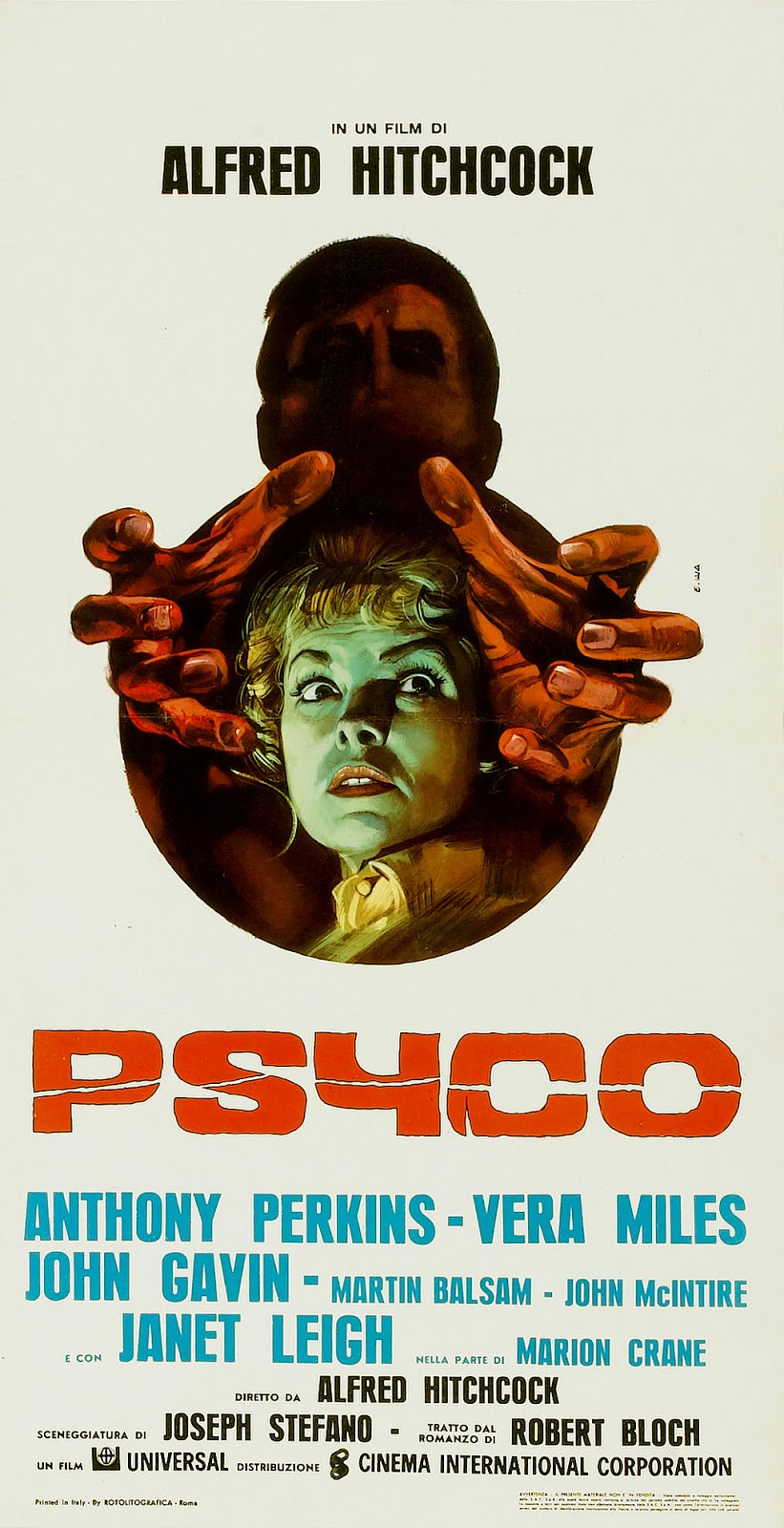
#3. Psycho (1963- dir. Alfred Hitchcock)

As I said in my discussion of The Birds a few days ago, Hitchcock’s horrors of the early sixties didn’t as much wrap up an age of horror as they launched a new one. With the possible exception of Franju’s gory Le yeux sans visage, Psycho was the ultimate shot across the bow for horror’s new age. After subsisting on years of vampires, ghosts, giant spiders, and other humbugs, 1960s audiences must have been utterly rattled by this unsparing portrait of a human monster. The film’s sexuality, the viciousness of the attacks, the grotesqueness of Mother’s corpse, and the sympathetic way Norman Bates is presented surely reconfigured the minds of movie audiences and made them capable of digesting even hardier stuff such as Night of the Living Dead, A Clockwork Orange, and The Exorcist. Hitchcock maximizes his film’s shocks with tricky, bait-and-switch storytelling, and Anthony Perkins aids and abets that assault with his completely ingratiating portrayal of Norman Bates. As far as I’m concerned, horror cinema’s two greatest decades are the 1930s and 1960s, and Universal was responsible for setting both of them in motion.

Review: 'It’s Saturday Morning! Celebrating the Golden Age of Cartoons 1960s-1990s'


Okay, so not every cartoon Joe Garner and Michael Ashley cover in It’s Saturday Morning! Celebrating the Golden Age of Cartoons 1960s-1990s aired on Saturday morning. In fact, they aren’t even all cartoons (see the entry on Pee Wee’s Playhouse). Yet the writers do a good job a selecting the shows that best defined each of the four generations their book explores. These are not cursory, encyclopedia-style entries; each is about four or five pages long, and each gets reasonably in depth about the genesis, content, and legacy of shows never intended to have a legacy once the six-year olds lost interest: Josie and the Pussycats, GI Joe, Space Ghost, He-Man and the Masters of the Universe, The Smurfs, and so on.

The odd part (aside from the authors’ bizarrely clueless insistence that all of these shows aired on Saturday mornings) is that Garner and Ashley deal with such a weightlessly fun topic as if has some greater value than stimulating nostalgia. The tone of the book should have been fun, friendly, and perhaps even a bit snarky, like that of Robinson and Karp’s Just Can’t Get Enough: Toys, Games, and Other Stuff From the ’80s That Rocked. The reverence seems to miss the obvious fact that most of these shows were great fun for six-year olds buzzed on Frankenberry but pretty crappy in essence. Garner and Ashley want us to believe that The Smurfs has a “complex mythology,” Garfield possessed “smart storytelling,” and that most of these shows were better animated, better written, and more educational than they actually were. All I ever learned from watching He-Man was how to perfect my Christmas wish list. There’s also a dogged determination to keep things reverent, which becomes a bit odd during a discussion of Fat Albert that continually references Bill Cosby’s artistry without at all acknowledging the monstrousness for which he is now best known.

While the tone could have been more appropriate to the material, the look of It’s Saturday Morning! gets everything right with big, color images from those delightfully garish childhood memories.

Sunday, October 28, 2018

Psychobabble’s 31 Favorite Universal Horrors: #4


Halloween season simply isn’t Halloween season without a regular dose of golden age Universal horror (1923-1963). Every day this October, I’ll be giving you a steady IV drip of it by counting down Psychobabble’s 31 Favorite Universal Horrors!

#4. The Invisible Man (1933- dir. James Whale)

James Whale found his voice with The Old Dark House. He started shouting from the rooftops with The Invisible Man. Its blend of horror and humor are seamless. The plot is pretty faithful to H.G. Wells, but that guy didn’t have a funny bone in his body. Whale and writer R.C. Sheriff find the humor in a mad scientist who can do as he pleases—so long as he’s totally naked— without going in any of the obvious gross or prurient directions. Really, Dr. Jack Griffin just wants to have fun, whether that means dancing down a road as a pair of floating pants while singing “Here we go gathering nuts in May” or throwing a few beer mugs about. OK, he takes the joke too far when he derails a train and murders his arch rival for the affections of Gloria Stuart, but can you blame him for that last one? That Dr. Kemp is such a bore! The same cannot be said of Griffin, and Claude Rains fleshes out his invisible role with a brilliantly expressive voice. However, the real stars of The Invisible Man may very well be the special effects team of John P. Fulton, John J. Mescall, and Frank D. Williams, whose disappearing act will still make you marvel “How did they do that?” Oh…and Una O’Connor. Never forget Una O’Connor.

Saturday, October 27, 2018

Review: 'The Kinks Are the Village Green Preservation Society' 2018 Remaster


It is a very Kinky bit of irony that as The Kinks were hitting an artistic peak in 1968, they were at an all-time commercial low. Consequently, almost nobody bought their masterpiece, the album that I personally believe to be pop’s very finest: The Kinks Are the Village Green Preservation Society. Of course, in the year’s following its near-silent release in late 1968, many have become aware of the album’s nostalgic, delicate, funny, sad, absurdly tuneful charms. You know that later-day artists such as Blur, Elliott Smith, Belle & Sebastian, and The Shins were listening—not to mention The Kinks own contemporary and Village Green super fan Pete Townshend.

Today, this album is regarded as a pop treasure, and as has become customary for such things, its fiftieth anniversary is not being ignored as its original birthday had been. The Kinks Are the Village Green Preservation Society is being released as a massive a five-CD, three-LP, 5-single box set. Alas, Psychobabble has only received a single CD containing a new remaster of the core album for review purposes. This remaster is very similar to the great sounding one from the triple-disc edition of Village Green released in 2004 with only slight, occasional differences. For example, the new master of “The Village Green Preservation Society” is noticeably louder and brighter than the old one, though you’d be hard pressed to discern any differences in most of the other tracks. As a whole, it’s a draw.

Psychobabble’s 31 Favorite Universal Horrors: #5


Halloween season simply isn’t Halloween season without a regular dose of golden age Universal horror (1923-1963). Every day this October, I’ll be giving you a steady IV drip of it by counting down Psychobabble’s 31 Favorite Universal Horrors!

#5. Dracula (1931- dir. Tod Browning)

Scoff if you will. Many have. They call it static, stagy, and hammy. They call it boring and inept. They can stake themselves as far as I’m concerned. Dracula is flawed in some ways, but the film’s overall effect is profound. This movie is so Gothic, so alluringly archaic, so deeply creepy you can practically smell the dank crypt air. Dracula builds atmosphere like few other films, and a horror movie is nothing without atmosphere. It also has Bela Lugosi, the man who embodies the count so completely that it is always unsatisfying seeing another actor portray him no matter how technically better the actor’s performance is. As iconic as Bela is, Dwight Frye arguably steals the film as Renfield. He’s crazed, but he is also funny, frightening, fearful, and strangely sympathetic. The entire opening sequence in Dracula’s castle is masterful: Dracula’s awe-inspiring appearance on his massive stairway, Renfield and Dracula’s sickly humorous dinner, the dreadful appearance of the vampire’s famished brides. Critics complain that the film loses all steam after it leaves Transylvania, but I prefer to think that the steam that opening sequence builds powers the rest of the picture. Frankenstein is technically a better movie, but no serious horror puts me in the Universal spirit like Dracula.

Friday, October 26, 2018

Diary of the Dead 2018: Week 4


I’m logging my Monster Movie Month © viewing with ultra-mini reviews at the end of every week this October. I write it. You read it. No one needs to get hurt.

October 19

Captain Kronos—Vampire Hunter (1974- dir. Brian Clemens) ****

At a time when Hammer was doubling down on its exploitative rep, the studio produced this comparatively light-hearted romp in which a swashbuckler trots across the countryside looking for vampires to stab. Captain Kronos—Vampire Hunter may be Hammer’s freshest film of the seventies. James Needs’s editing is very stylish (a pub swordfight is pricelessly executed), and Horst Janson is reasonably appealing as the vamp slayer (though his penchant for violent sex is a gratuitous capitulation to the era’s nastier ethos). Caroline Munro and John Cater as Kronos’s more personable sidekicks are better. It’s too bad this did not lead to the series it was intended to because it would have been great fun to watch this dynamic trio swashbuckle their way through other adventures.

Blair Witch (2016- dir. Adam Wingard) **
All written content of Psychobabble200.blogspot.com is the property of Mike Segretto and may not be reprinted or reposted without permission.