Showing posts with label Sting. Show all posts

Monday, September 1, 2025

Review: 'David Lynch: His Work, His World'

Over the course of a lovely but tiring seventeen years of Psychobabbling I've scaled way back on writing anything but reviews here. So I allowed a big, awful milestone to pass without much more than changing the banner at the top of this page. I'm talking about the death of David Lynch, my favorite artist, one who was so versatile, open, and willing to tap into dreams and nightmares, so old-fashioned hardworking, that he has been nothing short of the biggest creative inspiration in my own life. 

I got my start as a writer when my article on the role of dream worlds in Lynch's work was published in the final issue of the Twin Peaks fanzine Wrapped in Plastic way back in 2005. Although I've since published a couple of books, and even got to work on one of them with one of my top music heroes, Dave Davies, the biggest thrill of my career was seeing my name on the cover of Wrapped in Plastic beneath those of Peaks co-creator Mark Frost, star Catherine Coulson, writer Bob Engels, editor Mary Sweeney, and David Lynch. 

Monday, October 2, 2023

Review: 'A Masterpiece in Disarray: David Lynch's Dune, an Oral History'

Having only made one purely avant garde feature that became a smash by playing to freakos at midnight showings and one Oscar-baity period piece, David Lynch was a real weird choice to helm a blockbuster adaptation of Frank Herbert's space opera Dune. But chosen he was, though he couldn't quite be blamed for the critical and commercial disaster it became. Although Lynch's sensibility has never exactly been commercial, he was also at odds with a producer who didn't quit sync up with his vision on this particular project, a truly harrowing production in an inhospitable environment, source material that may be a bit too convoluted and esoteric to translate into matinee fare fit for Star Wars fans, and a truncated run-time that forced the story to get whittled down to a confusing nub. 

Thursday, May 26, 2022

Review: 'The Police: Around the World' Restored and Expanded Blu-ray

On the precipice of world domination, The Police embarked on a tour of all six populated continents with camera in hand in 1979/'80. When not blazing through numbers from their first three albums on stage, they were filming touristy skits involving Andy Summers sumo wrestling in Japan, Stewart Copeland arguing with a camel rider near the pyramids in Egypt, and Sting taking a fast-motion rickshaw ride in Hong Kong. The Police are often labeled as a new wave or punk-lite trio, but they clearly were a Monkees for the eighties. 

That's actually not entirely a joke and hardly an insult (faithful Psychobabble readers know I love The Monkees). The Police were heart-throb cute, had a bunch of exhilarating hits, made audiences crazy, liked to be on screen, and were incorrigibly silly and corny. All of these qualities are captured in the tremendously fun travelogue The Police: Around the World, which really does seem to use Bob Rafelson's "Monkees On Tour" episode as a template... though with a lot less sobriety. The doc's only moments of genuine off-stage sincerity seem to be when the guys lose themselves in a groovy raga jam (Andy plays sitar, Sting plucks tamboura, Stu taps the tabla) and when Sting expresses genuine horror at the sight a snake charmer feeding a live cobra to a mongoose. Around the World also captures The Police at a moment when they seem to actually enjoy each other's company, and that joy spills over to the stage where the band's musicianship admittedly outclasses The Monkees' by several kilometers. 

Thursday, May 5, 2022

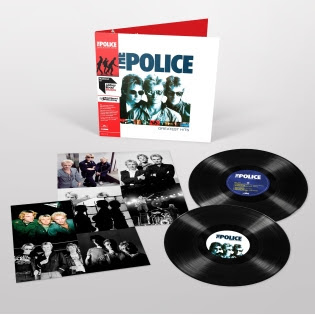
Review: The Police's 'Greatest Hits' Vinyl Half-Speed Remaster

The Police were one of the most reliable hit machines of the first half of the eighties. Sting churned out killer songs like "Don't Stand So Close to Me", "Spirits in the Material World" and "King of Pain". Andy Summers and Stewart Copeland kept his sappier tendencies in check and provided some of the most creative and off-kilter guitar and drum work (respectively) to adorn outrageously popular songs. All was right with the world until they broke up in a slow-fuse sonic boom of ego and acrimony at the height of their popularity. So The Police were no more, but they'd left behind five pretty damn perfect albums and a bushel of pretty damn perfect singles. It was all over but the greatest hits-ing.

Tuesday, September 7, 2021

Review: 'Dune' Blu-ray

Dune was the one major outlier when I first fell in love with the films of David Lynch. I hated it. Although I could not honestly say I completely understood Eraserhead (even though I totally said that), complete comprehension didn't matter when it came to such a purely experimental piece. That I didn't understand the byzantine plot of Dune mattered more since it had the bones of a completely conventional film. It is a space opera like Star Wars. It has a hero's journey. There are clearly defined good guys and bad guys and laser guns and made-up planets and giant monsters. Perhaps I was also offended that an ARTIST such as Lynch had played on the blockbuster field at all. That Lynch, himself, had completely disowned the film because producer Dino De Laurentiis insisted on a rather ruthless edit justified my serious Dune aversion and made me feel I didn't need to work to love it as much as I loved Eraserhead, Blue Velvet, Fire Walk with Me, and every other non-Dune picture Lynch made.

And yet, I still returned to Dune every few years. And it got a little better each time I watched it, while certain other Lynch movies (The Elephant Man, Lost Highway) drop in my estimation each time I revisit them. After multiple viewingsand still never having read the entirety of the Frank Herbert novel on which the film is basedDune's plot seems so lucid I feel like a dum-dum for not understanding it upon my first viewing. While it seemed to sorely lack Lynch's experimental verve all those years ago, I now can't understand how I didn't always recognize how far-out Dune is, with its disconcertingly fascistic hero and disgusting, pustule-plagued villain, who at one point, tries to force a captive to milk a cat duct-taped to a rat. I mean, did Lynch ever even devise anything weirder than that?

Thursday, August 12, 2021

Review: 'The Police: Every Little Thing'

The Police were probably the biggest band of the early eighties, yet their story is oddly ill served. There aren't a ton of books about The Police even though they have a completely unique story and enduring popularity. As told by Caroline & David Stafford in their new book, The Police: Every Little Thing, that story is one of overcoming odds. The great irony is that the odds The Police had to overcome was being traditionally good-looking industry insiders who wrote classically perfect songs, played extraordinarily well, and sold scads of records. Why were these odds? In a word: punk. Sting, Andy Summers, and Stewart Copeland came up at a time when the British press and fellow artists were suspicious of anyone who played too well, did not exude the appropriate level of intensity, or behaved too nicely. Music listeners were less judgmental and The Police became huge stars despite lacking punk cred. That's because they worked so hard and made strong records with such an individual blend styles. 

Any band with The Police's output would be worthy of close examination, but the worth of Every Little Thing runs deeper than Synchronicity being a great album that shifted 8 million units in the U.S. alone. The band's background is downright bizarre. Drummer Stewart Copeland's dad Miles was in the CIA, helped orchestrate a coup in Syria, and was apparently a bit of a sociopath. His older brother Miles was a frothing capitalist determined to make his way managing a major rock band. Summers was a thirty-something leftover of the psychedelic age expected to sell himself as a punk. Sting was a Sting (see: "Fields of Gold") expected to sell himself as a punk. There was no friendship among the guys, just a series of power struggles and compromises that resulted in some spectacular records.

So The Police: Every Little Thing would be necessary if it did nothing more than fill a gap in rock and roll history and tell a fascinating story. It also happens to be lyrically written and really funny (David is a former writing partner of Young Ones "socialist comedian" Alexei Sayle)-- a definitive biography of a definitive band worth the wait.

Thursday, November 7, 2019

Vinyl Remasters of 4 Police Albums


Perhaps no late seventies/eighties band was as successful and brilliant in equal proportion as The Police. Each of their five albums is a must-own, almost completely unburdened by sub-par material, and each one displays a different facet of this most complex of power trios. Their debut Outlandos d’Amour saw Sting, Andy Summers, and Stewart Copeland attempting to fool the punks into believing they were kindred spirits, failing at that, and producing a slick yet electrifying brew of speed rock, reggae, and pop. Their next two albums are their most similar as Regatta de Blanc and Zenyatta Mondatta lose the punk gestures to focus more on their tasty brand of poppy white (Blanc) reggae (Regatta—they were just as handy with a pretentious album title as they were with their instruments). 

Sunday, July 25, 2010

September 14, 2009: 20 Things You May Not Have Known About‘Quadrophenia’

On this day in 1979, Who Films unveiled Quadrophenia, an adaptation of The Who’s 1973 rock opera about a schizoid mod named Jimmy, at the Toronto Film Festival. The film is without question the finest cinematic adaptation of a Rock album (not that it has much competition… Sgt. Pepper’s Lonely Hearts Club Band? Tommy? Bleccck.) and dramatic Rock & Roll movie ever made. To commemorate the thirtieth anniversary of Quadrophenia, here’s a new feature I call 20 Things You May Not Know About

All written content of Psychobabble200.blogspot.com is the property of Mike Segretto and may not be reprinted or reposted without permission.