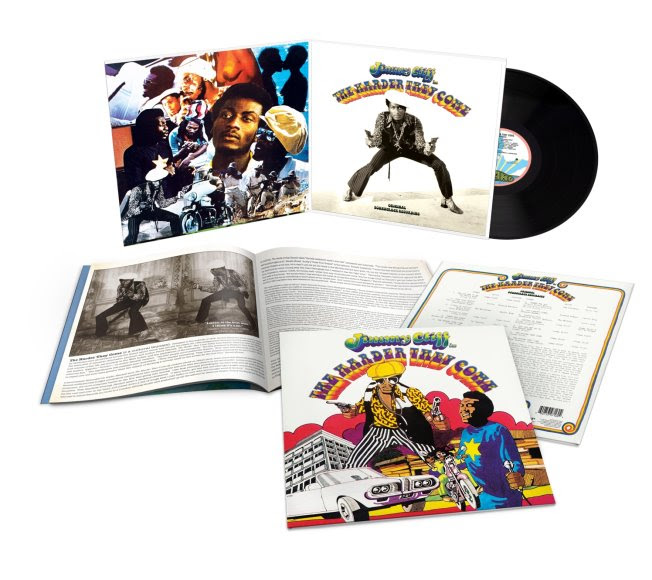
Although ska had been quite popular in the UK, and Millie Small even managed to get a stateside hit with "My Boy Lollipop" in 1964, reggae wasn't very well known outside Jamaica until the first Jamaican-made film, Perry Henzell's The Harder They Come (1972), introduced it to midnight movie audiences in 1973. Although sweet-voiced Jimmy Cliff, who starred as singer-turned-robber Ivanhoe Martin in the film, was the dominant artist on the soundtrack, The Harder They Come: Original Soundtrack served as a handy and consistently superb various artists primer for listeners unfamiliar with reggae and ska.
Friday, February 10, 2023
Monday, September 6, 2021
Review: 'The Vinyl Series Volume Two'
With its joyous mélange of ska, reggae, soul, and Spencer Davis Group, the theme of Chris Blackwell's The Vinyl Series: Volume One could be summed up as "Mod Party." Volume Two is a little harder to pin down. On first blush, Blackwell seems to have gone down more of a singer-songwriter alley this time, what with its very personal tracks by Cat Stevens ("Lady D'Arbenville"), Nick Drake (the sublimely somber "River Man"), John Martyn (somber ode to pal Drake "Solid Air"), Jimmy Cliff (lovely "Many Rivers to Cross"), and even Traffic (Dave Mason mumbles "Feelin' Alright" like he's playing to his chest in a coffee bar).
So then where does Free's Classic-Rock-101 staple "All Right Now" fit in? Or The Heptones' group-effort "Book Rules" or Toots and the Maytals' extroverted "Pressure Drop"? And is it a true singer-songwriter song if the singing and songwriting are split between two individuals, even (formerly) married ones such as Richard and Linda Thompson? And what about that woozily exuberant Mariachi band on "I Want to See the Bright Lights Tonight"? Nick Drake never used one of those.
Perhaps Blackwell's theme is "terrific songs from the Island Records archives," which is valid enough from a guy with such fine taste. Each of these songs is a classic, and though "All Right Now" does sound out of place, hearing it sandwiched between the Thompsons' night-on-the-town gem and Cliff's soul-stirrer make it sound fresher than it does between Lynyrd Skynyrd and Foreigner during a musty Classic Rock Radio Rock-Block.
As mastered by Alex Abrash, The Vinyl Series: Volume Two also sounds pretty fresh. Cat Stevens thumping the hollow body of his acoustic and The Heptones' bongos sound almost disquietingly present on flat, quiet vinyl. I wonder what the theme of Volume Three will be...
Wednesday, November 13, 2019
Review: '1973: Rock at the Crossroads'
Friday, March 25, 2016
366 Days at the Drive-In: Day 177
Sunday, July 25, 2010
August 24, 2009: The 15 Greatest Rock & Roll Movies!
15. Head (1968- dir. Bob Rafelson)
For more than 40 years, snobby rock critics have taken great pleasure in shitting all over the Monkees. Yes, those goopy Davy Jones love songs will rot your teeth, but the group had way more talent and smarts than most people gave them credit for. Mike Nesmith was writing and producing great tracks as early as their debut album, and by their third record Headquarters, the group was playing, writing, and singing some of the best pop music of the ‘60s. Still, no one took them seriously. The rock press depicted them as four foolish puppets even though they’d had their hands in such milestones as the birth of music video and the introduction of the Jimi Hendrix Experience to American audiences. They also managed to become a real touring rock band. But nothing the Monkees did was as radical as their starring role in Bob Rafelson’s utterly bizarre avant-garde rock musical Head, in which the boys send up their pre-fab image and their complete inability to escape it. Along the way, they lampoon the Vietnam War, the over-commercialization and industrialization of American society, hippies, politics, James Bond and Hammer horror movies, and of course, television, the medium that spawned the Monkees in the first place. This free-wheeling, patchwork freak-out is also notable for being co-scripted by Jack Nicholson during a stoned-out weekend retreat. The best part of Head for me is hearing the Monkees perform some of the best music of their career, including the soaring, psychedelic “Porpoise Song”, the lovely ballad “As We Go Along” (with Neil Young on guitar), Peter Tork’s exotic “Can You Dig It?” (complete with sexy belly-dancer sequence) and his euphoric rocker “Long Title: Do I Have to Do This All Over Again?”, and most significantly, a live rendition of Nesmith’s garage-rock monster “Circle Sky” (although I seem to be in the minority by preferring the studio version on the soundtrack album to the live one performed in the film). Unfortunately, the movie loses a lot of steam about two-thirds of the way in when the songs peter out, but Head is still an impressive testament to the talent of a supposedly talent-less band.
14. The Last Waltz (1978- dir. Martin Scorsese)
Every great Rock & Roll group should go out like this. With their career on the wane, The Band decided to tear down shop in 1976. Band-leader Robbie Robertson had been justifiably impressed with Martin Scorsese’s use of classic songs like “Be My Baby” and “Jumpin’ Jack Flash’” in Mean Streets and recruited the young director to film a farewell concert at the Winterland Ballroom in San Francisco on Thanksgiving Day. Originally, The Band were to be the only performers, but the line-up was expanded to include Ronnie Hawkins (whom The Band backed-up as The Hawks on his early records), Van Morrison, Muddy Waters, Paul Butterfield, Joni Mitchell, Bob Dylan, and... ummm... Neil Diamond. So, Diamond’s performance is pretty lame, but the others are dynamic and iconic; The Last Waltz would be required viewing if only for Morrison’s thrilling rendition of “Caravan” (the little kicks he throws as he exits the stage are absolutely adorable!). Of course, the show belongs to The Band, and they bow out on an utter high with stirring versions of “Chest Fever”, “The Night They Drove Old Dixie Down”, “Up on Cripple Creek”, and many others. Although the film is too long at 117 minutes, and the Neil Diamond number should have been cut, this is the most expertly filmed concert movie ever made. Scorsese does more than shoot the artists; he places them in an atmospheric, painterly landscape, especially during the studio sequences featuring The Band, Emmylou Harris, and The Staples Singers.
13. Don’t Look Back (1967- dir. D.A. Pennebaker)
In early 1965, Bob Dylan was in a weird place. He’d been tagged a genius by a generation of folkies who just as quickly deemed him a Judas for plugging in his guitar and playing absurd, electrifying rockers that owed as much to Chuck Berry as they did to Dylan Thomas. That push and pull really put him on the defensive, and Don’t Look Back, D.A. Pennebaker’s documentary of Dylan’s ’65 British tour, captures Bob at his most acerbic, his wittiest, and his meanest. The film is hardly a flattering portrait of Dylan. When I was younger, I thought he was just too hip when he humiliated poor little Donovan by following the Scottish folk singer’s silly love song with the lacerating “It’s All Over Now, Baby Blue” during a hotel-room show down. Now, I think it’s kind of painful to watch (and I really like Donovan). As tough viewing as Don’t Look Back can be at times, it’s a fascinating and insightful look at Dylan. Yes, his music is incredible, but he is that restless combination of insecurity and arrogance that can really make a young guy an asshole. In all fairness, the idiotic questions he is constantly asked by the press would try anyone’s patience, but he is absolutely ruthless when dispatching those daffy English reporters with his trademark barbs. When it comes to sheer surliness, Dylan is no match for his manager Albert Grossman, who threatens to kick the ass of a hotel manager who asks Dylan and his entourage to keep it down during a noisy party. That guy is one nasty motherfucker.
12. The Harder They Come (1972- dir: Perry Henzell)


